📸 Photo Description
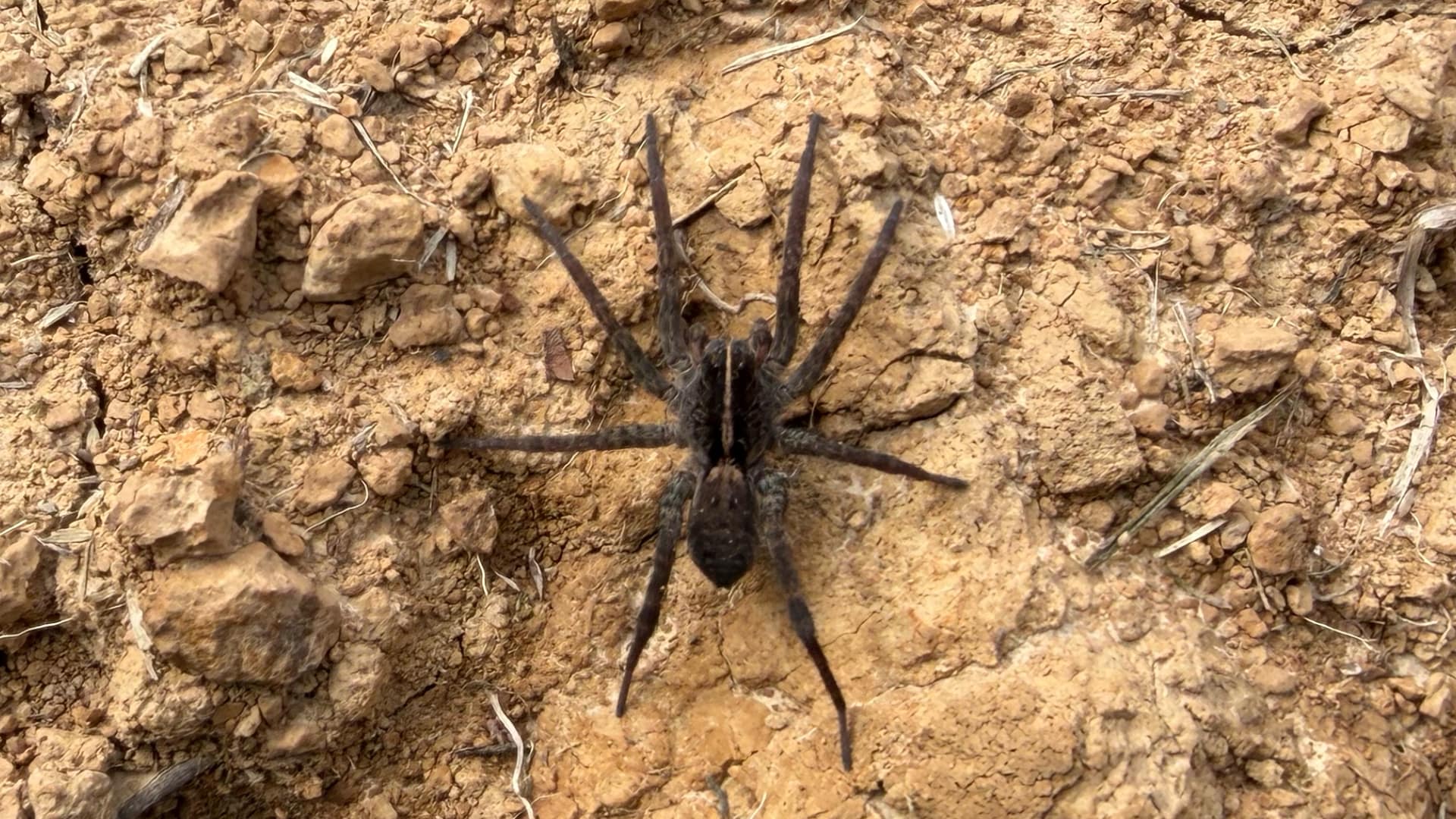
This image shows a dark brown spider on dry, sandy soil. You can see eight long legs spread out from its body, and it has a rounded abdomen (back section). The spider is positioned flat against the rocky ground, which is its natural habitat. Spiders are arachnids—animals with eight legs that hunt for food in many different environments.
🔬 Scientific Phenomena
Anchoring Phenomenon: Why do spiders live on the ground?
Spiders are predators that hunt small insects for food. This spider is likely on the ground hunting for prey like ants, beetles, or other small creatures that live in soil and rocky areas. Spiders have adapted to live in many habitats—including on the ground, in webs, under bark, and in caves—wherever they can find food and shelter. Ground-dwelling spiders like this one use their excellent eyesight and ability to sense vibrations in the soil to detect and catch their prey. They are an important part of the ecosystem because they help control insect populations naturally.
📚 Core Science Concepts
- Arachnids as Living Organisms: Spiders are animals (arachnids) with eight legs, a body divided into two main parts (cephalothorax and abdomen), and fangs that inject venom into their prey. Unlike insects with six legs, arachnids have eight.
- Habitat and Adaptation: Different animals live in different habitats based on where they can find food, water, and shelter. Ground-dwelling spiders are adapted to life on soil and rocks with camouflaged colors that help them hide from predators.
- Food Chains and Predators: Spiders are carnivores (meat-eaters) that hunt insects. They are predators in the food chain, which means other animals also hunt spiders for food.
- Biodiversity: There are thousands of different spider species around the world, each adapted to live in different environments and hunt different types of prey.
Pedagogical Tip:
Many students fear spiders due to misconceptions. Begin lessons by emphasizing that spiders are beneficial to humans—they eat pest insects and are rarely dangerous. Consider showing the spider in the photo as an example of a "helpful hunter" rather than a scary creature. This reframing builds scientific curiosity while addressing student anxiety.
UDL Suggestions:
Multiple Means of Representation: Provide the spider image alongside labeled diagrams showing spider body parts (legs, abdomen, fangs). Consider showing a short video of a spider moving and hunting so students can see spiders in action, not just in photos.
Multiple Means of Engagement: Allow students who are uncomfortable with spiders to learn through drawings or digital resources rather than live specimens. Create a "Spider Superpower" chart where students celebrate spider abilities (speed, strength, web-building) to build positive associations.
Multiple Means of Expression: Students can show learning by drawing spiders, creating habitat dioramas, writing spider fact cards, or acting out a spider hunt scenario rather than only written responses.
🎓 NGSS Connections
Performance Expectation: 3-LS1-1
Students who demonstrate understanding can construct evidence that some animals form groups that help members survive.
Disciplinary Core Ideas:
- Animals have body structures (like eight legs) that serve different functions needed for survival.
- Organisms depend on their environment to get the things they need to survive (food, water, shelter). Spiders depend on soil habitats to find insect prey.
- Different plants and animals live in different habitats and have adaptations suited to their environment.
Crosscutting Concepts:
- Different spiders show patterns in where they live based on what prey is available.
- A spider's eight legs, fangs, and body shape help it hunt and survive.
💬 Discussion Questions
- What do you think this spider is looking for on the ground, and why does it need to find it? (Bloom's: Analyze | DOK: 2)
Guides students to think about the spider's purpose and survival needs.
- How is a spider different from an insect, and what body part helps you tell the difference? (Bloom's: Compare | DOK: 2)
Helps students distinguish arachnids from insects by counting legs (8 vs. 6).
- If all the insects disappeared from this rocky soil habitat, what would happen to the spider? (Bloom's: Evaluate | DOK: 3)
Encourages systems thinking about food chains and habitat relationships.
- Why do you think this spider's dark brown color might be helpful for surviving in this sandy, rocky place? (Bloom's: Analyze | DOK: 2)
Introduces the concept of camouflage as an adaptation.
📖 Vocabulary
- Arachnid: An animal with eight legs, including spiders, scorpions, and ticks.
- Predator: An animal that hunts and eats other animals for food.
- Habitat: The place where an animal lives that has everything it needs to survive, like food, water, and shelter.
- Adaptation: A special body part or behavior that helps an animal survive in its environment.
- Venom: A special liquid that some spiders inject into their prey to paralyze or kill it so they can eat it.
- Camouflage: Colors or patterns on an animal's body that help it blend in with its surroundings so predators cannot see it easily.
🌡️ Extension Activities
Activity 1: Spider Habitat Hunt
Take students on a supervised outdoor exploration to look for spider webs, ground-dwelling spiders, or spider egg sacs in your school garden or nearby natural area. Have students sketch what they find and describe the habitat (Is it wet or dry? Sunny or shady? What insects are nearby?). This connects the classroom photo to real-world observation.
Activity 2: Design a Spider Body
Provide students with pipe cleaners, clay, googly eyes, and craft materials to build a 3D spider model. As they construct it, have them label the eight legs, body sections, and fangs. Ask: "Why do spiders need eight legs instead of six?" This hands-on building reinforces spider anatomy.
Activity 3: Food Chain Role-Play
Create a simple food chain: Sun → Plant → Insect → Spider → Bird. Have students dress up or draw themselves as each organism and show how energy and food flow through the chain. Emphasize that spiders are important hunters that control insect populations and serve as food for birds and other animals.
🔍 Zoom In / Zoom Out Concepts
Zoom In: Spider Venom and Fangs (Microscopic Level)
If we could shrink down and look very closely at a spider's fangs under a microscope, we would see two tiny hollow tubes connected to special venom glands inside the spider's body. When a spider bites its prey, venom (a special liquid) travels through these tubes like water through a straw. The venom paralyzes the insect so the spider can eat it safely. Scientists study spider venom under microscopes to understand how it works and even to develop new medicines that help people!
Zoom Out: Spider's Role in the Ecosystem (Food Web Level)
This single ground-dwelling spider is part of a much larger living system called an ecosystem. The spider hunts insects (like ants and beetles), which eat plants and decaying matter in the soil. Birds, lizards, and wasps hunt spiders for food. When the spider dies, it becomes food for decomposers like fungi and bacteria that break it down and return nutrients to the soil. The spider is a link in this chain—remove spiders from the ecosystem, and insect populations would explode, damaging crops and plants that humans depend on. Spiders help keep nature in balance!
🤔 Potential Student Misconceptions
Misconception 1: "All spiders are insects."
Scientific Clarification: Spiders are arachnids, not insects. Both have legs and live on Earth, but they are different types of animals. Insects have six legs, while spiders have eight legs. Other differences include body shape and how they hunt. Counting the legs is the easiest way to tell them apart!
Misconception 2: "All spiders are dangerous and will bite people."
Scientific Clarification: Most spiders are shy and would rather run away than bite a human. Spider venom is designed to paralyze tiny insects, not to hurt people. Spiders are actually helpful—they eat mosquitoes, flies, and other bugs that bother us. A spider would only bite a person if it felt trapped and had no way to escape, and even then, spider bites are usually harmless to humans.
Misconception 3: "Spiders don't do anything useful; we should get rid of them."
Scientific Clarification: Spiders are very useful! They eat thousands of insects every year, which protects crops, gardens, and homes from pest damage. Without spiders, we would have way too many bugs. Spiders are like nature's pest control team, working for free to keep our environment healthy!
🔗 Cross-Curricular Ideas
Math Connection: Counting Legs and Patterns
Have students count the spider's eight legs in the photo and compare to insects with six legs. Create a chart showing how many legs different animals have (spiders = 8, insects = 6, dogs = 4, humans = 2). Students can create a bar graph showing "Legs on Different Animals" or solve word problems like "If one spider has 8 legs, how many legs do 3 spiders have?" (3 × 8 = 24).
English Language Arts Connection: Spider Stories and Descriptive Writing
Read aloud classic spider stories like Charlotte's Web (adapted excerpts for Third Grade) or The Itsy Bitsy Spider. Have students write descriptive sentences about the spider in the photo using sensory words: "The spider has thin, dark legs," or "The spider moves quickly across the rocky ground." Students can also create "Spider Field Guide" pages where they write facts and draw the spider with labeled body parts.
Social Studies Connection: Spiders Around the World
Research spiders from different countries and habitats. Create a world map showing where different spider species live (jumping spiders in Asia, tarantulas in South America, water spiders in Europe). Discuss how spiders are found on every continent except Antarctica and how they are important to people in different cultures. Some cultures respect spiders as symbols of creativity and patience.
Art Connection: Camouflage and Habitat Art
Have students create a colored-sand or textured collage showing a spider in its natural rocky habitat. Use browns, tans, and grays to show how the spider's color helps it blend in. Students can also paint or draw spiders in different habitats (garden, forest, cave, desert) and discuss how their colors change to match each environment. Display as a "Spider Habitat Gallery."
🚀 STEM Career Connection
- Arachnologist — Studies spiders and their relatives — how they hunt, build webs and sense the world.
- Try it: Create a model to show how a spider's body is divided into two parts: the cephalothorax and the abdomen. (Practice: Developing and Using Models)
- Tools: a hand lens, collecting vials, high-speed cameras, a field notebook
- Where they work: forests and gardens, museums, insect labs, universities
- Meet one: Sebastian Echeverri — Why jumping spiders dance, and how their colours look different depending on which of their eyes is watching.
- Median pay: /year — "Zoologists and wildlife biologists"
- Conservation Biologist — Works out which plants and animals are in trouble, and what would help them recover.
- Try it: Design a model habitat that provides shelter and potential food sources for a ground-dwelling spider. (Practice: Developing and Using Models)
- Tools: population surveys, GPS trackers, habitat maps, trail cameras
- Where they work: nature reserves, conservation charities, government agencies, universities
- Meet one: Tierra Curry — Which plants and animals are closest to disappearing, and what it takes to save them.
- Median pay: /year — "Zoologists and wildlife biologists"
Wage figures are median annual wages for the U.S. occupation named after each one, from the U.S. Bureau of Labor Statistics, Occupational Employment and Wage Statistics (OEWS), national, May 2025. Several careers share one occupation, so their figures match.
---
Implementation Note: This lesson builds scientific vocabulary and observational skills while addressing common student misconceptions about spiders. Use the photo as a "mystery opener" to engage curiosity: "Who lives here? What is it hunting for? Why does it look this way?" This anchors learning in the visible phenomena students can observe and discuss.