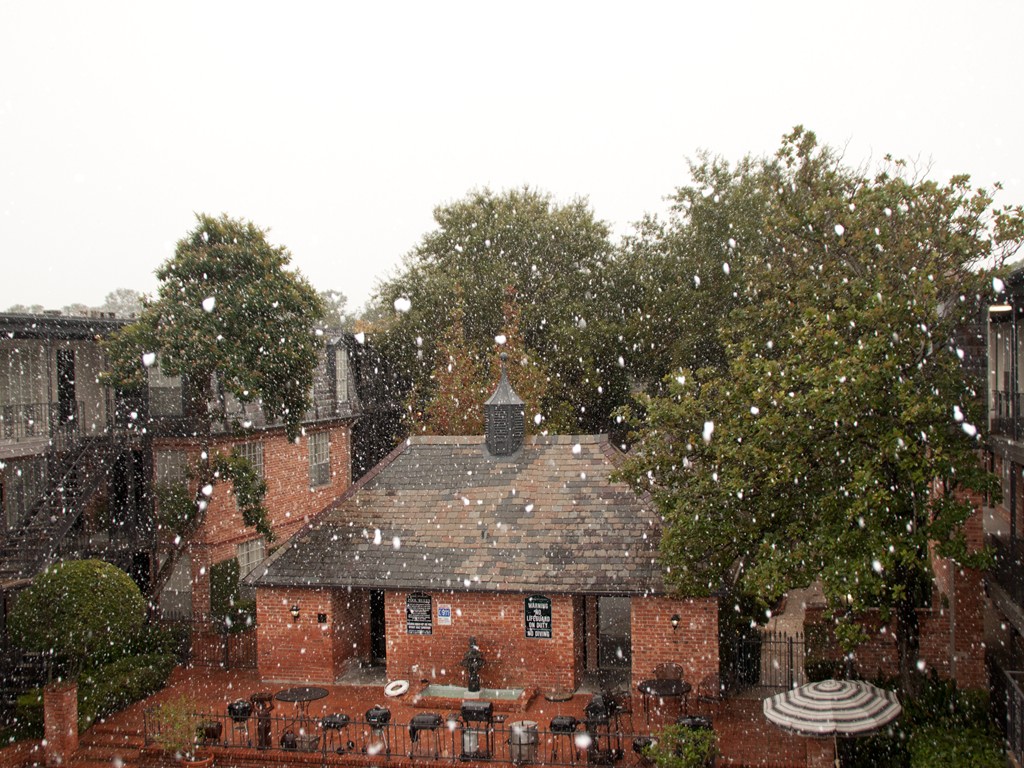
📸 Photo Description
This image shows snow falling on a brick courtyard surrounded by ivy-covered trees and buildings. You can see white snowflakes falling from gray clouds, landing on the ground, buildings, and plants below. The snow is a type of precipitation—water falling from clouds to Earth's surface.
🔬 Scientific Phenomena
Anchoring Phenomenon: Snowfall (frozen precipitation)
Why It's Happening:
Snow occurs when water vapor in the atmosphere condenses into ice crystals instead of water droplets. This happens when temperatures in the clouds and air are cold enough (below 32°F/0°C). The ice crystals stick together, becoming heavy enough to fall to the ground as snowflakes. Snow is part of the water cycle—a continuous process where water evaporates from Earth's surface, forms clouds, and returns to Earth as precipitation in different forms depending on temperature.
📚 Core Science Concepts
- Precipitation Types: Water falls from clouds in different forms—rain, snow, sleet, and hail. Snow is precipitation that forms when it's cold enough for water to freeze into ice crystals.
- Temperature and State of Matter: Water changes form based on temperature. When it's very cold, water freezes into solid ice crystals that make snowflakes. When it's warmer, water stays liquid or becomes a gas (water vapor).
- The Water Cycle: Water continuously moves between Earth's surface and the atmosphere. Evaporation (water rising), condensation (forming clouds), and precipitation (falling water/snow) are all connected stages.
- Weather Patterns and Observation: Snow is a visible weather event that students can observe and measure. Recording precipitation helps us understand weather patterns and seasons.
Pedagogical Tip:
Start by activating prior knowledge: Ask students "What do you already know about snow?" before diving into the science. This honors their lived experiences and creates a foundation for new learning. Many third graders have personal memories of snow play, which makes this phenomenon personally relevant and motivating.
UDL Suggestions:
Representation: Provide a visual water cycle diagram showing how snow fits into the larger cycle. Use multiple modalities—show the image, draw it together, and use a physical model (cotton balls as clouds, water droplets, etc.) so students can engage visually, kinesthetically, and verbally. Action & Expression: Allow students to choose how they demonstrate understanding: they can draw snow falling, write observations, create a model, or act out the water cycle.
🎓 NGSS Connections
Performance Expectation:
3-ESS2-1: Represent data in tables and graphical displays to describe typical weather conditions expected during a particular season.
Disciplinary Core Ideas:
- (Weather and Climate) – Students observe that weather varies day-to-day and across seasons, and that precipitation appears in different forms.
Crosscutting Concepts:
- – Snow and precipitation follow patterns related to seasons and temperature
- – Cold temperatures cause water to freeze into snow rather than fall as rain
💬 Discussion Questions
- "What has to happen to the water in the clouds for it to become snow instead of rain?" (Bloom's: Analyze | DOK: 2)
- "If it was warmer outside, what do you think would fall instead of snow? Why?" (Bloom's: Evaluate | DOK: 3)
- "Where do you think the water in this snow came from before it was a cloud?" (Bloom's: Understand | DOK: 1)
- "How could we measure how much snow falls in our schoolyard, and why would that be helpful?" (Bloom's: Create | DOK: 3)
📖 Vocabulary
- Precipitation: Water that falls from clouds to Earth, such as rain, snow, sleet, or hail.
- Snowflake: A small crystal of ice that forms in clouds and falls as snow.
- Freezing: The process when a liquid (like water) turns into a solid (like ice) because it gets very cold.
- Water Vapor: Invisible water in the form of a gas that rises from Earth into the atmosphere.
- Condensation: The process when water vapor cools down and turns into tiny water droplets that form clouds.
- Temperature: How hot or cold something is, measured with a thermometer.
🌡️ Extension Activities
- Snow Observation & Measurement Station: After a snowfall (or using ice/crushed ice as a substitute), have students measure snowfall depth using a ruler or stick marked with inches. They can record their measurements in a chart and make predictions about future snowfall. This builds data collection and graphing skills while connecting to the NGSS PE.
- Make a Snow Crystal Model: Provide pipe cleaners and string to students. They'll design their own "snowflake" by arranging materials into six-pointed shapes (reflecting real snowflake geometry). Discuss why snowflakes have patterns and connect this to how ice crystals form in specific shapes due to cold temperatures.
- Water Cycle in a Bag Experiment: Create a sealed plastic bag with a small amount of water and tape it to a sunny window. Students observe evaporation, condensation on the bag's sides, and the continuous cycle. They can draw and label the process, connecting it to the snow in the photo as another part of the same water cycle.
🔍 Zoom In / Zoom Out Concepts
Zoom In: Ice Crystal Formation (Microscopic Level)
If we could shrink down and look at a single snowflake under a super powerful microscope, we'd see that it's not just a ball of ice—it's made of water molecules arranged in a perfect geometric pattern with six sides. When water vapor freezes high in the cold clouds, the water molecules slow down and lock together in this special six-sided shape. Each snowflake follows this same pattern because of how water molecules naturally connect to each other when they freeze. This is why no two snowflakes are exactly alike—tiny differences in temperature and humidity as they form create unique patterns!
Zoom Out: Regional Winter Weather Systems (Earth System Level)
This single snowfall is part of a much larger weather system. The snow we see in this courtyard is connected to air masses, wind patterns, and ocean currents that span entire continents. Cold air moving south from polar regions meets warm, moist air moving north, creating the conditions for snowfall across whole regions or countries. Over time, patterns of snowfall contribute to seasonal changes, affect how much water flows in rivers and streams, and influence what plants and animals can survive in an area. Zooming out even further, Earth's snow and ice systems (called the cryosphere) play a huge role in reflecting sunlight back into space and regulating our planet's temperature.
🤔 Potential Student Misconceptions
Misconception 1: "Snow is frozen rain."
Scientific Clarification: Snow and rain are different from the start! Snow forms when water vapor freezes into ice crystals high in the clouds—it never becomes liquid water first. Rain forms when water vapor condenses into water droplets. Whether we get snow or rain depends on the temperature in the clouds and the air below. If it's cold enough all the way down, we get snow. If it's warmer, we get rain. They're two different pathways, not one changing into the other.
Misconception 2: "Clouds are made of snow/water that falls down."
Scientific Clarification: Clouds are actually made of tiny water droplets or ice crystals that are so small and light they float in the air! Snowflakes are much bigger and heavier, so they fall to the ground. Clouds don't "become" snow—instead, water droplets in clouds combine and grow larger until they're heavy enough to fall as precipitation (which might be snow if it's cold enough).
Misconception 3: "Snow comes from the ground freezing water."
Scientific Clarification: Snow doesn't form on the ground; it forms way up in the clouds high in the atmosphere where it's very cold. Snow falls from clouds to the ground. The ground being cold helps the snow stay frozen once it lands, but the snow itself is made in the sky, not on Earth's surface.
🔗 Cross-Curricular Ideas
Math Connection: Measuring and Graphing Snowfall
Have students measure snowfall depth using rulers marked with inches and centimeters. Create a class bar graph showing daily snowfall amounts over a week or month. Students can calculate totals, compare amounts ("Did we get more snow on Monday or Tuesday?"), and make predictions about future snowfall. This builds measurement, data interpretation, and early graphing skills while directly connecting to NGSS standards about representing weather data.
ELA Connection: Winter Weather Stories and Poetry
Read winter-themed picture books like Owl Babies by Martin Waddell or The Snowy Day by Ezra Jack Keats. Have students write their own winter weather observations as descriptive sentences or short poems using sensory words (cold, white, fluffy, wet, sparkly). They can also write "snow reports" pretending to be weather reporters, practicing informative writing while reinforcing precipitation vocabulary.
Social Studies Connection: How Snow Affects Communities
Discuss how snow changes what people do in their communities. Talk about winter transportation (snow plows, salt trucks), school closures, activities people enjoy (sledding, skiing), and how workers prepare for snow. Look at maps showing which parts of the world get a lot of snow versus little snow, and discuss how climate and geography affect where people live and what they do. This builds geography awareness and community understanding.
Art Connection: Snowflake Design and Symmetry
Have students create paper snowflakes by folding white paper and cutting intricate patterns, then unfolding to reveal symmetrical designs. Discuss how real snowflakes have six-sided symmetry (a math and science concept!). Students can display their creations and compare patterns, learning about symmetry while celebrating the artistic beauty of snow. They might also paint or draw winter scenes inspired by the photo, experimenting with white paint on dark paper to show falling snow.
🚀 STEM Career Connection
- Meteorologist — Studies the atmosphere to work out what the weather will do next.
- Try it: Record the daily temperature and precipitation for a week, noting when snow occurs. (Practice: Analyzing and Interpreting Data)
- Tools: weather balloons, radar, rain gauges, computer models
- Where they work: weather stations, airports, television studios, research centres
- Meet one: Marshall Shepherd — Why cities make their own weather, and why some neighbourhoods flood before others.
- Median pay: /year — "Atmospheric and space scientists"
- Hydrologist — Follows water — where it falls, where it goes underground, and where it comes out again.
- Try it: Compare data from different locations to see where snow is more common and explain why. (Practice: Analyzing and Interpreting Data)
- Tools: stream gauges, well probes, flow meters, rain gauges
- Where they work: rivers and reservoirs, water utilities, government surveys, universities
- Meet one: Newsha Ajami — How cities can use water more wisely, especially when there is not enough of it.
- Median pay: /year — "Hydrologists"
Wage figures are median annual wages for the U.S. occupation named after each one, from the U.S. Bureau of Labor Statistics, Occupational Employment and Wage Statistics (OEWS), national, May 2025. Several careers share one occupation, so their figures match.
---
Teacher Tip: This image is ideal for a seasonal lesson during winter months or as an introduction to precipitation. Consider having students compare this snow photo to images of rain or hail to build understanding of how temperature affects precipitation type. You might also have students collect and observe real snowflakes with magnifying glasses if your region experiences snow!