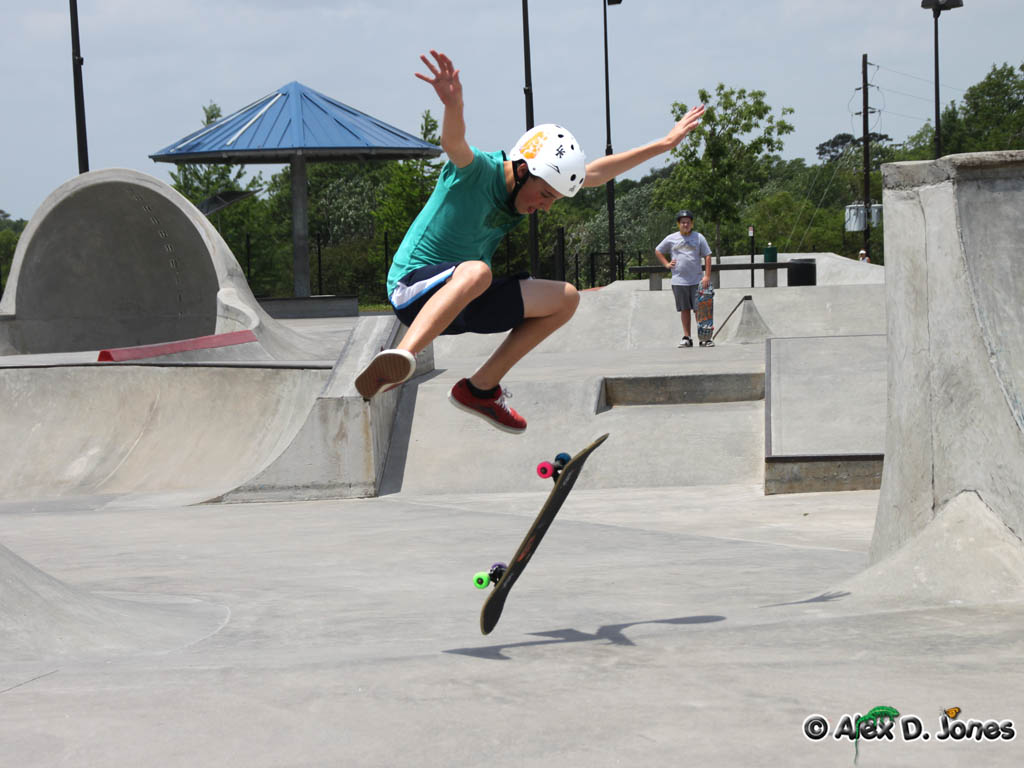
📸 Photo Description
In this image, a skateboarder is performing a trick at a concrete skate park, jumping high into the air while the skateboard flips beneath them. The skateboarder's body is stretched out with arms extended, showing the energy of movement. You can see the skateboard in mid-air below them, and other people watching in the background.
🔬 Scientific Phenomena
Anchoring Phenomenon: A moving skateboard and skateboarder demonstrate kinetic energy—the energy of motion.
Why This Happens: When the skateboarder pushes off the ground, they transfer energy to their body and the skateboard, making them move. Objects that are moving have kinetic energy. The faster something moves, the more kinetic energy it has. Even though the skateboard is in the air (separated from the skateboarder), it still has kinetic energy because it's moving through space.
📚 Core Science Concepts
- Kinetic Energy: Energy that an object has because it is moving. The skateboard, the skateboarder, and even their arms and legs all have kinetic energy in this photo.
- Force and Motion: The skateboarder used force (a push) to make the skateboard and their body move. A force is a push or pull that can change how something moves.
- Speed and Movement: The faster an object moves, the more kinetic energy it has. The skateboarder is moving very quickly here, so they have lots of kinetic energy.
- Energy Transfer: The skateboarder's muscles created energy that was transferred to the skateboard through a push, making it move across the ground and then launch into the air.
Pedagogical Tip:
Help students connect kinetic energy to their own bodies by having them run, skip, and walk at different speeds. Ask them: "When are you using more kinetic energy—when you walk slowly or run fast?" This makes an abstract concept concrete and personal.
UDL Suggestions:
Provide multiple ways for students to engage with kinetic energy: (1) Visual learners can watch slow-motion videos of skateboarders; (2) Kinesthetic learners can move their own bodies at different speeds and feel the difference; (3) Verbal learners can discuss and explain what they see; (4) Use simplified sentence frames like "The skateboard is moving because ___." to support students with varying language levels.
🎓 NGSS Connections
Performance Expectation: 3-PS2-1: Plan and conduct an investigation to provide evidence that balanced and unbalanced forces on an object will change the object's motion.
Disciplinary Core Ideas:
- : Forces and Motion
- : Types of Interactions
Crosscutting Concepts:
-
-
💬 Discussion Questions
- What made the skateboard and the skateboarder move through the air? (Bloom's: Understand | DOK: 1)
- How do you think the skateboarder's kinetic energy would change if they pushed even harder with their legs? (Bloom's: Predict | DOK: 2)
- Why does the skateboard have kinetic energy even though it's not touching the ground anymore? (Bloom's: Analyze | DOK: 3)
- If the skateboarder was moving slower, how would their kinetic energy be different? (Bloom's: Analyze | DOK: 2)
📖 Vocabulary
- Kinetic Energy: The energy that something has when it is moving.
- Force: A push or pull that makes something move or changes how it moves.
- Motion: When something changes position and moves from one place to another.
- Speed: How fast something is moving.
- Energy: The power to make things move or change.
- Push: Using force to move something away from you.
🌡️ Extension Activities
- Speed Investigation: Have students race toy cars or roll balls down ramps at different heights. Ask: "Does a car that moves faster have more or less kinetic energy?" Students can observe and record which objects move faster and discuss why.
- Human Kinetic Energy Exploration: In a safe space (gym or outdoor area), have students walk, jog, and run while you clap at different speeds. Ask them to match their movement to the clapping speed. Then discuss: "When were you using more kinetic energy—when you walked or when you ran?"
- Energy Stopping Challenge: Students can push toy cars and try to stop them by placing obstacles in the path. Discuss: "Why is it harder to stop a fast-moving car than a slow-moving car?" Connect this to kinetic energy.
🔍 Zoom In / Zoom Out Concepts
Zoom In (Microscopic Level):
When the skateboarder's muscles push off the ground, tiny cells in their legs are working very hard! Inside each muscle cell, there are even tinier parts called mitochondria that use energy from food (like breakfast!) to create the power needed to move. This is like having millions of tiny batteries inside your body that turn food into the energy to push, jump, and move. The harder the skateboarder works, the more their mitochondria have to work to provide energy!
Zoom Out (Community/Sport System Level):
This skateboard trick is part of a whole skateboarding community where skaters learn from each other, practice together at parks, and even compete in competitions. The skate park itself is part of a larger system that includes city planning, park maintenance, and sports programs. Skateboarders study physics (like kinetic energy!) to perform better tricks, and engineers design skate parks to be safe and fun. This one trick connects to athletes, coaches, engineers, designers, and many other people working together!
🤔 Potential Student Misconceptions
Misconception 1: "The skateboard stops having kinetic energy once it leaves the ground."
Clarification: The skateboard still has kinetic energy even when it's flying through the air! Kinetic energy doesn't disappear just because something isn't touching the ground. The skateboard keeps moving through the air until gravity pulls it back down. Moving = kinetic energy, whether you're on the ground or in the air!
Misconception 2: "Bigger objects always have more kinetic energy than smaller objects."
Clarification: Size doesn't matter as much as how fast something is moving. A small marble rolling very fast down a hill can have more kinetic energy than a big, slow-moving ball. Speed is the most important thing for kinetic energy!
Misconception 3: "You need to keep pushing to keep something moving."
Clarification: Once the skateboarder gives the skateboard a big push, it keeps moving even without another push (until air and friction slow it down). One powerful push can create kinetic energy that lasts for a while. That's why the skateboard flies through the air after just one push!
🔗 Cross-Curricular Ideas
Math Connection: Speed & Distance
Have students measure how far toy skateboards travel when given different amounts of force (gentle push vs. hard push). Create a simple bar graph showing distance traveled. Ask: "Which push made the skateboard go farther? Why?" This connects kinetic energy to measurable data and graphing skills.
ELA Connection: Action Verb Stories
Read or write action-packed stories about skateboarders using lots of movement verbs (zoom, soar, flip, spin, launch, glide). Have students write their own short story about a skateboarding trick, using vivid action words. Then act out the movements while reading aloud to bring kinetic energy to life through language and movement!
Social Studies Connection: Community Spaces
Discuss how skate parks are public spaces that bring communities together. Compare skate parks to other community gathering places (playgrounds, sports fields, pools). Talk about why communities build these spaces and who uses them. Connect this to local government and how cities plan for recreation and safety.
Art Connection: Motion in Visual Art
Create action-frozen artwork by drawing skateboarders in mid-trick using dynamic lines and angles. Use curved, swooping lines to show movement and speed. Display artwork and discuss: "How do artists show kinetic energy without using real movement?" Students can compare still images (photos, drawings) with videos to see how artists capture motion in different ways.
🚀 STEM Career Connection
- Mechanical Engineer — Designs things that move — engines, turbines, joints and gears — and works out the forces on them.
- Try it: Construct a simple pulley system using string, spools, and a small weight, and test how it makes lifting easier. (Practice: Developing and Using Models)
- Tools: CAD software, 3D printers, force sensors, wind tunnels
- Where they work: engineering firms, factories, design studios, research labs
- Meet one: Shini Somara — How air and water flow around things, worked out on a computer before anything is built.
- Median pay: /year — "Mechanical engineers"
- Physicist — Works out the rules that matter and energy follow, from the very small to the whole universe.
- Try it: Experiment with dropping objects of different weights from the same height and observe how their speed changes as they fall. (Practice: Developing and Using Models)
- Tools: lasers, detectors, vacuum chambers, computer simulations
- Where they work: research laboratories, particle accelerators, observatories, universities
- Meet one: Chanda Prescod-Weinstein — Dark matter — the invisible material that makes up most of the universe.
- Median pay: /year — "Physicists"
Wage figures are median annual wages for the U.S. occupation named after each one, from the U.S. Bureau of Labor Statistics, Occupational Employment and Wage Statistics (OEWS), national, May 2025. Several careers share one occupation, so their figures match.