📸 Photo Description
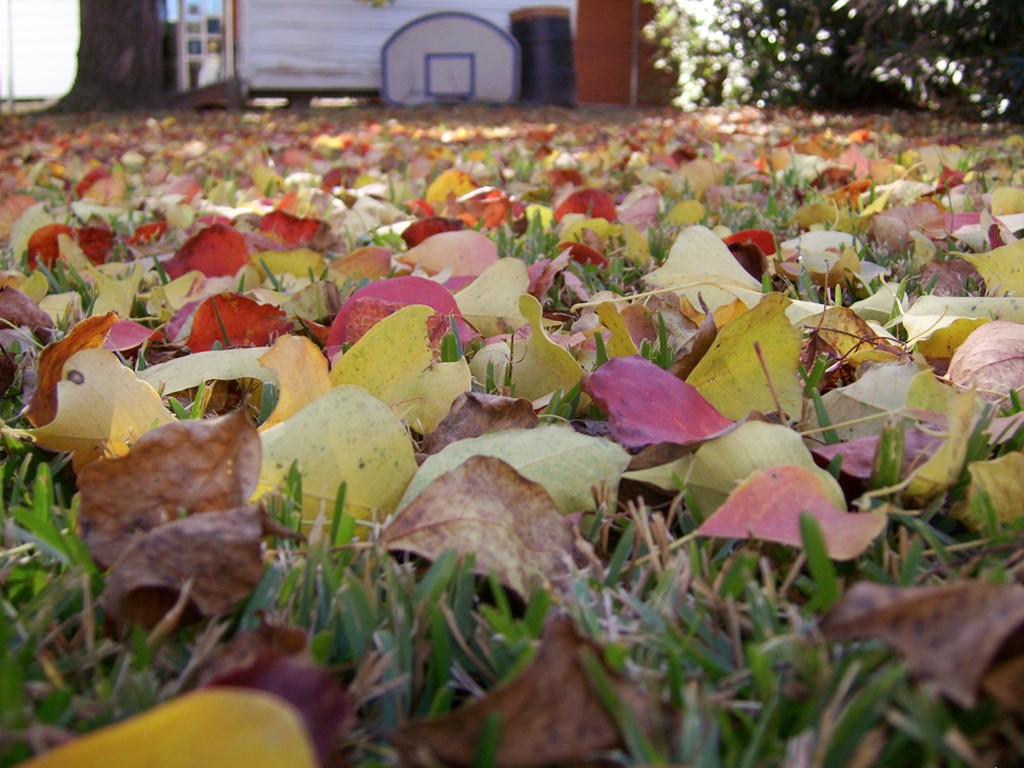
This image shows a yard covered with fallen leaves in many colors—red, yellow, orange, pink, and brown. Green grass peeks through the pile of leaves beneath a backyard with a basketball hoop and house visible in the background. The leaves have changed color and fallen from the trees, which is a sign that fall (autumn) has arrived.
🔬 Scientific Phenomena
Anchoring Phenomenon: Deciduous trees losing their leaves and changing color in autumn.
Why This Happens: As days get shorter and temperatures drop in fall, trees receive signals that winter is coming. Trees stop making food (through photosynthesis) and begin to close off the tubes that carry water to the leaves. Without water and nutrients, the green chlorophyll (pigment that makes leaves green) breaks down, revealing yellow and orange colors that were always there but hidden underneath. Eventually, leaves dry out and fall to the ground. Trees do this to survive winter when water in the soil freezes and becomes unavailable.
📚 Core Science Concepts
- Seasonal Changes: Earth's position and tilt create four distinct seasons, each with different weather patterns and environmental changes. Fall is characterized by cooling temperatures, shorter days, and trees preparing for winter.
- Plant Life Cycles: Plants go through cycles of growth, dormancy, and rest. In fall, deciduous trees enter a dormant state to conserve energy and water through the cold winter months.
- Pigments and Light: Leaves contain multiple pigments (chlorophyll = green, carotenoids = yellow/orange, anthocyanins = red/purple). Green chlorophyll masks the other colors during spring and summer, but as it breaks down in fall, the hidden colors become visible.
- Energy and Survival: Trees drop leaves to reduce water loss and preserve energy reserves in their roots and trunk for survival during winter when resources are scarce.
Pedagogical Tip:
Third graders benefit from direct observation and hands-on exploration. Rather than lecturing about photosynthesis, invite students to collect and sort fallen leaves by color. Ask them to predict which colors they'll find most often and create a tally chart. This builds observational skills while grounding abstract concepts in concrete experience.
UDL Suggestions:
Multiple Means of Representation: Create a visual anchor chart showing the four seasons with pictures and color samples. Include both photographs and student-drawn illustrations. Provide a simplified diagram showing chlorophyll breaking down and revealing other colors underneath—use actual colored paper or paint chips to make this tangible.
Multiple Means of Action & Expression: Allow students to demonstrate understanding through varied formats: drawing and labeling a leaf diagram, creating a color-sorting activity, writing/dictating sentences about fall changes, or building a timeline with pictures showing the progression from summer to fall.
Multiple Means of Engagement: Connect to student interests by discussing how they see fall in their own neighborhoods. Invite them to share fall traditions, foods, and outdoor activities. Use sensory language ("crunchy leaves," "cool air," "earthy smell") to engage multiple senses.
🎓 NGSS Connections
Performance Expectation: 3-LS4-1 - Analyze and interpret data from fossils to support an explanation for changes in organisms over time. (Note: While this image most directly supports seasonal/weather standards below, it can scaffold understanding of life cycles)
Disciplinary Core Ideas:
- - Weather and Climate: Scientists record patterns of the weather across different times and areas so that they can make predictions about what kind of weather might happen next.
- - Structure and Function: All organisms have input and output. Plants acquire their material for growth chiefly from air and water.
Crosscutting Concepts:
- - Seasons follow a predictable pattern; trees respond to seasonal patterns by changing colors and dropping leaves.
- - Shorter days and cooler temperatures cause trees to stop producing chlorophyll and drop leaves.
💬 Discussion Questions
- Why do you think trees drop their leaves in fall instead of keeping them all year long? (Bloom's: Analyze | DOK: 2)
- What do you observe about the different colors of leaves in this picture? Where do you think those colors were hiding during the summer? (Bloom's: Analyze | DOK: 2)
- If a tree didn't drop its leaves before winter, what problems might happen to the tree when it gets very cold? (Bloom's: Evaluate | DOK: 3)
- How would this yard look different in spring or summer compared to how it looks in this fall picture? (Bloom's: Compare/Contrast | DOK: 2)
📖 Vocabulary
- Chlorophyll: The green pigment (colored substance) in leaves that helps plants make food from sunlight.
- Deciduous: A type of tree that loses all its leaves in fall and grows new ones in spring.
- Dormant: When a plant or animal is resting and not growing or very active, like trees in winter.
- Pigment: A natural color-maker in leaves and other things; different pigments create different colors.
- Photosynthesis: The process plants use to turn sunlight, water, and air into food for themselves.
- Season: One of the four parts of the year (spring, summer, fall, winter) with its own weather patterns.
🌡️ Extension Activities
- Leaf Color Investigation: Take students on a nature walk to collect fallen leaves. Back in the classroom, sort leaves by color and create a bar graph showing which colors are most common. Discuss why certain colors might be more common (e.g., yellows and oranges are revealed in most trees, while reds depend on tree species and weather). Challenge students to predict which colors would appear if they collected leaves from different types of trees.
- Chlorophyll Chromatography (Simplified): Provide paper towels, markers, and a small cup of water. Have students cut paper towel strips, draw a line with a green marker near the bottom, and place the towel in water (the water should just touch the line). As water travels up, it will separate the green marker into different colors, demonstrating that "green" is actually multiple colors mixed together. Repeat with other fall colors.
- Seasonal Bulletin Board Timeline: Create a four-season photo display with the fall image as a starting point. Have students draw or collect pictures showing the same yard/trees in summer, fall, winter, and spring. Write descriptive sentences about what plants, weather, and animals look like in each season. This reinforces the cyclical nature of seasons and seasonal patterns.
🔍 Zoom In / Zoom Out Concepts
Zoom In: Cellular Level - Chlorophyll Breakdown
Deep inside each leaf cell are tiny structures called chloroplasts that contain chlorophyll (the green color). As fall arrives and days get shorter, trees send chemical signals that tell the leaf cells to stop making new chlorophyll and start breaking down the old green pigment. When the green chlorophyll disappears, it's like removing a green filter—the yellow and orange pigments (carotenoids) and red pigments (anthocyanins) that were hidden underneath become visible! Scientists using powerful microscopes can actually watch these color changes happen inside individual cells.
Zoom Out: Ecosystem and Forest Cycles
When millions of leaves fall in forests and yards across entire regions, they create an important blanket on the ground. These fallen leaves protect plant roots from freezing, provide a home for insects and small animals, and slowly break down into rich soil that feeds next year's plants. In a healthy forest ecosystem, this yearly cycle of leaf-fall and decomposition returns nutrients to the soil, helping trees grow stronger and providing food for the whole web of life—from tiny decomposers (fungi and bacteria) to deer, birds, and countless other creatures. The fall leaf-drop is actually a signal that the entire forest ecosystem is preparing for winter together.
🤔 Potential Student Misconceptions
Misconception 1: "Trees are dying when their leaves fall off."
Clarification: Falling leaves are actually a sign that trees are healthy and smart! Trees drop their leaves on purpose to survive winter, just like you might take off a heavy coat when you go inside where it's warm. The tree isn't dead—it's resting and saving energy. In spring, the tree will grow new leaves again.
Misconception 2: "All leaves turn red in the fall."
Clarification: Different types of trees have different colors hidden inside their leaves. Some trees make beautiful reds and purples, some turn mostly yellow and orange, and some turn brown. The colors we see depend on what type of tree it is and how warm or cold it gets. That's why a fall yard (like the one in the picture) has so many different colors all mixed together!
Misconception 3: "The leaves change color because they are getting sick or dirty."
Clarification: The leaves aren't getting sick—they're actually revealing their true colors! The green chlorophyll that covers up the yellow, orange, and red colors is like a blanket. In fall, the tree pulls that green blanket away, and we finally see all the pretty colors that were there the whole time under the green.
🔗 Cross-Curricular Ideas
Math: Data Collection and Graphing
Have students collect fallen leaves and sort them by color categories (red, yellow, orange, brown, pink, etc.). Create a tally chart to record how many leaves of each color they find, then represent the data as a bar graph or pictograph. Students can compare their results: "Which color had the most leaves? Which had the fewest? How many more yellow leaves than red leaves did we find?" This builds data literacy while exploring the phenomenon.
ELA: Descriptive Writing and Seasonal Poetry
Read aloud fall-themed picture books like Why Do Leaves Change Color? and discuss descriptive language. Invite students to write or dictate sentences describing what they see, hear, smell, and feel during fall. Challenge them to create an acrostic poem using the word "FALL" or "AUTUMN," with each line describing a fall observation. Display student writing alongside the photo to create a multisensory display.
Social Studies: Community and Cultural Traditions
Connect fall leaf changes to real-world community observations. Discuss fall traditions and celebrations in different cultures (harvest festivals, Thanksgiving, Day of the Dead, etc.). Have students interview family members about their favorite fall activities and create a class book of fall traditions. This helps students see how seasonal changes affect human activities, celebrations, and cultural practices in their own neighborhoods and around the world.
Art: Color Mixing and Nature Art Projects
Use the photo as inspiration for art exploration. Students can create leaf rubbings (placing paper over leaves and rubbing with crayons to transfer the texture and color), paint with fall colors to practice color mixing, or create a collage using real fallen leaves. Challenge students to mix paint colors to match the different shades of leaves they see in the photograph, building understanding of how colors combine while creating beautiful art.
🚀 STEM Career Connection
- Soil Scientist — Studies dirt seriously — what it is made of, what lives in it, and what will grow in it.
- Try it: Examine fallen leaves and the soil beneath the tree, describing how they might be connected. (Practice: Constructing Explanations and Designing Solutions)
- Tools: soil augers, pH meters, sieve stacks, sample bags
- Where they work: farms and fields, testing laboratories, government agencies, universities
- Meet one: Asmeret Asefaw Berhe — How soil stores carbon, and why that makes dirt part of the climate story.
- Median pay: /year — "Soil and plant scientists"
- Environmental Scientist — Measures how healthy the air, water and land are, and finds out what is harming them.
- Try it: Observe trees in your neighborhood and describe how they are changing as fall progresses. (Practice: Constructing Explanations and Designing Solutions)
- Tools: water test kits, air sensors, sample jars, data loggers
- Where they work: rivers and lakes, city environmental offices, testing labs, consulting firms
- Meet one: Tierra Curry — Which plants and animals are closest to disappearing, and what it takes to save them.
- Median pay: /year — "Environmental scientists and specialists, including health"
Wage figures are median annual wages for the U.S. occupation named after each one, from the U.S. Bureau of Labor Statistics, Occupational Employment and Wage Statistics (OEWS), national, May 2025. Several careers share one occupation, so their figures match.