📸 Photo Description
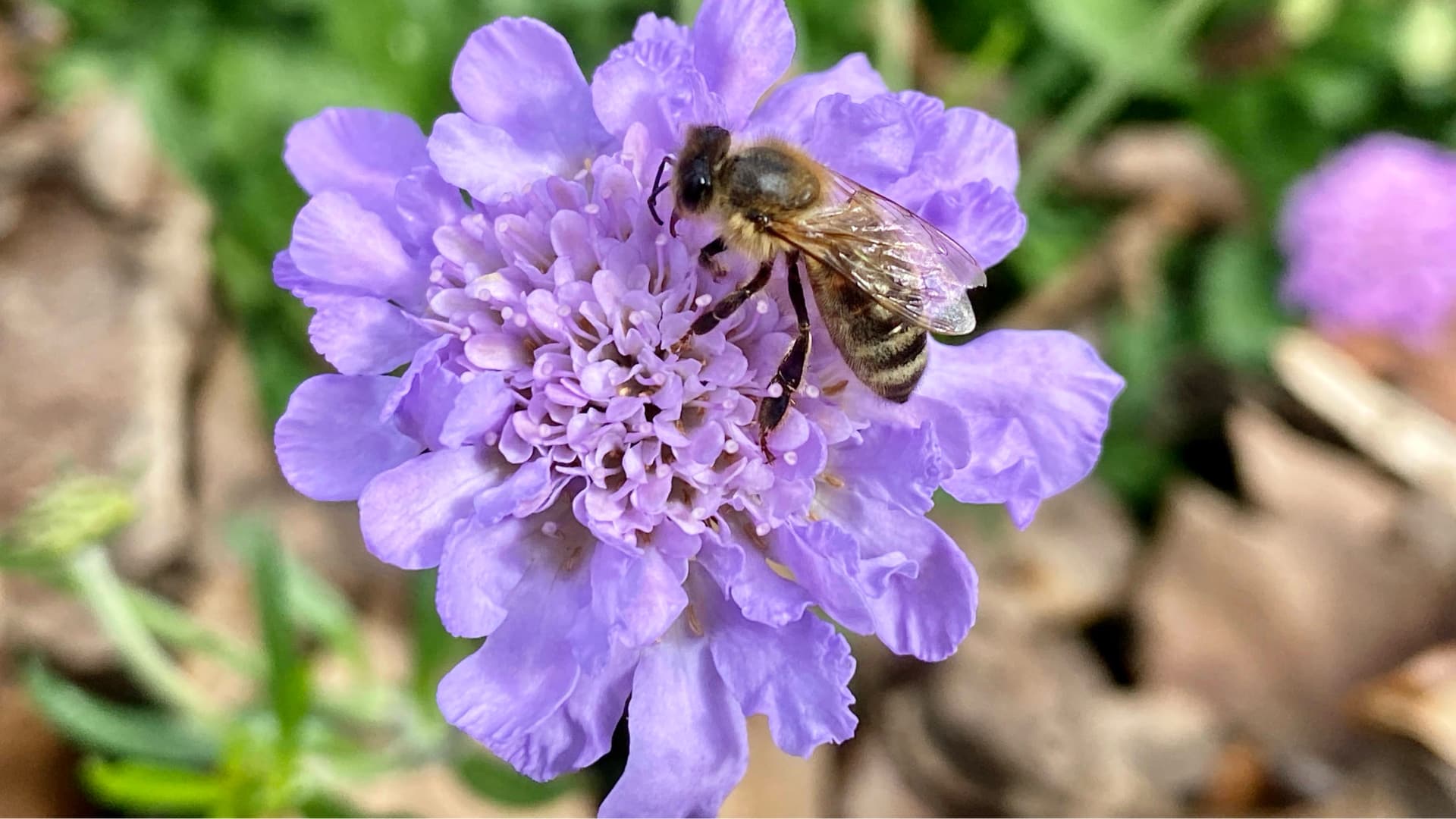
This image shows a honeybee landing on a purple flower called a scabious. The bee has fuzzy hairs all over its body that are covered with yellow pollen (a fine powder from flowers). You can see the bee using its long mouth part to drink nectar, which is sweet juice inside the flower. The bee is doing an important job for both itself and the flower!
🔬 Scientific Phenomena
Anchoring Phenomenon: A bee pollinating a flower through the transfer of pollen.
Why This Happens: Bees visit flowers to collect nectar (food) and pollen (protein). As the bee moves from flower to flower, pollen sticks to its fuzzy body. When the bee lands on another flower, some pollen rubs off onto that flower's female parts. This pollen helps the flower make seeds. This is a mutualistic relationship—the bee gets food, and the flower gets help making seeds. This process is called pollination, and it's essential for plants to reproduce and make fruits and vegetables that humans eat.
📚 Core Science Concepts
- Pollination: The process of moving pollen from one flower to another, which helps plants make seeds.
- Plant-Animal Relationships: Some animals and plants depend on each other. Bees need nectar and pollen for food, while flowers need bees to spread their pollen.
- Plant Reproduction: Flowers produce pollen and need it to travel to other flowers so they can create seeds and grow new plants.
- Adaptations: Bees have fuzzy bodies and long mouth parts (called a proboscis) that help them collect nectar and pollen. Flowers have bright colors and sweet nectar to attract bees.
Pedagogical Tip:
Use the "bee's eye view" strategy: Have students imagine they ARE the bee visiting the flower. Ask them to describe what they see, smell, and taste. This perspective-taking activates curiosity and helps students understand the bee's role in pollination more deeply than memorization alone.
UDL Suggestions:
Multiple Means of Representation: Provide the image alongside a large labeled diagram showing the bee's body parts and the flower's parts. Some students benefit from tactile models—consider using a fuzzy pipe cleaner (bee) and a real flower or flower model for students to physically demonstrate pollination.
Multiple Means of Action & Expression: Allow students to show understanding through drawing, acting out pollination, building a model with craft materials, or explaining verbally instead of writing only.
Multiple Means of Engagement: Connect pollination to foods students eat (apples, almonds, blueberries) to increase relevance and motivation.
🎓 NGSS Connections
Performance Expectation:
3-LS1-1: Develop models to describe that organisms have unique and diverse life cycles but all have in common birth, growth, reproduction, and death.
Disciplinary Core Ideas:
- Growth and Reproduction of Organisms
- Adaptation
Crosscutting Concepts:
- (flower and bee as a system)
- (bee's fuzzy body allows pollen to stick)
💬 Discussion Questions
- What do you think would happen to the flowers if there were no bees to visit them? (Bloom's: Analyze | DOK: 2)
- Why does the bee's body have to be fuzzy? What would happen if it were smooth like a rock? (Bloom's: Analyze | DOK: 2)
- Look at the flower's bright purple color. Why do you think flowers have bright colors? (Bloom's: Infer | DOK: 2)
- How is the bee helping the flower, and how is the flower helping the bee? Is this fair to both? (Bloom's: Evaluate | DOK: 3)
📖 Vocabulary
- Pollination: The movement of pollen from one flower to another to help the flower make seeds.
- Pollen: A fine, powdery substance made by flowers that helps them create seeds.
- Nectar: Sweet juice inside flowers that bees and other insects drink for energy.
- Adaptation: A special body part or behavior that helps an animal or plant survive and do its job.
- Proboscis: The long, straw-like mouth part that bees use to drink nectar from flowers.
🌡️ Extension Activities
- Pollinator Tracking Walk: Take students outside to observe different flowers and insects (bees, butterflies, ants). Have them use clipboards to draw or tally which insects visit which flowers. Discuss patterns they notice.
- Flower Dissection & Pollen Observation: Provide large, colorful flowers (lilies work well). Let students carefully pull apart petals and use magnifying glasses to find and observe the pollen on the flower's stamen (male part). They can draw what they see.
- Bee Dance Simulation: Teach students about the "waggle dance" honeybees use to tell other bees where flowers are. Have students work in small groups to create their own dance movements to show classmates where a "flower" is located in the classroom. This makes the invisible communication visible!
🔍 Zoom In / Zoom Out Concepts
Zoom In (Microscopic Level):
When you look at a bee's fuzzy body through a microscope, you'd see thousands of tiny hairs called setae. Each hair is designed like a little hook or branch. When the bee lands on a flower, pollen grains (which are super tiny—about the size of a speck of dust!) stick to these hairs because of static electricity and the sticky oils on the pollen. If you could shrink down to the size of a pollen grain, you'd see it has a bumpy, textured surface that's perfect for clinging to bee hair!
Zoom Out (Ecosystem Level):
This single bee visiting one purple flower is part of a much larger web of life. Bees pollinate plants, which make fruits and seeds that feed birds, squirrels, and other animals. Those animals spread more seeds when they travel. The flowers also provide nectar and pollen that feed not just honeybees, but also bumblebees, butterflies, and beetles. Without all these pollinators working together, entire meadows, gardens, and forests would struggle to grow. Even the food we eat—apples, almonds, cucumbers, and watermelons—depend on this pollination system working across whole regions and countries.
🤔 Potential Student Misconceptions
Misconception 1: "Bees are trying to steal nectar and pollen from flowers, so flowers don't like bees."
Clarification: Flowers actually WANT bees to visit them! Flowers produce nectar and pollen as a gift to bees. It's like the flower is saying, "Come drink my nectar and take my pollen!" The flower benefits because the bee carries pollen to other flowers. This is a win-win relationship, not a stealing situation.
Misconception 2: "All the yellow stuff on a bee is honey."
Clarification: The yellow stuff we see on bees in pictures is pollen, not honey. Honey is made later, inside the bee's special stomach, when the bee processes nectar back at the hive. Pollen is like the bee's "grocery bag"—it sticks to the bee's body as it travels from flower to flower.
Misconception 3: "Flowers can make seeds all by themselves without bees."
Clarification: Most flowering plants need pollen to move between flowers to make seeds. While some plants can pollinate themselves, many need help from pollinators like bees, butterflies, or wind. Without pollinators, many plants wouldn't be able to make new seeds and grow.
🔗 Cross-Curricular Ideas
Mathematics: Have students create a simple data table or bar graph showing "How many flowers did the bee visit?" and "How much nectar did it collect?" Students can make up realistic numbers (e.g., a bee might visit 50-100 flowers per trip) and practice counting, addition, and graphing. You could also measure flower petals or estimate the size of pollen using non-standard units.
English Language Arts: Students can write from the bee's perspective: "A Day in My Life as a Honeybee" or create a comic strip showing the bee's journey from flower to flower. They could also read and discuss the recommended children's books (The Bee Tree, Pollinators) and retell the story in their own words or draw their favorite part.
Social Studies: Discuss how different cultures around the world depend on bees for food and products like honey. Create a world map showing where certain crops (almonds from California, cocoa from Africa, vanilla from Madagascar) are grown and how bees help produce them. Students can also learn about beekeepers in their own community and how they care for bees.
Art: Students can create a large collaborative mural of a flower garden with bees, butterflies, and other pollinators. They could paint or collage flowers in bright colors (explaining why bright colors attract pollinators), make fuzzy bees from yarn or felt to show their hairy bodies, and add leaves and stems. This combines art with reinforcing the science concepts.
🚀 STEM Career Connection
- Botanist — Studies plants — how they grow, how they reproduce, and how they survive where they live.
- Try it: Build a model of a flower and a bee, demonstrating how the bee transfers pollen from one part of the flower to another. (Practice: Developing and Using Models)
- Tools: a hand lens, a plant press, a soil probe, field guides
- Where they work: botanical gardens, herbariums, forests and fields, universities
- Meet one: Robin Wall Kimmerer — Mosses — which she calls the coral reefs of the forest — and what Indigenous knowledge teaches about bringing plants back.
- Median pay: /year — "Soil and plant scientists"
- Entomologist — Studies insects — how they live, what they eat, and the jobs they do in an ecosystem.
- Try it: Draw a diagram showing how pollen travels from one flower to another with the help of a bee. (Practice: Developing and Using Models)
- Tools: insect nets, a hand lens, pinning boards, microscopes
- Where they work: museums, farms, insect labs, universities
- Meet one: Corrie Moreau — How ants evolved together with the bacteria that live inside them.
- Median pay: /year — "Zoologists and wildlife biologists"
Wage figures are median annual wages for the U.S. occupation named after each one, from the U.S. Bureau of Labor Statistics, Occupational Employment and Wage Statistics (OEWS), national, May 2025. Several careers share one occupation, so their figures match.