📸 Photo Description
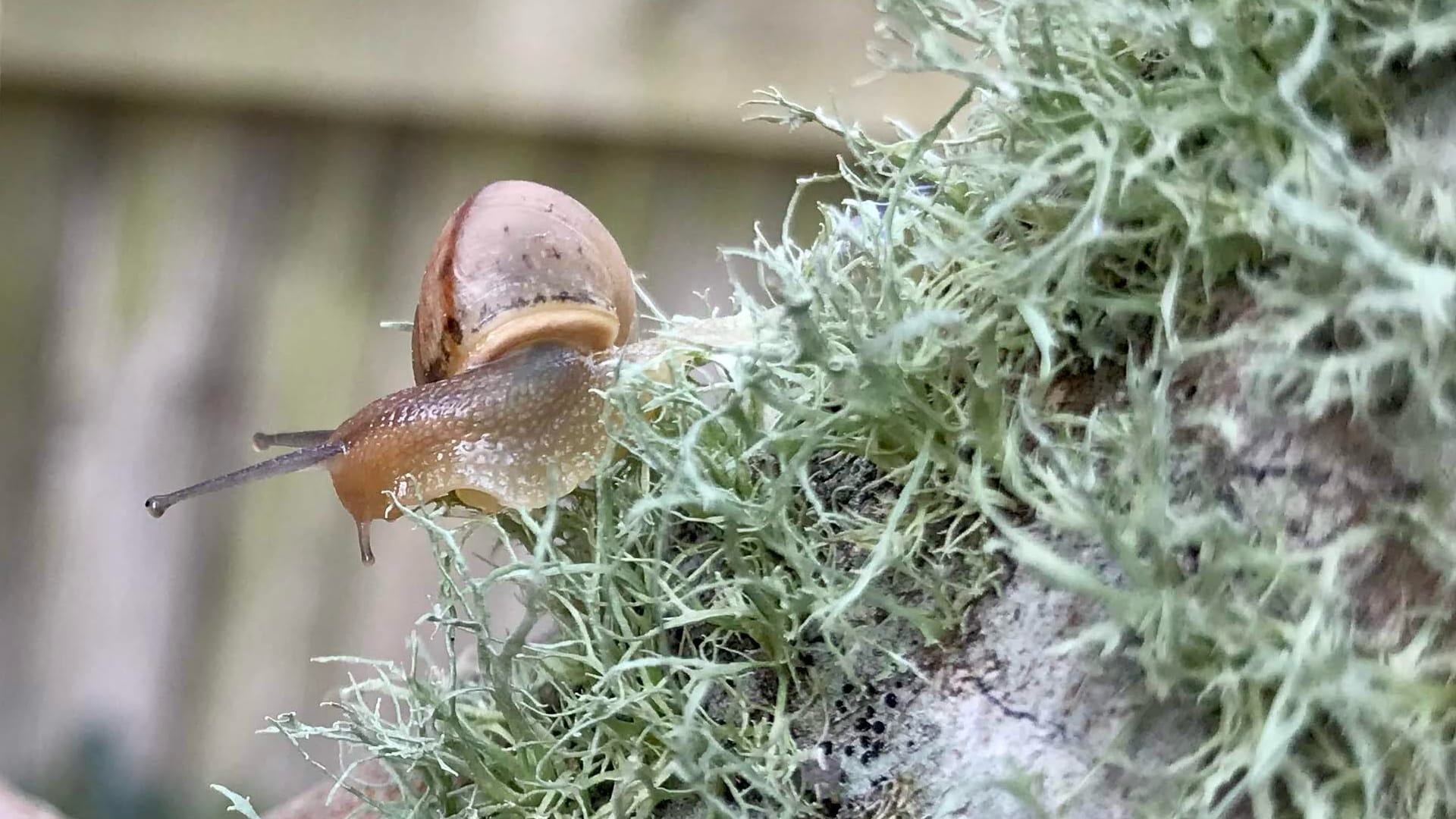
This image shows a garden snail crawling on green and gray lichen growing on a rock or wall. You can see the snail's brown spiral shell on its back, its soft body, and two long tentacles (called eyestalks) sticking out from its head. The snail is moving slowly across the lichen, which is a living organism that grows on hard surfaces.
🔬 Scientific Phenomena
Anchoring Phenomenon: How do snails move and find food in their environment?
This image captures a snail foraging—searching for and eating food. Snails are herbivores that feed on plants, algae, and lichen. The snail is moving toward the lichen because it senses food through its tentacles (which contain smell and touch sensors). The snail secretes a slimy mucus from its muscular foot, which reduces friction and allows it to glide across surfaces. This is why snails leave a shiny trail behind them. The snail's slow movement is actually an energy-efficient adaptation; by moving slowly, the snail conserves energy and moisture in its moist body.
📚 Core Science Concepts
- Adaptation: The snail's shell protects it from predators and drying out. Its slimy mucus helps it move and survive in different environments.
- Life Cycles & Habitats: Snails live in moist environments and are found on rocks, plants, and soil. They need moisture to survive because their bodies are soft and can dry out easily.
- Food Chains & Relationships: Snails are consumers that eat producers (plants, algae, lichen). Snails are also prey for birds, beetles, and other animals. Lichen is a symbiotic organism made of algae and fungi living together.
- Structures & Functions: The snail's foot allows movement, its shell provides protection, and its tentacles help it sense its surroundings (smell and touch).
Pedagogical Tip:
Use the phrase "slow and steady" when discussing snails. Third graders love the Aesop's fable connection, and it helps them remember that snails move differently than faster animals. Create a "speed comparison chart" on your board showing snail speed versus human speed versus a rabbit—this concrete visual helps students understand relative motion concepts.
UDL Suggestions:
Provide multiple means of engagement by allowing students to observe live snails (if possible) or watch time-lapse videos of snails moving. For students with visual processing needs, provide high-contrast images of snails and tactile models (clay snails) to explore. Consider offering the lesson content in both visual (diagrams) and kinesthetic (acting out snail movement) formats. For English Language Learners, pre-teach vocabulary with picture cards and have students label snail diagrams before discussions.
🎓 NGSS Connections
Performance Expectation: 3-LS1-1 Develop models to describe that organisms have unique and diverse life cycles but all have in common birth, growth, reproduction, and death.
Disciplinary Core Ideas:
- —Growth and Development of Organisms: Organisms have unique life cycles.
- —Interdependent Relationships in Ecosystems: Organisms interact with their environment.
- —Evolution of Traits: Different organisms have different structures for different functions (the snail's shell, foot, tentacles).
Crosscutting Concepts:
- —The snail's body parts help it survive.
- —Snails follow patterns of movement and feeding behavior.
- —Snails depend on moist environments and food sources.
💬 Discussion Questions
- Why do you think the snail is moving toward the lichen? What might it be doing there? (Bloom's: Infer | DOK: 2)
- How does a snail's shell help it survive in nature? What would happen if a snail didn't have a shell? (Bloom's: Analyze | DOK: 3)
- What body parts does the snail have, and what job does each one do? (Bloom's: Understand | DOK: 1)
- If you were a bird hunting for food, would you want to eat a snail with a hard shell or without one? Why? (Bloom's: Evaluate | DOK: 3)
📖 Vocabulary
- Snail: A slow-moving animal with a soft body and a hard spiral shell on its back.
- Lichen: A living thing made of algae and fungi growing together on rocks and trees.
- Adaptation: A special body part or behavior that helps an animal survive in its environment.
- Mucus: The slimy, wet coating that snails make to help them move and stay moist.
- Tentacle: Long, thin body parts on a snail's head that help it touch and smell things.
- Herbivore: An animal that eats only plants.
🌡️ Extension Activities
- Snail Speed Investigation: Create a simple "snail racetrack" using butcher paper on a table. Place a snail at the starting line and measure how far it travels in 1 minute using a ruler. Record the distance and compare speeds with classmates. Discuss variables: temperature, light, and moisture. Safety note: Handle snails gently and wash hands afterward.
- Snail Habitat Design: Provide students with a clear plastic container, soil, leaves, rocks, and a misting bottle. Have students design and build a snail habitat, predicting what conditions snails need to survive. Observe a snail in the habitat for a week, recording observations in a science journal. Safety note: Ensure snails are released safely or cared for appropriately after the experiment.
- Snail Life Cycle Illustration: Have students create a four-panel comic strip or poster showing the snail's life cycle: egg, baby snail, adult snail, and reproduction. Students can draw or use pictures cut from magazines and write captions explaining what happens in each stage.
🔍 Zoom In / Zoom Out Concepts
Zoom In: The Snail's Mucus Trail (Microscopic Level)
If you could look at the snail's slime trail through a microscope, you'd see it's made of special proteins and water that the snail's body produces. This mucus comes from a gland in the snail's muscular foot. When the snail moves, the mucus reduces friction—kind of like how ice makes it easier to slide than concrete. The mucus also helps the snail stay wet because it traps water close to the snail's soft body. Without this mucus-making ability, the snail would dry out and die, especially on a sunny day.
Zoom Out: The Snail's Role in the Ecosystem (Ecosystem Level)
When we zoom out, we see that snails are part of a much bigger community. Snails eat lichen and plants, which means they are consumers in the food chain. When snails eat, they help control algae and fungal growth on rocks and trees. Snails also become food for birds, ground beetles, and other predators. When snails die, their bodies break down and return nutrients to the soil, feeding the plants and fungi. The snail, lichen, fungi, algae, soil, and predators all work together in the same habitat—they depend on each other to survive. The snail is a small but important part of keeping this system balanced.
🤔 Potential Student Misconceptions
Misconception 1: "Snails are insects because they're small and crawl on the ground."
Scientific Clarification: Snails are NOT insects. Snails are mollusks—a different type of animal. Insects have six legs and three body parts. Snails have one muscular foot, a head, and a shell. They don't have legs. Snails are more closely related to octopuses and squid than to bugs!
Misconception 2: "The snail's shell is like a turtle's shell—it's skin that grows with the snail."
Scientific Clarification: A snail's shell is different from a turtle's shell. The snail's shell is made of a hard material called calcium carbonate (the same stuff that makes up chalk and seashells at the beach). The snail secretes this material and the shell stays attached to the snail's body. A turtle's shell is actually part of its skeleton and is covered by skin. The snail's shell grows larger as the snail grows, adding new spirals to the outside edge.
Misconception 3: "The snail's tentacles are for feeling things, so they work like our hands."
Scientific Clarification: The snail's tentacles are sense organs, not tools like our hands. The long tentacles (eye stalks) have eyes at the tips AND smell receptors all along them. Snails don't grab or hold things with their tentacles the way we use our hands. Instead, they use their tentacles to smell food from far away and to see light and shadows. The snail's mouth is under its head—it has a special tongue-like part called a radula that scrapes food off surfaces.
🔗 Cross-Curricular Ideas
Math: Measuring Snail Speed and Distance
Have students measure the snail's trail in centimeters and create a simple bar graph comparing snail speeds from different trials. Students can calculate average distances traveled and estimate how long it would take a snail to cross the classroom. This connects to measurement, data collection, and basic division concepts. Create a "speed poster" comparing snail speed (0.03 mph) to a human walking speed (3 mph) using simple ratios and visual representations.
ELA: Snail Story Writing and Poetry
Students can write creative stories from a snail's perspective ("A Day in the Life of a Snail") or compose shape poems and acrostic poems using the word SNAIL. Have students read aloud The Snail House by Catherine Rayner and create story sequence cards (beginning, middle, end). This builds narrative writing, descriptive vocabulary, and comprehension skills while reinforcing science content through storytelling.
Art: Natural Materials Habitat Diorama
Students can create a three-dimensional snail habitat diorama using a shoebox, natural materials (twigs, leaves, moss, rocks, lichen samples), and clay or painted snails. This hands-on project develops fine motor skills, spatial reasoning, and artistic expression while reinforcing understanding of snail habitats. Students can label their dioramas with vocabulary words and present them to the class, explaining why they chose certain materials.
Social Studies: Observing Living Things in Our Community
Take a classroom nature walk after rain to observe snails in the schoolyard or local park. Discuss why snails appear after rain (moisture), where they live (moist, shady places), and how humans can help or harm them. This connects to environmental stewardship and community observation. Students can create a "snail spotting map" marking locations where they found snails and discuss whether certain areas of the schoolyard are better snail habitats than others.
🚀 STEM Career Connection
- Ecologist — Studies how living things depend on each other and on the place they live.
- Try it: Collect data on where snails are found in a small area (like a garden or park) and record the types of plants and moisture levels in those spots. (Practice: Analyzing and Interpreting Data)
- Tools: quadrat frames, measuring tapes, GPS units, a field notebook
- Where they work: forests, grasslands, wetlands, universities
- Meet one: Sandra Díaz — What a plant's leaves, wood and shape tell you about how it lives — and how those traits add up across a whole ecosystem.
- Median pay: /year — "Environmental scientists and specialists, including health"
- Soil Scientist — Studies dirt seriously — what it is made of, what lives in it, and what will grow in it.
- Try it: Examine different soil samples and record observations about their texture, moisture, and any signs of life, like snail shells or trails. (Practice: Analyzing and Interpreting Data)
- Tools: soil augers, pH meters, sieve stacks, sample bags
- Where they work: farms and fields, testing laboratories, government agencies, universities
- Meet one: Asmeret Asefaw Berhe — How soil stores carbon, and why that makes dirt part of the climate story.
- Median pay: /year — "Soil and plant scientists"
Wage figures are median annual wages for the U.S. occupation named after each one, from the U.S. Bureau of Labor Statistics, Occupational Employment and Wage Statistics (OEWS), national, May 2025. Several careers share one occupation, so their figures match.
---
Educator Note: This lesson connects student curiosity about slow-moving animals to deeper questions about survival, adaptation, and interdependence in ecosystems. The snail is an excellent "entry point" organism for third graders because it is observable, non-threatening, and available in many climates. Consider collecting local snails or ordering them from a biological supplier to provide hands-on learning experiences.