📸 Photo Description
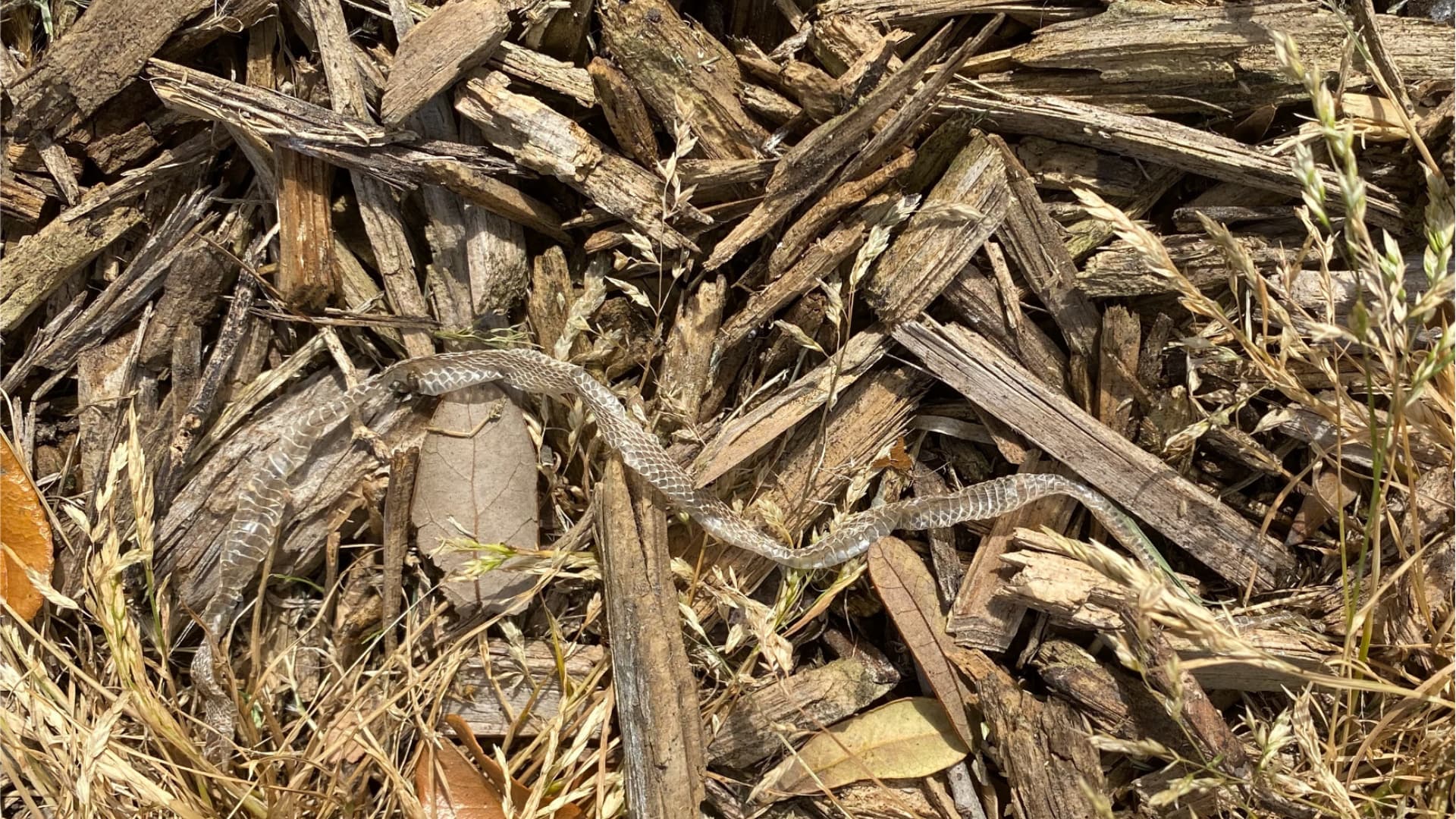
This image shows a snake moving through dried corn stalks and wood chips in its natural habitat. You can see the snake's patterned skin with scales that help it blend in with its surroundings. The snake is a harmless species that lives in areas with plant material, where it hunts for small prey like insects and rodents.
🔬 Scientific Phenomena
Anchoring Phenomenon: Why does a snake shed its skin, and how does its skin help it survive?
This image captures a snake in its typical environment, which connects to the larger phenomenon of adaptation and growth. Snakes shed their outer layer of skin (called the epidermis) several times per year as they grow larger. This happens because their skin doesn't grow with their body the way human skin does. Underneath the old skin is a fresh, new layer that allows the snake to continue growing. Additionally, a snake's patterned skin and scales are structural adaptations that help it hide from predators and move efficiently through tight spaces—both critical survival strategies.
📚 Core Science Concepts
- Structural Adaptations: Snakes have special features like scales and patterns on their skin that help them survive. Scales protect their bodies and help them move smoothly through grass, leaves, and soil. The coloring helps snakes blend into their surroundings (camouflage).
- Growth and Development: Snakes grow throughout their lives, and their skin doesn't stretch like ours does. When a snake gets too big for its skin, it sheds the old layer and grows a new one underneath. This happens multiple times as the snake grows.
- Habitat and Environment: Snakes live in specific environments where they can find food and shelter. This snake's habitat includes plants, leaf litter, and wood—places where small animals hide that the snake can eat.
- Life Cycles: Snakes are reptiles with their own life cycle. They are born or hatch from eggs, grow by shedding skin, hunt for food, and eventually reproduce.
Pedagogical Tip:
When teaching about snake skin, start with a hands-on comparison activity: Have students touch different textured materials (sandpaper, silk, bumpy rubber) while wearing a blindfold. Then reveal pictures of snake scales. Ask: "Which texture is most like a snake's scales?" This multisensory approach helps students understand why scales feel rough and bumpy—they're designed for gripping and moving, not smoothness.
UDL Suggestions:
To support diverse learners: (1) Provide tactile models of snake scales so students with visual impairments can explore the concept; (2) Offer a word bank with vocabulary terms for students still developing language skills; (3) Allow students to choose between drawing, building a model, or writing to demonstrate their understanding; (4) Use short video clips showing actual snake shedding to provide visual scaffolding for students who need concrete imagery before abstract discussion.
🎓 NGSS Connections
Performance Expectation:
3-LS1-1: Develop models to describe that organisms have unique and diverse life cycles but all animals have in common birth, growth, reproduction, and death.
Disciplinary Core Ideas:
- —Growth and Development of Organisms (snakes shed skin as they grow)
- —Adaptation (scales and coloring help snakes survive)
Crosscutting Concepts:
- (scales have a specific structure that serves survival functions)
- (the pattern on the snake's skin helps it hide in its environment)
💬 Discussion Questions
- "How do you think a snake's scales help it move through leaves and grass?"
(Bloom's: Understand | DOK: 1-2)
- "Why might a snake with brown and gray coloring survive better in a forest than a bright red snake?"
(Bloom's: Analyze | DOK: 2)
- "If a snake sheds its skin many times in its life, what does that tell us about how much the snake grows?"
(Bloom's: Analyze | DOK: 2-3)
- "Compare how snakes grow and shed their skin to how humans grow. What is different? What is the same?"
(Bloom's: Evaluate | DOK: 3)
📖 Vocabulary
- Scale: A small, thin plate of hard skin that covers a snake's body and protects it.
- Shed: When an animal removes or loses an outer layer of skin because it has grown too big for it.
- Adaptation: A special feature or behavior that helps an animal survive in its environment.
- Camouflage: Colors and patterns on an animal's skin that help it blend in and hide from other animals.
- Reptile: A cold-blooded animal with scales and a backbone, like snakes, lizards, and turtles.
- Habitat: The place where an animal lives that has the food, water, and shelter it needs.
🌡️ Extension Activities
- Shed Skin Investigation: Provide students with images or (if available and safe) preserved snake shed skin. Have students use magnifying glasses to observe the pattern of scales. They can make a detailed drawing and label the scales, comparing their observations to pictures of live snakes.
- Camouflage Hunt: Create a habitat display with dried leaves, twigs, and soil (like the image shows). Hide small toy snakes or snake-colored objects around the display. Have students search for them and discuss why some were easier or harder to find based on their colors and patterns. Relate this to real snakes hiding from predators.
- Growth and Shedding Timeline: Have students create a visual timeline showing a snake's life cycle from egg to adult, highlighting the multiple times it sheds its skin. They can use drawings or create a chart showing approximate ages when snakes shed (hatchlings shed every 4-6 weeks; adults every 3-4 months). Ask: "Why does a baby snake shed more often than an adult snake?"
🔍 Zoom In / Zoom Out Concepts
Zoom In: Inside a Snake's Skin (Microscopic Level)
If we could shrink down to see inside a snake's skin with a powerful microscope, we would discover tiny cells packed tightly together. Under the outer layer of scales are special cells that make keratin—the same tough material that makes your fingernails hard! As a snake grows, new cells form underneath the old skin layer. Eventually, the old layer becomes loose and the snake sheds it, revealing the fresh, new skin underneath. The cells are arranged in overlapping patterns, kind of like roof shingles, which helps water roll off and protects the snake's body.
Zoom Out: The Forest Ecosystem (Large System)
When we zoom out and look at the bigger picture, we see that this snake is just one part of a whole forest ecosystem. The snake lives in this habitat with plants (like the corn stalks in the photo), insects, small rodents, and other animals. The snake eats the small animals, and larger predators might eat the snake. When the snake sheds its skin, the old skin becomes part of the soil and helps feed decomposers like bacteria and fungi. Everything in the forest is connected—the plants provide shelter and food for prey, the prey feeds the snake, and when the snake dies, it returns nutrients to the soil to help plants grow again.
🤔 Potential Student Misconceptions
Misconception 1: "Snakes shed their skin because it gets damaged or dirty."
Clarification: Snakes don't shed because their skin wears out. They shed because their bodies grow bigger, but their skin doesn't stretch and grow with them like human skin does. It's a normal, healthy process that happens on a schedule, not because something is wrong. A snake might shed 4-8 times per year, even if its skin looks perfectly fine!
Misconception 2: "When a snake sheds its skin, it hurts or the snake is sick."
Clarification: Shedding doesn't hurt the snake at all—it's a natural and healthy part of growing up, just like how humans lose baby teeth to make room for bigger adult teeth. The new skin underneath is already formed and ready, so the snake just leaves the old skin behind like taking off an old jacket.
Misconception 3: "All snakes are poisonous and dangerous."
Clarification: Most snakes are actually harmless to humans and help us by eating rodents and insects that can be pests. Snakes are shy and would rather hide from people than attack. The coloring and patterns on a snake's skin help it hide in nature, not scare people—they're for camouflage, not warning!
🔗 Cross-Curricular Ideas
Math Connection: Measuring and Graphing Shed Cycles
Have students create a bar graph showing how often different snakes shed their skin at different ages. Provide data such as: "A baby snake sheds every 4-6 weeks, a young snake sheds every 8-10 weeks, and an adult snake sheds every 3-4 months." Students can measure the bars with rulers and answer questions like, "How many more times does a baby snake shed in one year compared to an adult snake?"
ELA Connection: Writing a Snake's Diary
Students write a short diary entry or journal from the perspective of the snake in the photo. Prompts might include: "Today I shed my skin. How did I feel?" or "I'm looking for food in the corn stalks. What do I see and smell?" This combines narrative writing with perspective-taking and reinforces vocabulary learned in the science lesson.
Art Connection: Camouflage Collage
Students create a mixed-media collage showing a snake hiding in its natural habitat using materials like dried leaves, twigs, bark, colored paper, and markers. They must choose colors and patterns that help their snake "disappear" into the background. Display the finished collages and have classmates play a "find the snake" game, discussing why certain snakes are harder to spot.
Social Studies Connection: Where Do Snakes Live? (Geography)
Using a large world map or globe, mark the regions where different snake species live. Students research and locate habitats like rainforests, deserts, grasslands, and forests. They can create a simple chart showing which snakes live in which habitats and discuss how a snake's coloring adapts to its specific environment (e.g., desert snakes are often sandy-colored, rainforest snakes are often green).
🚀 STEM Career Connection
- Biologist — Studies living things of every kind and what keeps them alive.
- Try it: Design a habitat for a snake that includes places to hide and move, explaining how each part helps the snake survive. (Practice: Constructing Explanations and Designing Solutions)
- Tools: microscopes, sample jars, measuring tools, a field notebook
- Where they work: laboratories, field sites, museums, universities
- Meet one: Sandra Díaz — What a plant's leaves, wood and shape tell you about how it lives — and how those traits add up across a whole ecosystem.
- Median pay: /year — "Biological scientists, all other"
- Conservation Biologist — Works out which plants and animals are in trouble, and what would help them recover.
- Try it: Describe how a snake's camouflage helps it avoid predators and find food, and explain why this is important for the snake population. (Practice: Constructing Explanations and Designing Solutions)
- Tools: population surveys, GPS trackers, habitat maps, trail cameras
- Where they work: nature reserves, conservation charities, government agencies, universities
- Meet one: Tierra Curry — Which plants and animals are closest to disappearing, and what it takes to save them.
- Median pay: /year — "Zoologists and wildlife biologists"
Wage figures are median annual wages for the U.S. occupation named after each one, from the U.S. Bureau of Labor Statistics, Occupational Employment and Wage Statistics (OEWS), national, May 2025. Several careers share one occupation, so their figures match.
---
Teacher Notes: This lesson emphasizes that all animals have life cycles with growth stages, and that physical features (structures) help animals survive. Be mindful that some students may have snake phobias; frame snakes as beneficial animals that help control pest populations. Always prioritize student comfort and provide opt-in rather than mandatory close-up encounters with any animal materials.