📸 Photo Description
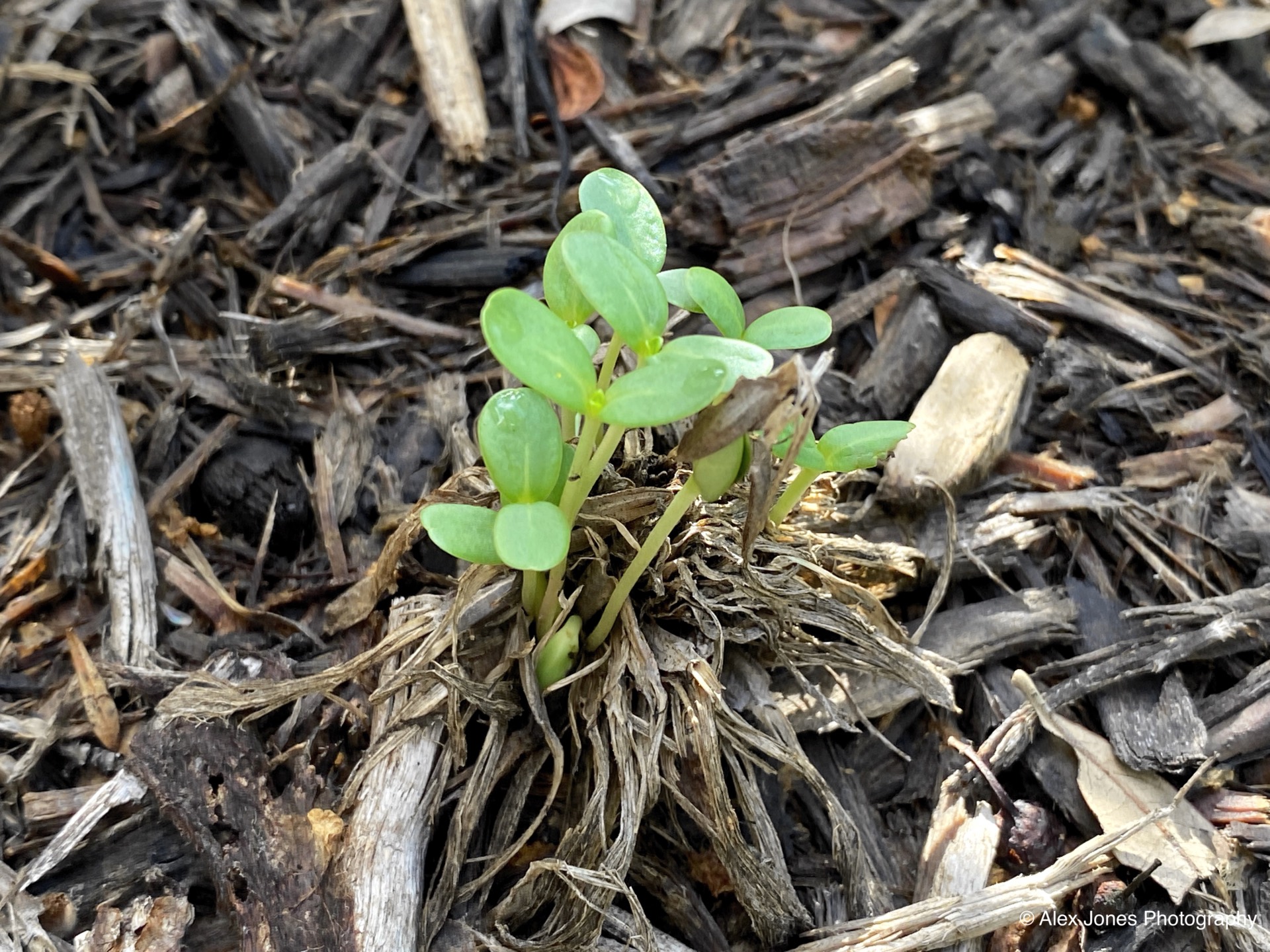
A small green plant with round leaves is growing up through old, dry plant pieces on the ground. The tiny plant looks fresh and healthy even though it is surrounded by brown, dead material. You can see the plant's green stem and several small leaves reaching toward the light.
🔬 Scientific Phenomena
This image shows the Anchoring Phenomenon of plant germination and early growth in a natural environment. A seed has sprouted and is developing into a young seedling (called a germling) despite growing through decomposing organic matter. This is happening because the seed contained stored energy and nutrients needed for initial growth, and the surrounding decomposed material actually provides additional nutrients and helps retain moisture. The young plant is demonstrating its ability to push through obstacles to reach sunlight, which it needs for photosynthesis to continue growing.
📚 Core Science Concepts
- Seed Germination: Seeds contain everything a new plant needs to start growing, including a tiny plant (embryo) and stored food energy.
- Plant Life Cycle: This seedling represents the early stage of a plant's life cycle, transitioning from seed to mature plant.
- Plant Needs: Plants require water, sunlight, air, and nutrients from soil to survive and grow.
- Adaptation and Survival: Plants have structures that help them survive in their environment, like strong stems that can push through debris.
Pedagogical Tip: Have students act out being a seed germinating by starting curled up on the floor, then slowly "growing" upward while reaching for the "sunlight." This kinesthetic activity helps them understand the process and remember the sequence.
UDL Suggestions: Provide multiple ways for students to observe plant growth: real seedlings, time-lapse videos, and detailed photographs. Offer various recording methods like drawings, photos, or verbal descriptions to accommodate different learning preferences and abilities.
🔍 Zoom In / Zoom Out Concepts
- Zoom In: Inside the seed, cells are dividing rapidly to create new plant tissues. The root cells are growing downward following gravity, while shoot cells are growing upward toward light. Water is being absorbed into cells, making them expand and grow.
- Zoom Out: This single seedling is part of a larger ecosystem where decomposing plant matter enriches the soil for new plants. As this plant grows, it will produce oxygen, provide food for animals, and eventually create seeds to continue the cycle in the forest or grassland community.
🤔 Potential Student Misconceptions
- Misconception: Plants get their food from soil.
Reality: Plants make their own food through photosynthesis using sunlight, water, and carbon dioxide. Soil provides nutrients and water, but not food.
- Misconception: Seeds need soil to grow.
Reality: Seeds can germinate in various materials as long as they have water, proper temperature, and air. The seed contains its own food supply for initial growth.
- Misconception: Dead plant material is harmful to new plants.
Reality: Decomposing plant matter provides valuable nutrients and helps create healthy soil for new plant growth.
🎓 NGSS Connections
- Performance Expectation: 3-LS1-1 - Develop models to describe that organisms have unique and diverse life cycles but all have in common birth, growth, reproduction, and death.
- Disciplinary Core Ideas: - Growth and Development of Organisms
- Crosscutting Concepts: and
💬 Discussion Questions
- What do you think this plant needed to grow through all that dead material? (Bloom's: Analyze | DOK: 2)
- How might this young plant change the environment around it as it continues to grow? (Bloom's: Evaluate | DOK: 3)
- What patterns do you notice between where plants grow and what surrounds them? (Bloom's: Analyze | DOK: 2)
- If you planted seeds in different materials, what do you predict would happen and why? (Bloom's: Create | DOK: 3)
📖 Science Vocabulary
- Seedling: A young plant that has just started growing from a seed
- Germination: The process when a seed begins to grow into a new plant
- Decompose: When dead plants and animals break down and become part of the soil
- Nutrients: Substances that help living things grow and stay healthy
- Photosynthesis: The process plants use to make food using sunlight, water, and air
🔗 Cross-Curricular Ideas
- Math - Measurement & Growth Tracking: Have students plant seeds and measure seedling height weekly using non-standard units (paper clips, craft sticks) or standard units (centimeters). Create a simple bar graph or line plot to show how much the plant grows each week. This connects measurement, data collection, and graphing skills.
- ELA - Sequencing & Narrative Writing: Students can write or illustrate the sequence of events in a plant's life cycle using "First, Next, Then, Finally" sentence starters. They could also create a story from the perspective of a seed, describing its journey from germination through growth.
- Art - Nature Collage & Observation Drawing: Students can create detailed observational drawings of seedlings or make collages using actual plant materials (dried leaves, twigs, seeds). This develops fine motor skills and encourages close observation of natural details while creating beautiful artwork.
- Social Studies - Community Gardens & Food Growth: Connect to local gardens in the community. Discuss where food comes from and how plants are grown. Students could learn about farmers and gardeners as community helpers who grow plants to feed people.
🚀 STEM Career Connection
- Agricultural Scientist — Works out how to grow more food on the same land without wearing the soil out.
- Try it: Investigate how the amount of water affects the germination rate of seeds by setting up different watering levels. (Practice: Constructing Explanations and Designing Solutions)
- Tools: test plots, soil kits, seed drills, yield monitors
- Where they work: research farms, seed companies, extension services, universities
- Meet one: Segenet Kelemu — How to protect African food crops from disease, and how insects themselves can become food.
- Median pay: /year — "Soil and plant scientists"
- Biologist — Studies living things of every kind and what keeps them alive.
- Try it: Observe germinating seeds under a magnifying glass and record detailed observations about their growth stages. (Practice: Constructing Explanations and Designing Solutions)
- Tools: microscopes, sample jars, measuring tools, a field notebook
- Where they work: laboratories, field sites, museums, universities
- Meet one: Sandra Díaz — What a plant's leaves, wood and shape tell you about how it lives — and how those traits add up across a whole ecosystem.
- Median pay: /year — "Biological scientists, all other"
Wage figures are median annual wages for the U.S. occupation named after each one, from the U.S. Bureau of Labor Statistics, Occupational Employment and Wage Statistics (OEWS), national, May 2025. Several careers share one occupation, so their figures match.