📸 Photo Description
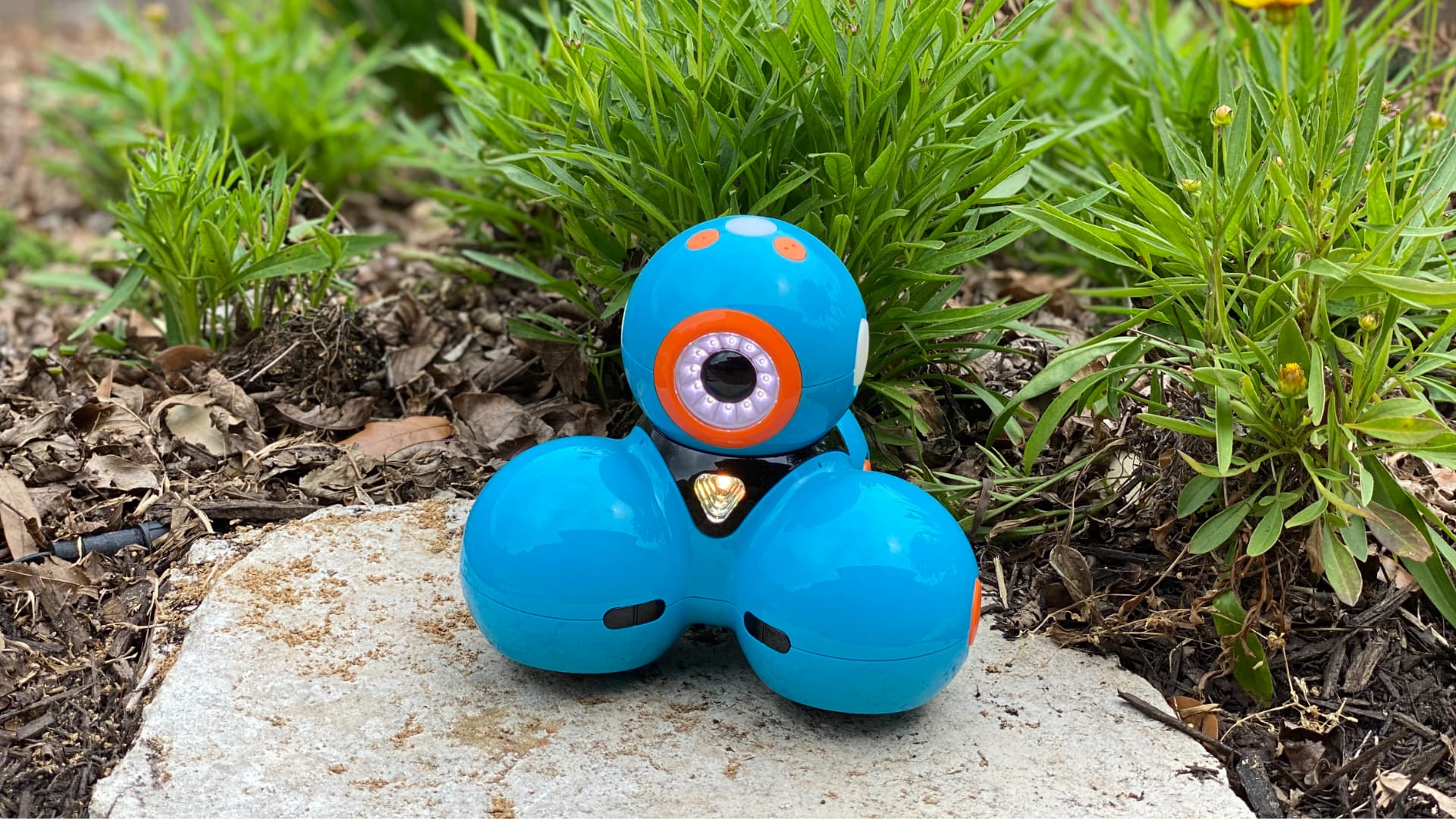
This image shows a small, blue robotic device with a round head featuring large orange eyes and a bright orange sensor ring. The robot has a three-wheeled base and is positioned on a concrete surface surrounded by soil, mulch, and green grass. The device appears designed to move around and observe its environment using its camera and sensors.
🔬 Scientific Phenomena
Anchoring Phenomenon: A robot programmed to explore and collect information from its surroundings.
Why This Is Happening: Robots are tools that humans design and program to perform tasks automatically. This robot likely uses sensors (like the camera visible in its "eye") to gather data about the environment—such as light, obstacles, or movement—and then responds by moving or recording information. Just as scientists observe nature to answer questions, this robot observes its environment and sends that data back to help humans understand what's happening in the garden or outdoor space.
📚 Core Science Concepts
- Observation and Data Collection: Robots can use cameras and sensors to observe things we want to study, just like scientists use tools to gather information about the natural world.
- Simple Machines and Motion: The robot's wheels are simple machines that help it move across different surfaces—soil, grass, and concrete—showing how wheels reduce friction and make movement easier.
- Technology and Problem-Solving: Humans design robots to help answer scientific questions or complete tasks that might be difficult or unsafe for people to do alone.
- Input and Output: The robot receives information from its sensors (input) and responds by moving or sending data (output), similar to how our brains receive signals from our senses and tell our bodies to move.
Pedagogical Tip:
Before diving into how the robot works, ask students to observe it silently for 30 seconds and record what they notice—this activates their observation skills and creates genuine curiosity. Third graders are naturally drawn to movement; use this as motivation to explore how machines help scientists gather information.
UDL Suggestions:
Provide multiple means of engagement by allowing students to physically interact with the robot (if safe and appropriate), watch it move, and predict its path. Some learners may benefit from handling a non-electronic wheel or simple machine to understand motion concepts before analyzing the robot's movement. Consider pairing visual observation with verbal descriptions for students who benefit from auditory input.
🎓 NGSS Connections
Performance Expectation: 3-5-ETS1-1: Define a simple design problem reflecting a need or a want that includes specified criteria for success and constraints on materials, time, or cost.
Disciplinary Core Idea: Defining and Delimiting Engineering Problems
Crosscutting Concepts:
- (the robot as a system with parts that work together)
- (sensors detect changes, which cause the robot to respond)
💬 Discussion Questions
- What does this robot's "eye" do, and why might scientists want a robot with a camera? (Bloom's: Understand | DOK: 2)
- How is this robot similar to how you explore your classroom or playground? (Bloom's: Compare | DOK: 2)
- If we wanted this robot to find something in the garden (like a specific plant or bug), what would we need to teach it first? (Bloom's: Analyze | DOK: 3)
- Why do you think scientists might use a robot instead of going outside to explore themselves? (Bloom's: Evaluate | DOK: 3)
📖 Vocabulary
- Robot: A machine controlled by a program that can do tasks without a person telling it what to do every step of the way.
- Sensor: A tool on a robot that gathers information about the world, like a camera that sees or a thermometer that measures temperature.
- Program: A set of instructions that tells a robot exactly what to do and in what order.
- Observe: To watch and notice details carefully to learn something new.
- Data: Information we collect by measuring or observing things.
🌡️ Extension Activities
- Design Your Own Robot Problem: Provide students with pictures of outdoor environments (a garden, a forest, a pond) and ask: "What question could a robot help us answer here?" Students draw or describe a robot that would solve that problem and explain what sensors it would need. This connects design thinking to real-world applications.
- Build a Simple Wheeled Device: Using paper cups, straws, paper fasteners, and construction paper, students design and build a simple wheeled vehicle that can move across different surfaces. They test how it moves on grass, soil, and concrete, then discuss why wheels help it move and how that's similar to the robot's movement.
- Create a "Robot Path" Obstacle Course: Lay out a simple course on the classroom floor using tape, blocks, and cones. Students predict the path the robot will take, observe it move through the course, and record what they notice. Follow up with: "What would we need to change to make the robot follow a different path?"
🔍 Zoom In / Zoom Out Concepts
Zoom In: Inside the Robot's Camera and Brain
Deep inside this robot's "eye" are tiny electronic parts called circuits and a chip (smaller than a grain of rice!) that work together like the robot's brain. When light enters the camera, it gets converted into electrical signals that travel through these circuits. These signals tell the robot what it "sees"—a plant, a rock, or the grass. Without these invisible electronic pathways, the robot would just be a blue ball that can't think or understand anything about its environment.
Zoom Out: The Robot in the Larger Scientific Ecosystem
This robot is part of a larger system of environmental monitoring—scientists use many tools like this one to collect data from gardens, farms, forests, and wetlands all around the world. The information gathered by robots like this helps us understand how plants grow, where animals live, and how weather affects nature. This data connects to bigger questions about caring for our planet: Are gardens healthy? Is there enough water for plants? Are ecosystems changing? By zooming out, we see that this one small robot is part of a global effort to observe and protect Earth's natural systems.
🤔 Potential Student Misconceptions
Misconception 1: "The robot is alive because it moves and has eyes."
Clarification: While robots can move and sense their environment (like living things do), they are not alive. Robots are machines that follow instructions we give them through programs. Living things like plants, animals, and people can think, grow, and make decisions on their own. A robot can only do what its program tells it to do—it cannot decide to do something new or grow bigger without human help.
Misconception 2: "The robot can think and understand things just like I do."
Clarification: This robot has sensors and cameras that collect information, but it doesn't "think" the way you do. Your brain can wonder, imagine, and make decisions. The robot's computer chip can only process the information its sensors collect and follow its program. A scientist has to look at the data the robot collects and use their own thinking to answer questions about what the data means.
Misconception 3: "Robots are only for toys or fun—they don't help with real science."
Clarification: Robots are very important tools for real scientists! They help scientists explore places that might be too dangerous, too far away, or too small for humans to reach safely. Some robots explore the ocean floor, others climb mountains, and some (like this one) help us learn about gardens and ecosystems. Robots do serious work to help us understand and protect our world.
🔗 Cross-Curricular Ideas
Mathematics: Create a measurement and distance activity where students predict how far the robot will travel across the classroom in 10 seconds, measure the actual distance it travels, and compare their predictions to the results. Students can record data in a simple chart and practice estimating, measuring with rulers or tape measures, and comparing numbers—all skills aligned to 3rd grade measurement standards (3.MD.A.2).
English Language Arts: Have students write and illustrate "Robot Adventure Stories" where they imagine the robot exploring different outdoor settings. Students write simple narratives describing what the robot "sees" through its camera, what questions it might help answer, and how scientists use the data. This connects to narrative writing standards (W.3.3) and allows creative expression while reinforcing science vocabulary.
Social Studies: Explore "Robots Around Our Community" by discussing different jobs people do in your town (farmers, park rangers, construction workers, veterinarians) and brainstorming how robots might help them. Students can create a poster or presentation showing one community helper and design a robot that would assist that person—connecting to understanding roles in society and human-technology relationships (3.1.1).
Art: Engage students in a "Design Your Own Robot" art project where they draw or build a robot using recyclable materials (paper cups, bottle caps, aluminum foil, markers) designed to solve a specific problem they identify. Students label the robot's parts, explain what sensors it needs, and color it creatively. This integrates visual arts standards with engineering design thinking and allows multiple ways of representing ideas.
🚀 STEM Career Connection
- Robotics Engineer — Builds machines that sense their surroundings and act on what they find.
- Try it: Program a simple robot (like a Bee-Bot or Code-a-pillar) to navigate a maze and record the path it takes. (Practice: Analyzing and Interpreting Data)
- Tools: microcontrollers, motors and servos, sensors, programming environments
- Where they work: robotics companies, factories, research labs, universities
- Meet one: Shini Somara — How air and water flow around things, worked out on a computer before anything is built.
- Median pay: /year — "Engineers, all other"
- Electrical Engineer — Designs the circuits and systems that move electricity where it is needed.
- Try it: Use a simple circuit kit to light up a bulb with batteries and wires, observing how the electricity flows. (Practice: Analyzing and Interpreting Data)
- Tools: oscilloscopes, circuit boards, multimeters, simulation software
- Where they work: power companies, electronics firms, research labs, universities
- Meet one: Danielle George — The radio receivers that let giant telescopes hear signals from space.
- Median pay: /year — "Electrical engineers"
Wage figures are median annual wages for the U.S. occupation named after each one, from the U.S. Bureau of Labor Statistics, Occupational Employment and Wage Statistics (OEWS), national, May 2025. Several careers share one occupation, so their figures match.