📸 Photo Description
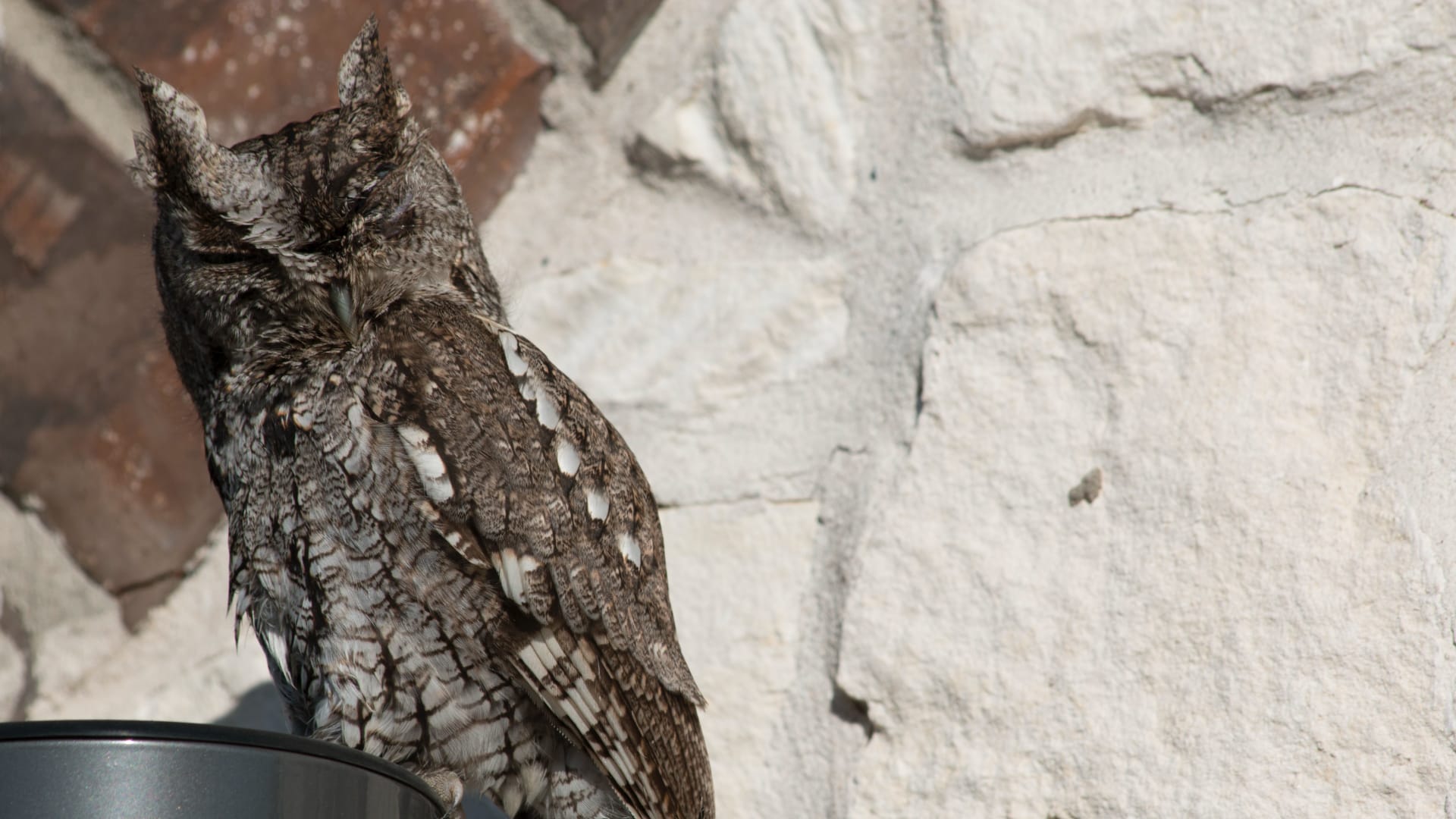
This photograph shows a small owl with big eyes and pointed ear tufts perched on a white brick wall. The owl's feathers are gray and brown with white markings that help it blend in with its surroundings. You can see the owl's special features like its sharp beak and watchful eyes that help it hunt and survive in nature.
🔬 Scientific Phenomena
This image represents animal adaptation and camouflage—a key survival strategy in the life-science domain. The owl's mottled gray and brown coloring is a perfect example of how animals have specific features that help them survive in their environment. The owl's coloration helps it hide from predators and sneak up on prey by blending in with tree bark and rocky surfaces. The prominent ear tufts, large forward-facing eyes, and sharp beak are all specialized body structures that allow this owl to hunt effectively at night and during low-light conditions.
📚 Core Science Concepts
- Structural Adaptations: Animals have body parts (like the owl's large eyes, ear tufts, sharp beak, and camouflaged feathers) that help them survive and meet their needs for food, shelter, and safety.
- Camouflage as Survival: The owl's coloring matches its environment (trees, rocks, brick walls), making it hard for other animals to see it—this helps the owl hide from danger and hunt successfully.
- Sensory Structures: Owls have specially adapted eyes positioned on the front of their head for hunting, and ear tufts that help them hear sounds in the dark.
- Patterns in Animal Needs: All animals, including owls, need food, water, air, and shelter to survive, and their special body features help them find these things.
Pedagogical Tip:
When teaching about animal adaptations to kindergarteners, use a multisensory approach: have students look at the owl's camouflaged feathers, trace the shape of the ear tufts with their fingers in the air, and make owl hunting sounds. This helps young learners connect observable features to survival functions in a memorable way.
UDL Suggestions:
To support diverse learners, provide multiple representations: show the photograph alongside a live video clip of an owl hunting, a stuffed owl toy students can hold and examine, and simplified illustrations labeling the owl's key body parts. Allow students to respond to learning through drawing pictures of owls, acting like owls, and telling stories about what owls need to survive.
🔍 Zoom In / Zoom Out Concepts
Zoom In: At the cellular and tissue level, the owl's feathers are made of thousands of tiny structures called barbs and barbules that trap air and help the owl fly silently. The pigments in the feathers (melanin) create the brown and gray colors that provide camouflage. The owl's eye contains special cells that are extremely sensitive to light, allowing it to see in dim conditions.
Zoom Out: Owls are part of larger ecosystems where they play the role of predator, hunting small rodents and insects that might otherwise overpopulate. The owl's presence in an ecosystem helps keep populations of prey animals balanced. Urban and rural environments provide different hunting grounds and shelter options, and the owl's adaptations allow it to survive in both settings. The owl's survival also depends on the availability of trees and safe perching spots like the brick wall shown in this photo.
🤔 Potential Student Misconceptions
- Misconception: "Owls are awake during the day just like people are."
- Clarification: Most owls are nocturnal, meaning they are active at night and sleep during the day. This is an adaptation that helps them hunt when their prey is most active and when their large eyes give them a hunting advantage.
- Misconception: "The owl's big eyes can move in all directions like human eyes."
- Clarification: Owls cannot move their eyes side to side very much. Instead, they have adapted to turn their heads almost all the way around to look in different directions. This is a special feature that helps them be excellent hunters.
- Misconception: "The owl's feathers are just for making the bird pretty."
- Clarification: The owl's feathers serve many important survival purposes: they provide camouflage to hide from danger, they keep the owl warm, they help it fly silently when hunting, and they protect the bird from the weather.
🎓 NGSS Connections
K-LS1-1: Use observations to describe patterns of what plants and animals (including humans) need to survive.
This standard is directly addressed through observing the owl's specialized body parts and discussing how features like camouflaged feathers, large eyes, sharp beak, and ear tufts help the owl meet its needs for food, safety, and survival.
All organisms have external parts. Different animals use their body parts in different ways to see, hear, and smell their surroundings. Animals use these senses to find food, water, shelter, and mates. Humans match the pattern of senses we have to humans and to other animals.
💬 Discussion Questions
- What special body parts does this owl have that help it find food? (Bloom's: Analyze | DOK: 2)
Encourage students to point out and name the owl's large eyes, pointed ears, sharp beak, and talk about what each part does.
- Why do you think the owl's feathers are brown and gray instead of bright colors like a parrot? (Bloom's: Infer | DOK: 3)
Guide students to think about how the owl hides and hunts, and how bright colors might make it easier for other animals to see it.
- If this owl moved to a green forest, would its gray and brown feathers still help it hide? Why or why not? (Bloom's: Evaluate | DOK: 3)
This helps students think about how adaptations work in specific environments and why animals live in certain places.
- What else do you think this owl needs besides its special body parts to stay alive? (Bloom's: Remember | DOK: 1)
Students should name food, water, air, and shelter—connecting back to basic animal survival needs.
📖 Vocabulary
- Adaptation: A special body part or behavior that helps an animal survive and meet its needs in its environment.
- Camouflage: Colors and patterns on an animal's body that help it blend in and hide from other animals.
- Nocturnal: An animal that is awake and active at night and sleeps during the day.
- Feathers: The light, fluffy covering on a bird's body that helps it fly, stay warm, and hide from danger.
- Predator: An animal that hunts and eats other animals to survive.
🌡️ Extension Activities
- Owl Eye Observation: Give students a small paper plate with two large circles cut out to simulate owl eyes positioned on the front of the face. Have students wear these "owl eyes" and try to look at objects around the classroom. Then give them eyes positioned on the sides like a rabbit or deer. Discuss how the position of eyes helps different animals survive—forward-facing eyes help hunters (like owls), while side-facing eyes help prey animals see danger coming.
- Camouflage Hunt: Hide pictures of differently colored animals (green frog on green paper, white polar bear on white paper, brown owl on brown paper, colorful parrot on brown paper) around the classroom. Have students search for them and discuss which animals are harder to find and why. Ask: "Where would each animal be easiest to hide?" This makes camouflage concrete and observable.
- Make an Owl Needs Poster: In small groups, have students create a simple illustrated poster showing what an owl needs to survive (food, water, air, shelter, safety). Each group can draw or cut out pictures representing one need. Display the posters and discuss how the owl's special body parts help it meet each need.
🔗 Cross-Curricular Ideas
- Math: Create a simple bar graph showing how many students have seen an owl, heard an owl, or read about an owl. Count and compare the bars. Practice sorting animal pictures into "nocturnal" and "diurnal" categories.
- ELA/Literacy: Read aloud picture books about owls (see resource list below). Have students dictate or write sentences completing prompts like "An owl needs _____ to survive" or "The owl's _____ helps it hunt." Create a class "Owl Facts" book where each student contributes one page.
- Art: Students create their own owl using collage materials (tissue paper, construction paper, feathers if available) focusing on the camouflaged colors and patterns they observe in the photograph. Display these alongside the original photo.
- Social Studies/Community: Discuss where owls live in your local community (parks, trees near houses, forests). Take a virtual or real nature walk to observe trees and buildings where owls might perch, connecting classroom learning to the student's local environment.
🚀 STEM Career Connection
- Wildlife Biologist — Studies wild animals — what they eat, where they go, and what they need to survive.
- Try it: Explain how an owl's camouflage helps it survive in its habitat. (Practice: Constructing Explanations and Designing Solutions)
- Tools: binoculars, radio collars, trail cameras, a field notebook
- Where they work: national parks, wildlife refuges, state wildlife agencies, universities
- Meet one: Rae Wynn-Grant — Where black bears and people run into each other, and how to keep both safe.
- Median pay: /year — "Zoologists and wildlife biologists"
- Ecologist — Studies how living things depend on each other and on the place they live.
- Try it: Design a habitat for an owl that includes places for it to hide and hunt. (Practice: Constructing Explanations and Designing Solutions)
- Tools: quadrat frames, measuring tapes, GPS units, a field notebook
- Where they work: forests, grasslands, wetlands, universities
- Meet one: Sandra Díaz — What a plant's leaves, wood and shape tell you about how it lives — and how those traits add up across a whole ecosystem.
- Median pay: /year — "Environmental scientists and specialists, including health"
Wage figures are median annual wages for the U.S. occupation named after each one, from the U.S. Bureau of Labor Statistics, Occupational Employment and Wage Statistics (OEWS), national, May 2025. Several careers share one occupation, so their figures match.