📸 Photo Description
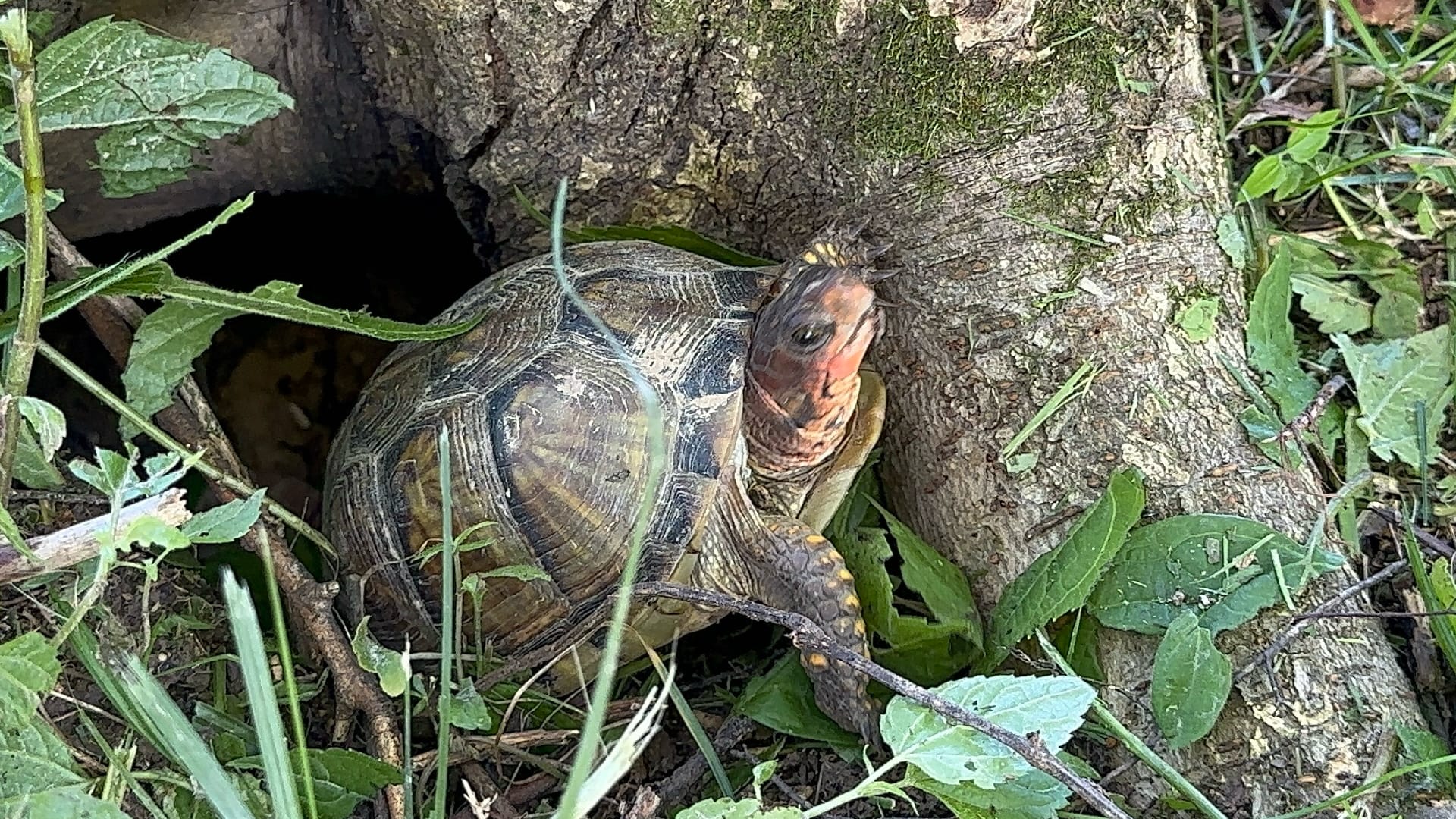
A turtle sits among green plants and tree roots near the ground. The turtle has a brown and tan shell with ring patterns, and you can see its head, legs, and long tail. The turtle appears to be resting in its natural habitat surrounded by leaves and grass.
🔬 Scientific Phenomena
The anchoring phenomenon shown is animal adaptation for survival. This turtle demonstrates how animals have special body parts (structures) that help them survive in their environment. The turtle's hard shell protects it from predators, while its position near plants and shelter shows how animals choose safe places to live. The shell's coloring helps it blend in with the natural surroundings, making it harder for predators to spot.
📚 Core Science Concepts
- Animal Structures and Functions: The turtle's shell serves as protection, its legs help it move on land, and its coloring provides camouflage.
- Habitat Requirements: Animals need food, water, shelter, and space to survive. This turtle has found a habitat that meets these basic needs.
- Life Cycles and Growth: The ring patterns on the turtle's shell can indicate age and growth over time, similar to tree rings.
- Behavioral Adaptations: The turtle's choice to rest in a sheltered area demonstrates how animals behave in ways that help them survive.
Pedagogical Tip: Use the "See, Think, Wonder" thinking routine with this image. Have students first observe what they see, then think about what they notice, and finally wonder about questions they have. This builds scientific observation skills.
UDL Suggestions: Provide multiple ways for students to share observations by offering options like drawing, verbal descriptions, or acting out turtle movements. This supports different learning preferences and abilities.
🔍 Zoom In / Zoom Out Concepts
- Zoom In: Inside the turtle's shell are calcium carbonate layers that grow stronger over time. The turtle's cells work together to repair and grow the shell throughout its life.
- Zoom Out: This turtle is part of a larger ecosystem where it helps control plant growth by eating vegetation and provides food for larger predators, maintaining the balance of nature in its habitat.
🤔 Potential Student Misconceptions
- Misconception: Turtles can come out of their shells like taking off clothes.
Clarification: A turtle's shell is part of its skeleton and cannot be removed - it's permanently attached to their body.
- Misconception: All turtles live in water.
Clarification: Some turtles live on land (tortoises), some in water, and some in both environments depending on their species.
- Misconception: Turtles are slow because they're lazy.
Clarification: Turtles move slowly to conserve energy and because their heavy shells make quick movement difficult, but this helps them survive.
🎓 NGSS Connections
Performance Expectation: 3-LS4-3: Construct an argument with evidence that in a particular habitat some organisms can survive well, some survive less well, and some cannot survive at all.
Disciplinary Core Ideas:
- : Environmental changes affect organisms
- : Growth and development of organisms
- : Biodiversity and humans
Crosscutting Concepts:
-
-
💬 Discussion Questions
- What body parts help this turtle survive in its environment? (Bloom's: Analyze | DOK: 2)
- How might this turtle's life be different if it lived in a desert instead of this grassy area? (Bloom's: Evaluate | DOK: 3)
- What patterns do you notice on the turtle's shell and what might they tell us? (Bloom's: Apply | DOK: 2)
- If you were designing a new animal for this habitat, what features would you give it to help it survive? (Bloom's: Create | DOK: 4)
📖 Science Vocabulary
- Adaptation: A special feature that helps an animal survive in its environment.
- Habitat: The place where an animal lives and finds everything it needs to survive.
- Camouflage: Colors or patterns that help an animal blend in with its surroundings.
- Predator: An animal that hunts and eats other animals.
- Structure: A body part of an animal that has a special job or function.
🔗 Cross-Curricular Ideas
- Math - Measuring and Counting: Have students measure the turtle's shell using non-standard units (like paper clips or blocks) and create a bar graph showing the measurements of different turtles in the class. Students can also count the ring patterns on the shell to practice skip counting by 2s or 5s.
- ELA - Animal Research and Writing: Students can read informational texts about turtles and write simple fact cards or short paragraphs describing what they learned. They could create a "Turtle Field Guide" with illustrations and descriptive sentences about different turtle species and their habitats.
- Art - Shell Pattern Design: Students can create their own turtle shell designs using natural colors and patterns inspired by the photo. They can use colored pencils, paint, or collage materials to design unique shells and explain how their color patterns would help their imaginary turtle survive in a specific habitat.
- Social Studies - Animal Care and Responsibility: Connect to citizenship by discussing how humans can protect turtles and their habitats. Students can learn about local conservation efforts, create "Help Our Turtles" posters, or research rules about keeping turtles as pets responsibly.
🚀 STEM Career Connection
- Herpetologist — Studies reptiles and amphibians — snakes, lizards, frogs and turtles.
- Try it: Look at the turtle's shell and count the visible rings, then predict how old the turtle might be. (Practice: Analyzing and Interpreting Data)
- Tools: snake hooks, pitfall traps, temperature probes, a field notebook
- Where they work: deserts and wetlands, zoos, natural history museums, universities
- Meet one: Earyn McGee — What happens to desert lizards when the streams they live near dry up.
- Median pay: /year — "Zoologists and wildlife biologists"
- Conservation Biologist — Works out which plants and animals are in trouble, and what would help them recover.
- Try it: Discuss what might happen if this turtle's habitat changed, and list ways to protect it. (Practice: Analyzing and Interpreting Data)
- Tools: population surveys, GPS trackers, habitat maps, trail cameras
- Where they work: nature reserves, conservation charities, government agencies, universities
- Meet one: Tierra Curry — Which plants and animals are closest to disappearing, and what it takes to save them.
- Median pay: /year — "Zoologists and wildlife biologists"
Wage figures are median annual wages for the U.S. occupation named after each one, from the U.S. Bureau of Labor Statistics, Occupational Employment and Wage Statistics (OEWS), national, May 2025. Several careers share one occupation, so their figures match.