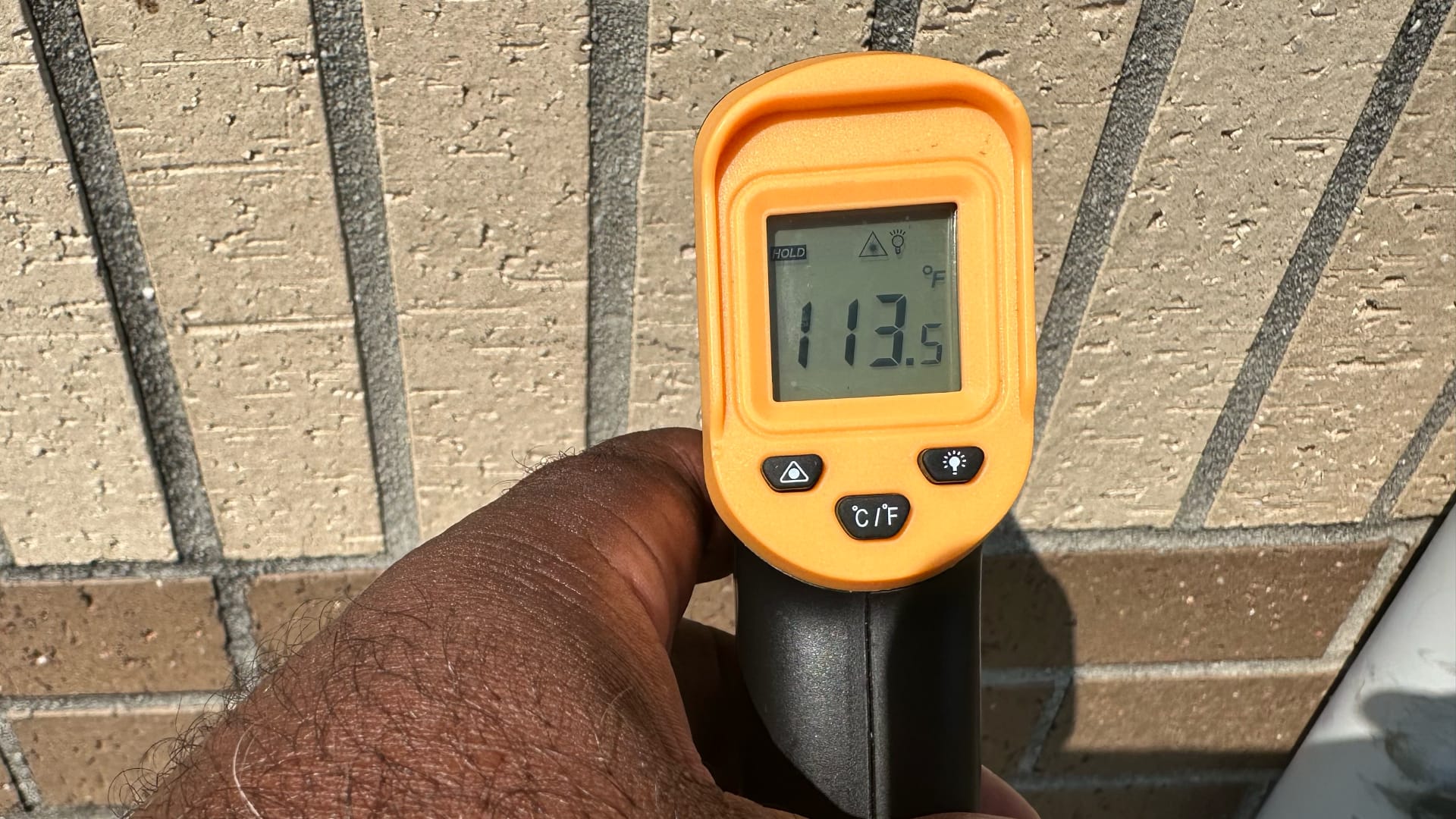
📸 Photo Description
A person is holding an orange infrared thermometer that shows a temperature reading of 113.5 degrees Fahrenheit on its digital screen. The thermometer is pointed at a brick patio surface on a sunny day. This special thermometer can measure how hot something is without touching it.
🔬 Scientific Phenomena
The anchoring phenomenon is non-contact temperature measurement using infrared radiation. All objects emit invisible infrared energy (heat waves) based on their temperature. The infrared thermometer contains a special sensor that detects these heat waves and converts them into a temperature reading on the digital display. This works because warmer objects give off more infrared energy than cooler objects, allowing the device to calculate temperature from a distance.
📚 Core Science Concepts
- Heat Transfer and Radiation - All objects give off invisible heat energy called infrared radiation, and warmer objects emit more energy than cooler objects.
- Temperature Measurement - Temperature tells us how hot or cold something is, and we can measure it using different tools like thermometers.
- Technology and Tools - Scientists and engineers create special instruments to help us observe and measure things we cannot see or touch safely.
- Energy and Matter - Heat is a form of energy that moves from warmer objects to cooler objects and can be detected even when we're not touching the object.
Pedagogical Tip: Have students predict temperatures of different classroom objects before measuring them with a regular thermometer, then discuss how an infrared thermometer could measure the same objects from far away.
UDL Suggestions: Provide multiple ways for students to record temperature data - through drawings, numbers, color coding (red for hot, blue for cool), or digital photos of thermometer readings to support diverse learning needs.
🔍 Zoom In / Zoom Out Concepts
- Zoom In: At the molecular level, heat is actually tiny particles (molecules) moving faster or slower. When molecules move fast, the object feels hot. When they move slowly, the object feels cold. The infrared thermometer detects the energy from these moving molecules.
- Zoom Out: This technology connects to weather systems, where meteorologists use infrared satellites to measure temperatures of clouds, land, and oceans from space to predict weather patterns and track storms across the entire planet.
🤔 Potential Student Misconceptions
- Misconception: The thermometer shoots heat rays at objects to measure them.
Clarification: The thermometer only receives heat energy that objects are already giving off naturally - it doesn't send anything out.
- Misconception: Only "hot" things give off heat energy.
Clarification: All objects give off some heat energy, even ice cubes, but warmer objects give off more energy than cooler objects.
- Misconception: You need to touch something to know its temperature.
Clarification: While contact thermometers work by touching, infrared thermometers can measure temperature from far away by detecting invisible heat waves.
🎓 NGSS Connections
- Performance Expectation: 3-PS2-1 - Plan and conduct an investigation to provide evidence of the effects of balanced and unbalanced forces on the motion of an object
- Disciplinary Core Ideas: - Energy can be transferred from place to place by heat
- Crosscutting Concepts: - Patterns in nature can be observed and used as evidence
- Science and Engineering Practices: Planning and carrying out investigations using tools and technologies
💬 Discussion Questions
- What do you think would happen if we pointed this thermometer at different objects around our classroom? (Bloom's: Predict | DOK: 2)
- Why might this type of thermometer be more useful than a regular thermometer in some situations? (Bloom's: Analyze | DOK: 3)
- How do you think the temperature reading would change if we measured the same brick at different times of day? (Bloom's: Hypothesize | DOK: 2)
- What other tools or technologies help us measure things we cannot see or touch? (Bloom's: Apply | DOK: 2)
📖 Science Vocabulary
- Infrared: Invisible heat energy that all objects give off
- Temperature: A measurement that tells us how hot or cold something is
- Radiation: Energy that travels through space without needing to touch anything
- Sensor: A part of a tool that detects or feels something in the environment
- Digital display: A screen that shows numbers or information electronically
🔗 Cross-Curricular Ideas
- Math Connection - Data Collection and Graphing: Have students measure temperatures of 5-6 different classroom objects using a regular thermometer, then create a bar graph or picture graph to show which objects are hottest and coolest. Students can order temperatures from least to greatest and discuss patterns they observe.
- ELA Connection - Descriptive Writing: Ask students to write or draw about what they think objects feel like based on their temperature readings. They can create sentences using temperature words like "hot," "warm," "cool," and "cold" to describe their observations, then share their descriptions with the class.
- Art Connection - Color Temperature: Create an art project where students use warm colors (reds, oranges, yellows) to represent hot objects and cool colors (blues, purples, greens) to represent cool objects. Students can draw scenes with objects and color-code them based on whether they would be hot or cold to the touch.
- Social Studies Connection - Community Helpers: Discuss how different community workers use thermometers and temperature measurements in their jobs (firefighters checking building temperatures, doctors measuring fevers, chefs cooking food). Students can interview family members about how they use temperature in their work.
🚀 STEM Career Connection
- Robotics Engineer — Builds machines that sense their surroundings and act on what they find.
- Try it: Design and build a simple robot arm that can hold an infrared thermometer and measure the temperature of objects at a distance, planning for how it will move and aim. (Practice: Planning and carrying out investigations)
- Tools: microcontrollers, motors and servos, sensors, programming environments
- Where they work: robotics companies, factories, research labs, universities
- Meet one: Shini Somara — How air and water flow around things, worked out on a computer before anything is built.
- Median pay: /year — "Engineers, all other"
- Automotive Technician — Diagnoses why a vehicle is not working and fixes it — increasingly with a computer as well as a wrench.
- Try it: Use the infrared thermometer to 'diagnose' the temperature of different parts of a toy car or a model engine, predicting which parts might be warmer or cooler and why. (Practice: Planning and carrying out investigations)
- Tools: diagnostic scanners, hydraulic lifts, torque wrenches, multimeters
- Where they work: repair shops, dealerships, fleet garages, racing teams
- Median pay: /year — "Automotive service technicians and mechanics"
Wage figures are median annual wages for the U.S. occupation named after each one, from the U.S. Bureau of Labor Statistics, Occupational Employment and Wage Statistics (OEWS), national, May 2025. Several careers share one occupation, so their figures match.