📸 Photo Description
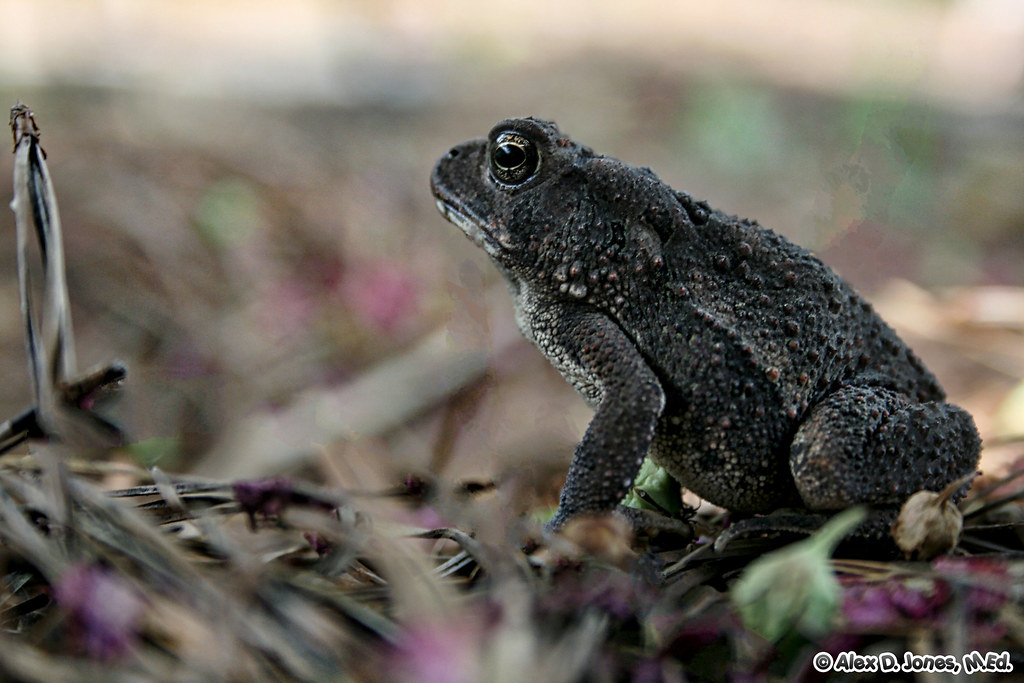
This dark-colored toad sits on the ground covered with small pieces of leaves and purple flowers. The toad has bumpy, wet-looking skin and big golden eyes that help it see in dim light. Water droplets cover its body, showing that toads need to stay moist to survive.
🔬 Scientific Phenomena
The anchoring phenomenon here is amphibian adaptation to terrestrial environments. This toad demonstrates how amphibians have evolved specific traits to survive both in water and on land. The bumpy skin texture helps with camouflage and protection, while the moist skin allows for cutaneous respiration (breathing through skin). The prominent eyes indicate crepuscular/nocturnal behavior patterns, and the overall body structure shows adaptations for both aquatic and terrestrial locomotion.
📚 Core Science Concepts
- Animal Adaptations: The toad's physical features help it survive in its environment - bumpy skin for protection and camouflage, large eyes for seeing at night, and moist skin for breathing.
- Life Cycles: Toads undergo metamorphosis, starting as eggs, becoming tadpoles that live in water, then transforming into adult toads that can live on land.
- Habitat Requirements: Toads need both water and land environments during their lifetime, making them dependent on healthy ecosystems.
- Camouflage and Protection: The toad's dark, textured skin helps it blend in with soil, leaves, and shadows to hide from predators.
Pedagogical Tip: Use a "Think-Pair-Share" strategy when introducing animal adaptations. Have students first observe the image individually, then discuss with a partner what they notice, before sharing observations with the whole class. This builds observation skills and scientific vocabulary.
UDL Suggestions: Provide multiple ways for students to demonstrate their understanding of toad adaptations: drawing and labeling, creating a movement sequence showing metamorphosis, or building a model habitat. This supports different learning preferences and abilities.
🔍 Zoom In / Zoom Out Concepts
- Zoom In: At the cellular level, the toad's skin contains special cells that can absorb oxygen and water directly from the environment. Mucus glands in the skin produce a protective coating that prevents the toad from drying out and helps fight off harmful bacteria.
- Zoom Out: This toad is part of a larger wetland ecosystem that includes ponds, streams, and surrounding land areas. Toads help control insect populations by eating mosquitoes and flies, while also serving as food for birds, snakes, and other predators, making them an important link in the food web.
🤔 Potential Student Misconceptions
- Misconception: "Toads are slimy and will give you warts if you touch them."
Reality: Toads have dry, bumpy skin (not slimy like frogs), and they cannot give humans warts. The bumps are natural skin texture, not warts.
- Misconception: "Toads and frogs are exactly the same animal."
Reality: While both are amphibians, toads typically have drier, bumpier skin and spend more time on land, while frogs have smoother, moister skin and stay closer to water.
- Misconception: "Toads live their whole lives on land."
Reality: Toads need water to lay their eggs and their babies (tadpoles) must live in water before becoming adults.
🎓 NGSS Connections
- Performance Expectation: 3-LS4-3 - Construct an argument with evidence that in a particular habitat some organisms can survive well, some survive less well, and some cannot survive at all.
- Disciplinary Core Ideas: - Environmental changes can affect organisms, and - Animals have body parts that capture and convey information for survival
- Crosscutting Concepts: - The shape and stability of structures are related to their function
💬 Discussion Questions
- "What body parts help this toad survive in its environment, and how do they work?" (Bloom's: Analyze | DOK: 2)
- "How might this toad's life be different during wet seasons compared to dry seasons?" (Bloom's: Evaluate | DOK: 3)
- "What would happen to the toad if all the nearby ponds dried up permanently?" (Bloom's: Synthesize | DOK: 3)
- "How are this toad's adaptations similar to or different from other animals you know?" (Bloom's: Compare | DOK: 2)
📖 Science Vocabulary
- Adaptation: A special body part or behavior that helps an animal survive in its home.
- Amphibian: An animal that can live both in water and on land during its lifetime.
- Metamorphosis: The process of changing from one form to another as an animal grows up.
- Camouflage: Colors or patterns that help an animal blend in with its surroundings.
- Habitat: The natural place where an animal lives and finds everything it needs to survive.
- Nocturnal: Active during the night time when it's dark.
🔗 Cross-Curricular Ideas
- ELA - Animal Fact Writing: Students write 3-5 sentences about toad adaptations using the "I notice, I wonder, I learned" format. They can illustrate their writing and create a classroom "Amphibian Encyclopedia" book where all student pages are compiled together.
- Math - Toad Life Cycle Timeline: Create a visual timeline showing the stages of toad metamorphosis (eggs → tadpoles → toadlets → adult toads) and estimate how many days or weeks each stage lasts. Students can measure and draw the timeline to scale, practicing measurement and sequencing skills.
- Art - Camouflage Collage: Students create a mixed-media collage showing a toad in its natural habitat using leaves, twigs, soil, and painted elements. This reinforces understanding of camouflage while developing fine motor skills and artistic expression.
- Social Studies - Wetland Community Map: Students research and create a map or diorama of a wetland habitat showing where different organisms live (toads, frogs, fish, plants, insects). This connects to understanding communities and how different organisms depend on shared spaces.
🚀 STEM Career Connection
- Herpetologist — Studies reptiles and amphibians — snakes, lizards, frogs and turtles.
- Try it: Compare the life cycle of a toad (egg, tadpole, adult) to the life cycle of a butterfly and identify one similarity and one difference. (Practice: Analyzing and Interpreting Data)
- Tools: snake hooks, pitfall traps, temperature probes, a field notebook
- Where they work: deserts and wetlands, zoos, natural history museums, universities
- Meet one: Earyn McGee — What happens to desert lizards when the streams they live near dry up.
- Median pay: /year — "Zoologists and wildlife biologists"
- Biologist — Studies living things of every kind and what keeps them alive.
- Try it: Research and list three adaptations of toads that help them breathe on land and in water. (Practice: Analyzing and Interpreting Data)
- Tools: microscopes, sample jars, measuring tools, a field notebook
- Where they work: laboratories, field sites, museums, universities
- Meet one: Sandra Díaz — What a plant's leaves, wood and shape tell you about how it lives — and how those traits add up across a whole ecosystem.
- Median pay: /year — "Biological scientists, all other"
- Wetland Ecologist — Studies marshes, swamps and bogs — places that are neither quite land nor quite water.
- Try it: Describe how a toad's need for both land and water makes it dependent on wetland environments. (Practice: Analyzing and Interpreting Data)
- Tools: waders, water level gauges, sediment corers, plant keys
- Where they work: marshes and swamps, water agencies, conservation groups, universities
- Meet one: Sandra Díaz — What a plant's leaves, wood and shape tell you about how it lives — and how those traits add up across a whole ecosystem.
- Median pay: /year — "Environmental scientists and specialists, including health"
Wage figures are median annual wages for the U.S. occupation named after each one, from the U.S. Bureau of Labor Statistics, Occupational Employment and Wage Statistics (OEWS), national, May 2025. Several careers share one occupation, so their figures match.