📸 Photo Description
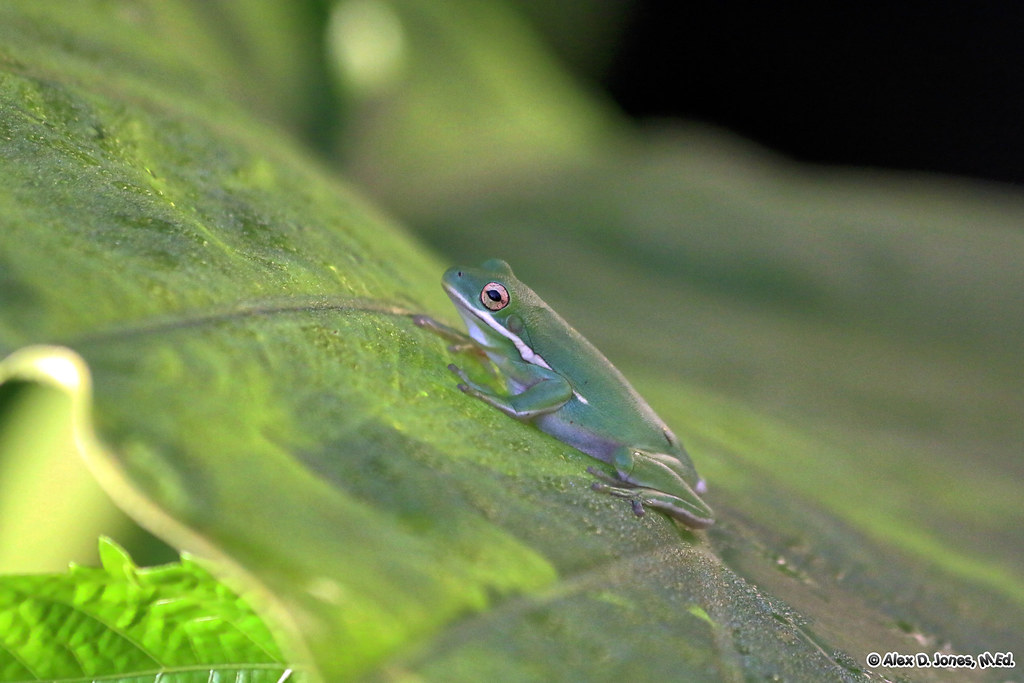
A small green tree frog sits on a large green leaf. The frog has smooth, bright green skin and big red eyes. Its tiny toes help it grip the leaf as it rests in its forest home.
🔬 Scientific Phenomena
This image represents the Anchoring Phenomenon of animal adaptation for survival in specific habitats. The tree frog displays multiple adaptations that allow it to thrive in its arboreal (tree-dwelling) environment. Its green coloration provides camouflage among leaves, protecting it from predators. The specialized toe pads contain microscopic structures that create adhesive forces, enabling the frog to climb vertical surfaces and hang upside down on leaves. The large eyes indicate enhanced vision for hunting insects in low-light conditions typical of forest canopies.
📚 Core Science Concepts
- Animal Adaptations: Physical features that help animals survive in their environment, such as the frog's green color for hiding and sticky toe pads for climbing.
- Habitat Requirements: Living things need specific conditions to survive, including food, water, shelter, and space that match their body features.
- Camouflage: Some animals have colors or patterns that help them blend into their surroundings to avoid being eaten or to catch prey.
- Life Cycles: Frogs undergo metamorphosis, changing from tadpoles that live in water to adult frogs that can live on land and in trees.
Pedagogical Tip: Use the "See, Think, Wonder" thinking routine with this image. Have students first observe what they see, then share what they think is happening, and finally ask questions about what they wonder. This builds scientific observation skills and generates authentic student questions to drive inquiry.
UDL Suggestions: Provide multiple ways for students to demonstrate their understanding of frog adaptations - they could draw and label, act out the adaptations through movement, create a verbal explanation, or build a model. This supports diverse learners and learning preferences while maintaining rigorous science content.
🔍 Zoom In / Zoom Out Concepts
- Zoom In: The frog's toe pads contain millions of tiny hairs called setae that interact with leaf surfaces at the molecular level, creating van der Waals forces that provide adhesion without being sticky to touch.
- Zoom Out: This tree frog is part of a complex rainforest ecosystem where it serves as both predator (eating insects) and prey (food for birds and snakes), contributing to energy flow and nutrient cycling that maintains forest health across entire watersheds.
🤔 Potential Student Misconceptions
- Misconception: Frogs are slimy and wet all the time.
Clarification: Tree frogs have smooth, moist skin that helps them breathe, but they're not slimy. The moisture helps oxygen pass through their skin.
- Misconception: All frogs live in ponds or water.
Clarification: While frogs need water to reproduce, many adult frogs like tree frogs spend most of their time on land or in trees, only returning to water to lay eggs.
- Misconception: Animals choose their colors to match their environment.
Clarification: Animals don't choose their adaptations. Over many generations, frogs with green coloration survived better in green environments, so green became common.
🎓 NGSS Connections
- Performance Expectation: 3-LS4-3 - Construct an argument with evidence that in a particular habitat some organisms can survive well, some survive less well, and some cannot survive at all.
- Disciplinary Core Ideas: - Environmental changes can affect organisms, and - Sometimes differences in characteristics give individuals advantages in surviving and reproducing.
- Crosscutting Concepts: - Students can identify how specific adaptations help frogs survive in their tree habitat.
💬 Discussion Questions
- What specific body parts help this frog survive in trees, and how does each part help? (Bloom's: Analyze | DOK: 2)
- If this green frog lived in a desert instead of a forest, what adaptations might help it survive better? (Bloom's: Evaluate | DOK: 3)
- How might this frog's life be different during the day compared to at night? (Bloom's: Apply | DOK: 2)
- What evidence from the photo shows this frog is well-adapted to its habitat? (Bloom's: Evaluate | DOK: 3)
📖 Science Vocabulary
- Adaptation: A special feature that helps an animal survive in its home.
- Habitat: The place where an animal lives and finds everything it needs.
- Camouflage: Colors or patterns that help animals blend in and hide.
- Predator: An animal that hunts and eats other animals.
- Prey: An animal that gets eaten by other animals.
- Metamorphosis: The process of changing from one form to another as an animal grows.
🔗 Cross-Curricular Ideas
- Math - Measurement & Comparison: Have students measure the length of tree frog pictures and compare sizes to other animals. Create a simple bar graph showing "How long is a tree frog compared to a grasshopper, butterfly, and ant?" This connects animal adaptations to mathematical thinking and data representation.
- ELA - Descriptive Writing: Students write "sensory poems" about being a tree frog, describing what they would see, hear, feel, and smell in the forest canopy. They can use descriptive words (green, sticky, smooth, cool) to create vivid imagery that reinforces vocabulary while developing writing skills.
- Art - Camouflage Collage: Students create a mixed-media collage showing a tree frog hiding among leaves using torn green paper, paint, and natural materials. This hands-on art project helps students understand why green coloration is an adaptation while developing fine motor skills and artistic expression.
- Social Studies - Habitat Preservation: Discuss why rainforests are important homes for tree frogs and other animals. Students can learn about different countries where tree frogs live and why protecting forests helps these animals survive, connecting to environmental stewardship and global awareness.
🚀 STEM Career Connection
- Herpetologist — Studies reptiles and amphibians — snakes, lizards, frogs and turtles.
- Try it: Compare the toe pads of a tree frog to the feet of a toad and explain the differences in function. (Practice: Analyzing and Interpreting Data)
- Tools: snake hooks, pitfall traps, temperature probes, a field notebook
- Where they work: deserts and wetlands, zoos, natural history museums, universities
- Meet one: Earyn McGee — What happens to desert lizards when the streams they live near dry up.
- Median pay: /year — "Zoologists and wildlife biologists"
- Conservation Biologist — Works out which plants and animals are in trouble, and what would help them recover.
- Try it: Research a local frog species and create a poster about its habitat needs and any threats it faces. (Practice: Analyzing and Interpreting Data)
- Tools: population surveys, GPS trackers, habitat maps, trail cameras
- Where they work: nature reserves, conservation charities, government agencies, universities
- Meet one: Tierra Curry — Which plants and animals are closest to disappearing, and what it takes to save them.
- Median pay: /year — "Zoologists and wildlife biologists"
Wage figures are median annual wages for the U.S. occupation named after each one, from the U.S. Bureau of Labor Statistics, Occupational Employment and Wage Statistics (OEWS), national, May 2025. Several careers share one occupation, so their figures match.