📸 Photo Description
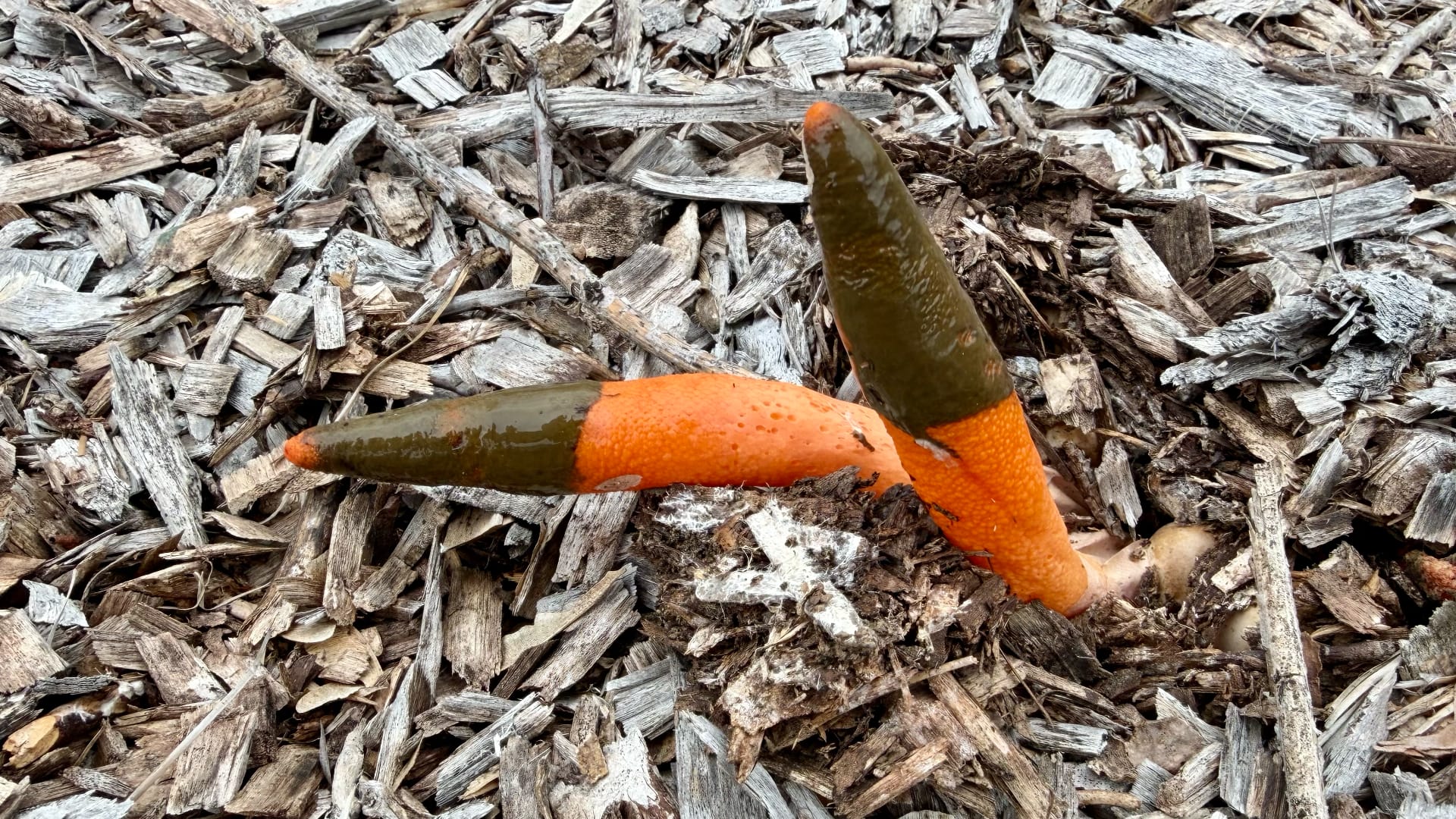
This bright orange mushroom is growing up from wood chips on the ground. The mushroom has two thick, finger-like parts that look slimy and wet. One part stands straight up while the other leans to the side.
🔬 Scientific Phenomena
This image shows a stinkhorn mushroom emerging from decomposing organic matter. The anchoring phenomenon is fungal decomposition and reproduction. Stinkhorn mushrooms grow from spores and help break down dead plant material like wood chips. They produce a strong smell to attract flies and other insects, which then carry their spores to new locations. This demonstrates how fungi play a crucial role in nature's recycling system by decomposing organic matter and returning nutrients to the soil.
📚 Core Science Concepts
- Living vs. Non-living Classification: Mushrooms are living organisms that grow, reproduce, and respond to their environment, even though they don't move like animals or make food like plants.
- Decomposition Process: Fungi break down dead organic matter (like wood chips) into smaller pieces, returning nutrients to the soil for other plants to use.
- Life Cycles: Mushrooms represent the reproductive stage of fungi, similar to how flowers are the reproductive parts of plants.
- Interdependence in Ecosystems: Stinkhorn mushrooms depend on insects for spore dispersal, while insects may benefit from the mushroom as a food source.
Pedagogical Tip: Use the "Think-Pair-Share" strategy when introducing mushrooms. Have students first think individually about what they know about mushrooms, then pair with a partner to discuss, and finally share with the class. This helps activate prior knowledge and reveals misconceptions early.
UDL Suggestions: Provide multiple ways for students to observe fungi by offering magnifying glasses, digital microscopes, and printed close-up photos. Some students may be hesitant to touch or get close to mushrooms, so having various observation tools ensures all learners can engage with the content.
🔍 Zoom In / Zoom Out Concepts
Zoom In: At the microscopic level, the mushroom is made of tiny thread-like structures called hyphae that spread through the wood chips. These microscopic threads secrete enzymes that break down the wood fibers into nutrients the fungus can absorb.
Zoom Out: This mushroom is part of a larger forest ecosystem where fungi serve as nature's recyclers. They work alongside bacteria and other decomposers to break down fallen logs, dead leaves, and other organic matter, creating rich soil that supports the growth of trees, plants, and the animals that depend on them.
🤔 Potential Student Misconceptions
- Misconception: "Mushrooms are plants because they grow from the ground."
Clarification: Mushrooms are fungi, which are neither plants nor animals. Unlike plants, they cannot make their own food through photosynthesis and must get nutrients by breaking down other organic matter.
- Misconception: "All mushrooms are bad or poisonous."
Clarification: While some mushrooms can be harmful, many are beneficial to ecosystems and some are safe to eat. Fungi play important roles as decomposers in nature.
- Misconception: "The mushroom is the whole organism."
Clarification: The visible mushroom is just the reproductive part, like a flower on a plant. Most of the fungus lives underground or inside the material it's decomposing.
🎓 NGSS Connections
- Performance Expectation: 3-LS4-3: Construct an argument that some animals form groups that help members survive.
- Disciplinary Core Ideas: and
- Crosscutting Concepts: and
💬 Discussion Questions
- What do you think would happen to all the dead leaves and fallen trees in a forest if there were no mushrooms or other decomposers? (Bloom's: Analyze | DOK: 3)
- How might this orange mushroom be similar to and different from the plants in your garden? (Bloom's: Compare | DOK: 2)
- Why do you think this mushroom grew in the wood chips instead of on the concrete sidewalk? (Bloom's: Analyze | DOK: 2)
- What evidence can you observe that tells us this mushroom is a living thing? (Bloom's: Evaluate | DOK: 2)
📖 Science Vocabulary
- Fungus: A living thing that gets food by breaking down dead plants and animals.
- Decomposer: An organism that breaks down dead materials and returns nutrients to the soil.
- Spore: A tiny seed-like structure that fungi use to reproduce and spread.
- Organism: Any living thing, including plants, animals, and fungi.
- Nutrient: A substance that living things need to grow and stay healthy.
- Ecosystem: All the living and non-living things in an area that interact with each other.
🔗 Cross-Curricular Ideas
- ELA - Descriptive Writing: Have students write a short paragraph describing the mushroom using sensory words (orange, slimy, bumpy, damp). They can practice adjectives and create a "Mushroom Description" bulletin board. This connects writing standards to scientific observation.
- Math - Measurement and Growth: Students can measure the height and width of mushrooms they find or observe in photos. They can create bar graphs comparing the sizes of different mushrooms and practice measurement skills with non-standard and standard units.
- Art - Nature Observation Drawings: Students can sketch mushrooms they observe or use the photo as inspiration for detailed drawings. They can experiment with colored pencils to capture the orange and dark green colors, practicing fine motor skills and observation of natural details.
- Social Studies - Community Helpers: Connect decomposers to community helpers by discussing how both "clean up" and help things work better. Mushrooms clean up forests, just like sanitation workers clean up communities. This helps students understand interdependence and roles in systems.
🚀 STEM Career Connection
- Mycologist — Studies fungi — mushrooms, moulds and yeasts, and the hidden threads that connect them underground.
- Try it: Design a simple experiment to test what conditions help a mushroom grow, like moisture or darkness. (Practice: Constructing Explanations and Designing Solutions)
- Tools: spore prints, petri dishes, microscopes, collecting baskets
- Where they work: forests, laboratories, botanical gardens, universities
- Meet one: Giuliana Furci — Fungi nobody had catalogued before, and getting them protected the way animals and plants are.
- Median pay: /year — "Microbiologists"
- Soil Scientist — Studies dirt seriously — what it is made of, what lives in it, and what will grow in it.
- Try it: Collect soil samples from different locations and observe what organic materials are present. (Practice: Constructing Explanations and Designing Solutions)
- Tools: soil augers, pH meters, sieve stacks, sample bags
- Where they work: farms and fields, testing laboratories, government agencies, universities
- Meet one: Asmeret Asefaw Berhe — How soil stores carbon, and why that makes dirt part of the climate story.
- Median pay: /year — "Soil and plant scientists"
Wage figures are median annual wages for the U.S. occupation named after each one, from the U.S. Bureau of Labor Statistics, Occupational Employment and Wage Statistics (OEWS), national, May 2025. Several careers share one occupation, so their figures match.