📸 Photo Description
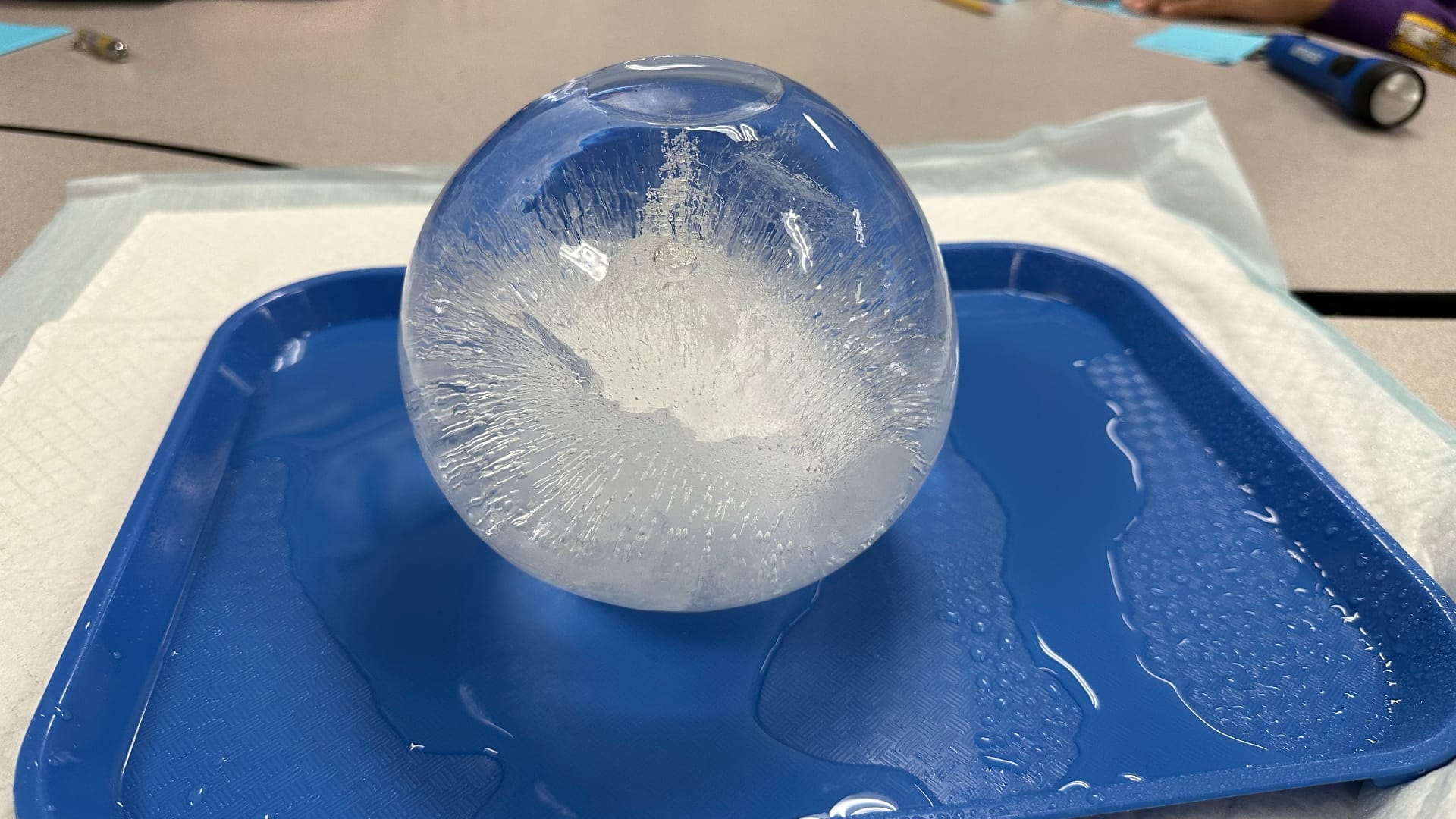
A large, clear ice ball sits in a blue plastic tray. The ice has a cloudy white center that looks like it froze from the outside in. Water droplets cover the tray, showing that the ice is melting at room temperature.
🔬 Scientific Phenomena
This image shows the Anchoring Phenomenon of ice melting and the freezing process that created the ice ball's unique appearance. The cloudy center formed because water freezes from the outside toward the center, trapping air bubbles and impurities in the middle. The melting occurs because the ice absorbs thermal energy from the warmer air around it, causing the solid water molecules to gain enough energy to change back into liquid water.
📚 Core Science Concepts
- States of Matter: Water exists as a solid (ice), liquid (water), and gas (water vapor), and can change between these states when energy is added or removed.
- Heat Transfer: Thermal energy moves from warmer objects (air) to cooler objects (ice), causing the ice to melt.
- Freezing Patterns: Water freezes from the outside in, which explains why the ice ball has a clear outer layer and cloudy center.
- Physical Changes: Melting is a reversible physical change where the substance stays the same but changes form.
Pedagogical Tip: Use ice investigations early in the day so students can observe changes over time. Have students make predictions about what will happen and return to check their hypotheses throughout the lesson.
UDL Suggestions: Provide multiple ways for students to record observations: drawing, writing, verbal descriptions, or taking photos. This supports different learning preferences and abilities while building scientific documentation skills.
🔍 Zoom In / Zoom Out Concepts
- Zoom In: At the molecular level, water molecules in ice are locked in a rigid crystal structure. When heat energy is added, these molecules vibrate faster and break free from their fixed positions, allowing them to flow as liquid water.
- Zoom Out: This melting process connects to the larger water cycle on Earth. Ice melting in glaciers, lakes, and rivers provides fresh water for ecosystems and contributes to sea level changes that affect coastlines worldwide.
🤔 Potential Student Misconceptions
- Misconception: "Ice is colder than water." Reality: Ice and water can be the same temperature. Ice melts when it absorbs energy, not necessarily because the air is "hot."
- Misconception: "The ice disappears when it melts." Reality: The ice changes form but doesn't disappear - it becomes the same amount of water.
- Misconception: "Only fire or the sun can melt ice." Reality: Ice will melt in any environment warmer than 32°F (0°C), including normal room temperature.
🎓 NGSS Connections
- Performance Expectation: 2-PS1-1 Plan and conduct an investigation to describe and classify different kinds of materials by their observable properties
- Disciplinary Core Idea: - Different kinds of matter exist and many of them can be either solid or liquid, depending on temperature
- Crosscutting Concept: - Patterns in the natural world can be observed and used as evidence
- Science and Engineering Practice: Planning and carrying out investigations to answer questions
💬 Discussion Questions
- What do you think caused the ice ball to have a cloudy center and clear edges? (Bloom's: Analyze | DOK: 2)
- How could we speed up or slow down the melting process? (Bloom's: Apply | DOK: 2)
- What patterns do you notice about how the ice is melting? (Bloom's: Understand | DOK: 1)
- If we put this melted water back in the freezer, what do you predict will happen and why? (Bloom's: Evaluate | DOK: 3)
📖 Science Vocabulary
- Melting: When a solid changes to a liquid by warming up
- Thermal energy: Heat energy that moves from warm things to cool things
- Physical change: When something changes how it looks but stays the same material
- States of matter: The different forms that materials can take like solid, liquid, or gas
- Freezing: When a liquid changes to a solid by cooling down
🔗 Cross-Curricular Ideas
- Math - Measurement and Data: Have students measure the ice ball's height and width using non-standard units (like blocks or paper clips) at the beginning of the lesson, then measure again after 15 minutes, 30 minutes, and 1 hour. Students can create a simple graph showing how the size changes over time, practicing data collection and comparison skills.
- ELA - Descriptive Writing: Ask students to write or dictate detailed descriptions of the ice ball using sensory words (what they see, hear, and feel). This builds vocabulary and observation skills while connecting to the science content. Students can also sequence events in order: "First the ice ball was big. Then it started to melt. Finally, it became a puddle of water."
- Art - Frozen Sculptures: Have students create their own ice balls or ice sculptures using water balloons or containers, then observe and draw what happens as the ice melts over several days. This hands-on experience deepens understanding while allowing for creative expression and documentation through art.
- Social Studies - Community Helpers: Connect to jobs that involve ice and water management, such as city workers who remove ice from sidewalks in winter, water treatment plant workers, or meteorologists who study weather patterns and ice formation.
🚀 STEM Career Connection
- Physicist — Works out the rules that matter and energy follow, from the very small to the whole universe.
- Try it: Design an experiment to see how the temperature of the air affects how fast an ice ball melts. (Practice: Planning and carrying out investigations)
- Tools: lasers, detectors, vacuum chambers, computer simulations
- Where they work: research laboratories, particle accelerators, observatories, universities
- Meet one: Chanda Prescod-Weinstein — Dark matter — the invisible material that makes up most of the universe.
- Median pay: /year — "Physicists"
- Materials Engineer — Chooses and shapes the right material for a job, and tests it until it fails.
- Try it: Test which material, like plastic or cloth, can keep an ice ball frozen for the longest time. (Practice: Planning and carrying out investigations)
- Tools: tensile testers, furnaces, microscopes, hardness testers
- Where they work: manufacturing plants, product design firms, testing labs, universities
- Meet one: Ainissa Ramirez — How to make metal stick to glass and ceramics — she invented a solder that does it.
- Median pay: /year — "Materials engineers"
Wage figures are median annual wages for the U.S. occupation named after each one, from the U.S. Bureau of Labor Statistics, Occupational Employment and Wage Statistics (OEWS), national, May 2025. Several careers share one occupation, so their figures match.