📸 Photo Description
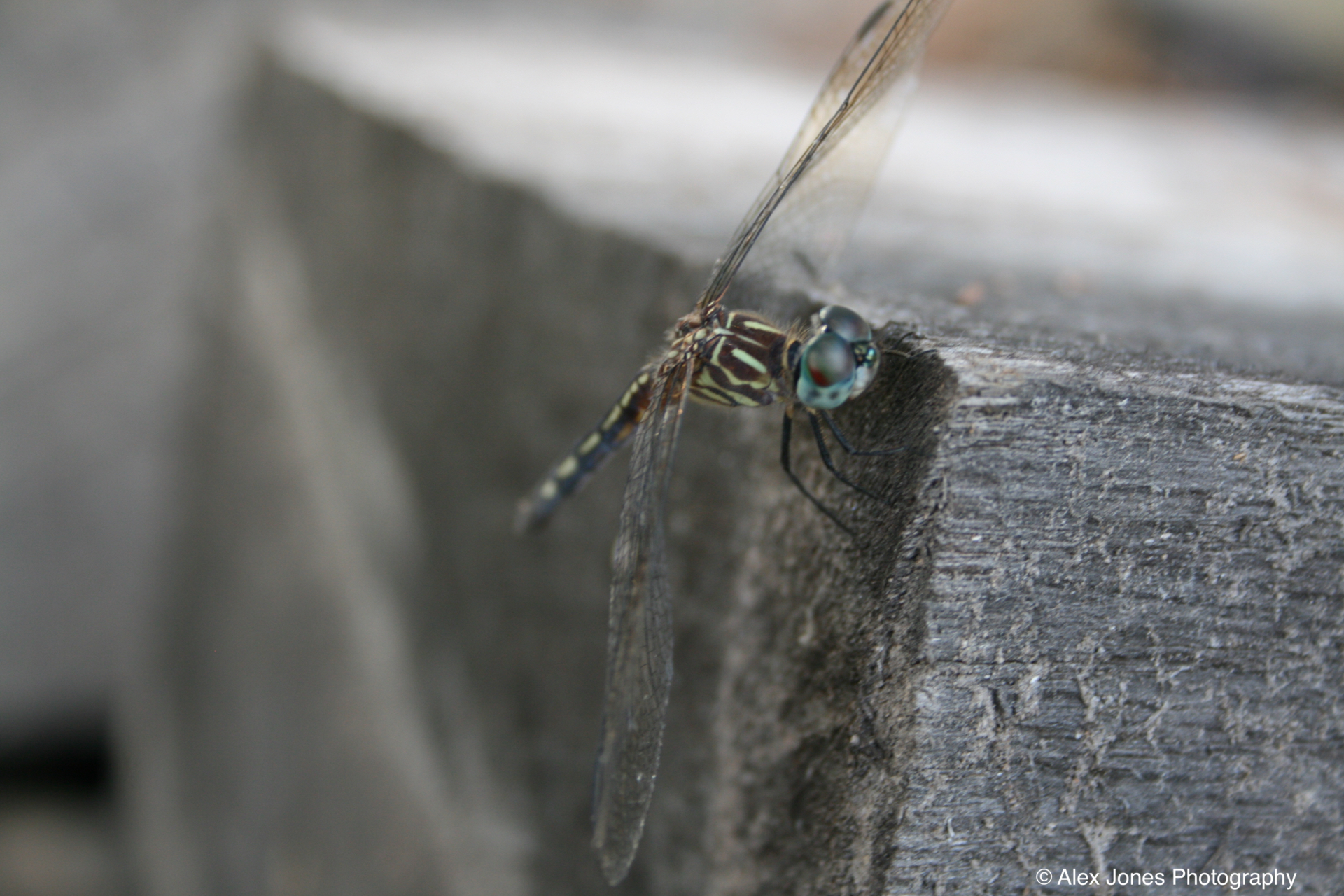
A dragonfly sits on a piece of wood with its big blue eyes and clear wings. The dragonfly has a long, thin body with yellow and black stripes. You can see its four wings spread out from its body.
🔬 Scientific Phenomena
This image shows the anchoring phenomenon of insect adaptation for survival. The dragonfly demonstrates specialized body structures that help it survive in its environment. Its large compound eyes provide excellent vision for hunting prey and avoiding predators. The four wings allow for incredible flight maneuvers, including hovering and flying backwards. The streamlined body reduces air resistance during flight, while the striped coloration may provide camouflage or warning signals to other animals.
📚 Core Science Concepts
- Animal Body Parts and Functions: Dragonflies have specialized structures like compound eyes for seeing, wings for flying, and strong legs for catching prey.
- Adaptation for Survival: The dragonfly's body parts help it survive by finding food, escaping danger, and moving through its environment.
- Life Cycles: Dragonflies undergo complete metamorphosis, starting as aquatic nymphs before transforming into flying adults.
- Habitat Requirements: Dragonflies need both water (for reproduction) and air (for adult life), showing how animals depend on their environment.
Pedagogical Tip: Use the "See-Think-Wonder" thinking routine when introducing this image. Have students observe what they see, think about what's happening, and wonder about questions they have. This builds scientific inquiry skills.
UDL Suggestions: Provide magnifying glasses for students to examine real dragonfly images or specimens up close. Create tactile models of dragonfly body parts using pipe cleaners and cellophane for students who benefit from hands-on learning experiences.
🔍 Zoom In / Zoom Out Concepts
Zoom In: The dragonfly's compound eyes contain thousands of individual lenses called ommatidia. Each tiny lens captures a small piece of the visual picture, which the dragonfly's brain combines to create a mosaic-like view of the world with incredible motion detection.
Zoom Out: Dragonflies are important predators in freshwater ecosystems, controlling mosquito populations and serving as food for birds, fish, and spiders. Their presence indicates healthy wetland environments, making them important indicator species for ecosystem health.
🤔 Potential Student Misconceptions
- Misconception: "Dragonflies are harmful and will sting people."
Reality: Dragonflies cannot sting humans and are actually beneficial because they eat mosquitoes and other pests.
- Misconception: "All insects have the same body parts."
Reality: While all insects have three body segments and six legs, they have different specialized parts like dragonflies' four wings versus butterflies' two pairs of different-sized wings.
- Misconception: "Dragonflies live their whole lives flying around."
Reality: Dragonflies spend most of their lives (up to several years) as aquatic nymphs underwater before becoming flying adults for just a few months.
🎓 NGSS Connections
- Performance Expectation: 3-LS4-3. Construct an argument with evidence that in a particular habitat some organisms can survive well, some survive less well, and some cannot survive at all.
- Disciplinary Core Ideas: Environmental Changes, Growth and Development of Organisms
- Crosscutting Concepts: ,
💬 Discussion Questions
- How do you think a dragonfly's large eyes help it survive in its environment? (Bloom's: Analyze | DOK: 2)
- What would happen to a dragonfly if all the ponds and streams in its habitat dried up? (Bloom's: Evaluate | DOK: 3)
- Compare the dragonfly's wings to a bird's wings - how are they similar and different? (Bloom's: Analyze | DOK: 2)
- Why might having four separate wings be better for a dragonfly than having two wings like a butterfly? (Bloom's: Evaluate | DOK: 3)
📖 Science Vocabulary
- Compound eyes: Special eyes made of many tiny lenses that help see movement very well
- Adaptation: A body part or behavior that helps an animal survive in its environment
- Predator: An animal that hunts and eats other animals for food
- Metamorphosis: The process of changing from one life stage to another, like a caterpillar becoming a butterfly
- Habitat: The natural place where an animal lives and finds everything it needs to survive
🔗 Cross-Curricular Ideas
- Mathematics - Measurement and Counting: Have students measure the wingspan of a dragonfly using a ruler or measuring tape. Students can then create a bar graph comparing the sizes of different insects (dragonflies, butterflies, ladybugs). This connects to measurement standards and data representation.
- English Language Arts - Descriptive Writing: Students can write descriptive paragraphs about the dragonfly using sensory words (what they see, hear, and imagine feeling). They could also read picture books about dragonflies and create their own "All About Dragonflies" informational booklet with illustrations.
- Art - Nature Illustration: Students can create detailed colored pencil or watercolor drawings of dragonflies, focusing on the intricate patterns of their wings and striped bodies. They could also create a mixed-media collage using tissue paper, cellophane, and metallic markers to represent the dragonfly's transparent wings and shimmering body.
- Social Studies - Habitats and Communities: Connect dragonflies to local ecosystems by taking a virtual or real field trip to a pond or wetland near the school. Students can learn about the different animals and plants that live together and how dragonflies play a role in their community.
🚀 STEM Career Connection
- Entomologist — Studies insects — how they live, what they eat, and the jobs they do in an ecosystem.
- Try it: Compare pictures of a dragonfly nymph and an adult dragonfly, and explain how one helps the other survive. (Practice: Constructing Explanations and Designing Solutions)
- Tools: insect nets, a hand lens, pinning boards, microscopes
- Where they work: museums, farms, insect labs, universities
- Meet one: Corrie Moreau — How ants evolved together with the bacteria that live inside them.
- Median pay: /year — "Zoologists and wildlife biologists"
- Biologist — Studies living things of every kind and what keeps them alive.
- Try it: Design a simple shelter that a dragonfly nymph could live in, explaining why it would be safe. (Practice: Constructing Explanations and Designing Solutions)
- Tools: microscopes, sample jars, measuring tools, a field notebook
- Where they work: laboratories, field sites, museums, universities
- Meet one: Sandra Díaz — What a plant's leaves, wood and shape tell you about how it lives — and how those traits add up across a whole ecosystem.
- Median pay: /year — "Biological scientists, all other"
Wage figures are median annual wages for the U.S. occupation named after each one, from the U.S. Bureau of Labor Statistics, Occupational Employment and Wage Statistics (OEWS), national, May 2025. Several careers share one occupation, so their figures match.