📸 Photo Description
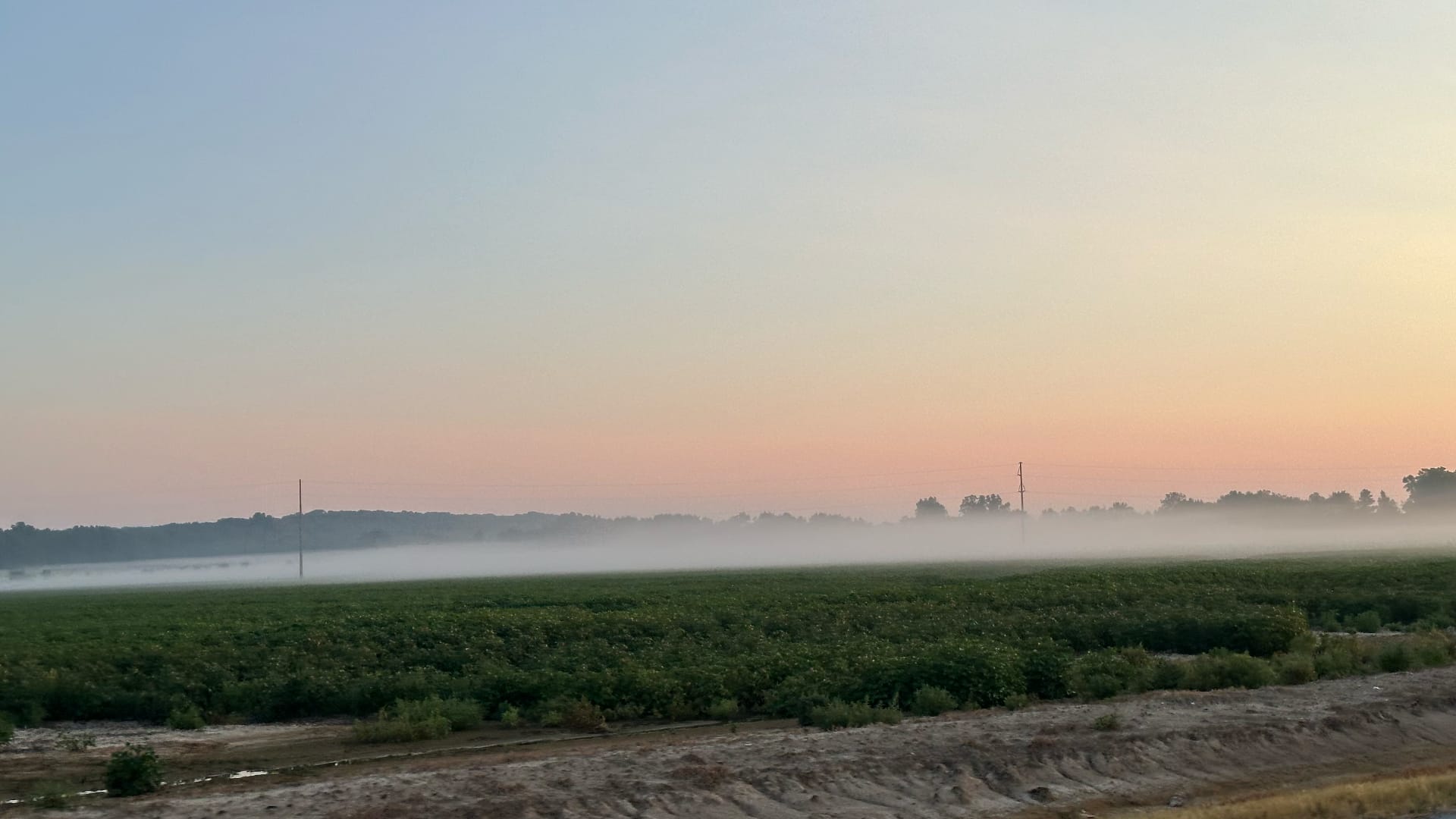
The image shows a misty morning with fog floating low over green farm fields. The sun is rising in the distance, making the sky look pink and orange. You can see crops growing in rows and some power lines in the background.
🔬 Scientific Phenomena
This image captures the anchoring phenomenon of fog formation during dawn. Fog occurs when water vapor in the air condenses into tiny water droplets that float near the ground. This happens when warm, moist air meets cooler surfaces (like the ground that cooled overnight), causing the water vapor to change from an invisible gas back into visible water droplets. The timing at dawn is perfect because nighttime allows the ground to cool significantly while the air still holds moisture from the previous day.
📚 Core Science Concepts
- Water Cycle in Action: The fog demonstrates evaporation (water becoming invisible vapor) and condensation (vapor becoming visible droplets) happening simultaneously in nature.
- Temperature Changes: The image shows how Earth's surface cools at night and begins warming again at sunrise, creating the perfect conditions for fog formation.
- States of Matter: Water exists in different forms - as invisible water vapor in the air and as tiny liquid droplets that form the visible fog.
- Weather Patterns: Fog is a weather phenomenon that occurs under specific conditions of temperature, humidity, and air movement.
Pedagogical Tip: Use this image as a "Notice and Wonder" activity. Have students first observe without explanation, then share what they notice and what they wonder about. This builds scientific thinking skills and natural curiosity before introducing vocabulary.
UDL Suggestions: Provide multiple ways for students to engage with this concept: visual learners can observe and draw the fog, kinesthetic learners can act out water molecules condensing, and auditory learners can describe what they see using scientific vocabulary. Consider having students breathe on a cold window to see condensation firsthand.
🔍 Zoom In / Zoom Out Concepts
- Zoom In: At the molecular level, invisible water molecules in the air are slowing down as they cool and clustering together to form tiny visible droplets. Each fog droplet contains millions of water molecules that have changed from gas to liquid state.
- Zoom Out: This local fog is part of Earth's global water cycle, where water continuously moves between oceans, atmosphere, and land. The water in this fog may have come from distant oceans and will eventually return there, connecting this farm field to water systems worldwide.
🤔 Potential Student Misconceptions
- Misconception: "Fog is smoke or pollution coming from the ground."
Clarification: Fog is made of pure water droplets, just like clouds, not smoke or harmful particles.
- Misconception: "The fog appears because it's cold outside."
Clarification: Fog forms when warm, moist air meets cooler surfaces - it's the temperature difference that matters, not just cold weather.
- Misconception: "Fog and clouds are completely different things."
Clarification: Fog is essentially a cloud that forms at ground level - both are made of tiny water droplets suspended in air.
🎓 NGSS Connections
- Performance Expectation: 2-ESS1-1 - Use information from several sources to provide evidence that Earth events can occur quickly or slowly
- Disciplinary Core Ideas: - Some events happen very quickly, others occur very slowly, over a time period much longer than one can observe
- Crosscutting Concepts: - Patterns in the natural world can be observed and used as evidence
💬 Discussion Questions
- What do you think will happen to this fog as the sun gets higher in the sky? (Bloom's: Predict | DOK: 2)
- How is the fog in this picture similar to what happens when you breathe on a cold window? (Bloom's: Analyze | DOK: 2)
- Why do you think the fog is staying close to the ground instead of floating up high like clouds? (Bloom's: Analyze | DOK: 3)
- What evidence can you see in the picture that tells you this is early morning? (Bloom's: Evaluate | DOK: 2)
📖 Science Vocabulary
- Fog: A cloud that forms near the ground made of tiny water droplets floating in the air
- Condensation: When invisible water vapor cools down and turns into visible water droplets
- Water vapor: Water in its invisible gas form that floats in the air
- Evaporation: When liquid water changes into invisible water vapor and rises into the air
- Temperature: How hot or cold something is, measured with a thermometer
- Humidity: The amount of water vapor in the air
🔗 Cross-Curricular Ideas
- Math - Measurement & Data: Have students use a simple thermometer to record temperatures at different times of the day (early morning, mid-morning, afternoon). Create a bar graph showing how temperature changes throughout the day and connect it to when fog appears and disappears. This helps students see that fog formation is linked to measurable temperature changes.
- ELA - Descriptive Writing: Ask students to write or draw a "fog story" from the perspective of a water droplet. Where did it come from? How did it become part of the fog? Where will it go next? This creative writing activity helps students understand the water cycle while practicing narrative skills and vocabulary use.
- Art - Observational Sketching: Have students create watercolor or chalk pastel paintings of misty landscapes, focusing on how colors change and blend when fog is present. This helps them observe and represent the subtle color gradations visible in the photo (blues, pinks, oranges, greens) and develops fine motor skills.
- Social Studies - Farming & Agriculture: Discuss how farmers depend on weather patterns like fog and morning dew. Students can learn that fog provides moisture to crops and helps them grow. Research local farms in your area and how weather affects their work, connecting science to community and economics.
🚀 STEM Career Connection
- Climate Scientist — Studies how weather patterns change over many years, and what is driving the change.
- Try it: Research historical weather data for your area to see how often fog occurs at different times of the year. (Practice: Analyzing and Interpreting Data)
- Tools: ice cores, satellite data, computer models, long temperature records
- Where they work: research institutes, government climate offices, universities, polar stations
- Meet one: Carlos Nobre — How close the Amazon rainforest is to the point where it stops being a rainforest.
- Median pay: /year — "Atmospheric and space scientists"
- Hydrologist — Follows water — where it falls, where it goes underground, and where it comes out again.
- Try it: Create a simple model showing how water vapor in the air cools and condenses to form fog near the ground. (Practice: Analyzing and Interpreting Data)
- Tools: stream gauges, well probes, flow meters, rain gauges
- Where they work: rivers and reservoirs, water utilities, government surveys, universities
- Meet one: Newsha Ajami — How cities can use water more wisely, especially when there is not enough of it.
- Median pay: /year — "Hydrologists"
Wage figures are median annual wages for the U.S. occupation named after each one, from the U.S. Bureau of Labor Statistics, Occupational Employment and Wage Statistics (OEWS), national, May 2025. Several careers share one occupation, so their figures match.