📸 Photo Description
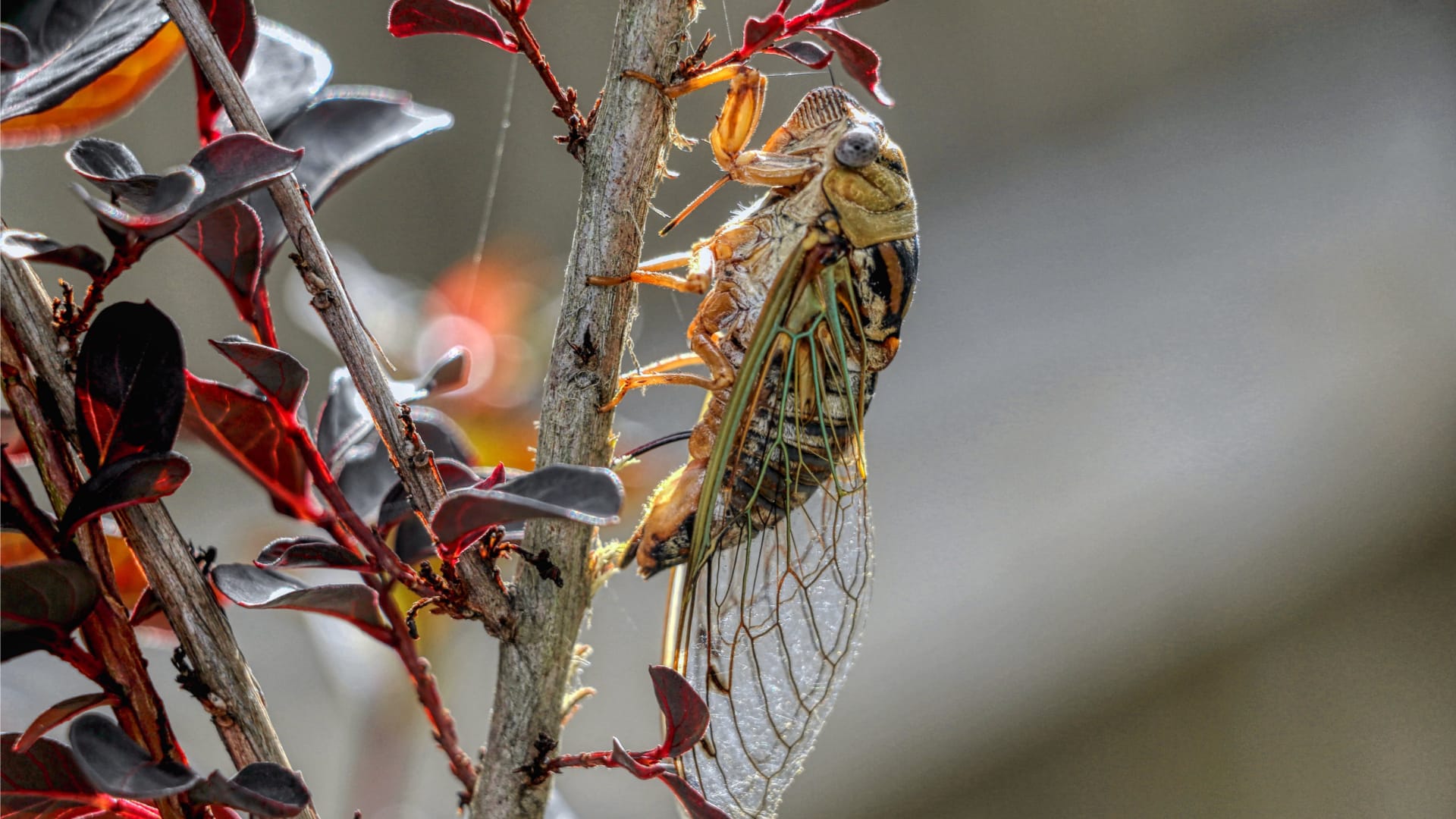
A large cicada with golden-brown coloring sits on a tree branch. You can see its big, clear wings with dark lines running through them. The cicada has large eyes and a thick body, and it's holding onto the bark with its strong legs.
🔬 Scientific Phenomena
This image captures the Anchoring Phenomenon of cicada emergence and adult transformation. The cicada has recently molted from its nymph stage, shedding its old exoskeleton to reveal its adult form with fully developed wings. This process is called metamorphosis, specifically incomplete metamorphosis, where the insect goes through three life stages (egg, nymph, adult) rather than four. The cicada's positioning on the tree bark represents its instinctual behavior to find a secure surface for this vulnerable transformation process.
📚 Core Science Concepts
- Life Cycles and Metamorphosis: Cicadas demonstrate incomplete metamorphosis, progressing from egg to nymph to adult without a pupal stage.
- Adaptation and Survival: The cicada's strong claws, protective coloration, and wing structure are adaptations that help it survive in its tree habitat.
- Animal Behavior: Cicadas exhibit instinctual behaviors like climbing trees, molting in safe locations, and eventually producing sounds to attract mates.
- Body Structure and Function: The cicada's body parts (wings for flight, legs for gripping, eyes for seeing) are specifically designed for its survival needs.
Pedagogical Tip: Use the "See, Think, Wonder" thinking routine when introducing this image. Have students first observe what they see, then share what they think is happening, and finally express what they wonder about the cicada.
UDL Suggestions: Provide multiple ways for students to explore cicada sounds by playing audio recordings, showing videos, and allowing students to create their own "cicada sounds" with instruments or voice. This supports auditory learners and students who benefit from multi-sensory experiences.
🔍 Zoom In / Zoom Out Concepts
- Zoom In: At the cellular level, the cicada's exoskeleton is made of chitin, a tough material that provides protection but cannot grow. When the cicada outgrows its shell, special hormones trigger the molting process where the old exoskeleton splits and the cicada emerges with a new, larger one.
- Zoom Out: Cicadas play important roles in forest ecosystems. As nymphs, they aerate soil and recycle nutrients. As adults, they serve as food for birds, spiders, and other predators. Their mass emergence every 13-17 years (for some species) affects the entire food web and forest health.
🤔 Potential Student Misconceptions
- Misconception: "Cicadas are the same as grasshoppers or crickets."
Clarification: While all are insects, cicadas have different life cycles, body structures, and behaviors. Cicadas spend most of their lives underground as nymphs.
- Misconception: "The cicada in the photo is sick or dying because it's not moving."
Clarification: Cicadas often remain still during and after molting to let their new exoskeleton harden and their wings dry.
- Misconception: "All cicadas come out every 17 years."
Clarification: Only some cicada species are periodical. Many species emerge annually during summer months.
🎓 NGSS Connections
- Performance Expectation: 3-LS1-1 - Develop models to describe that organisms have unique and diverse life cycles but all have in common birth, growth, reproduction, and death.
- Disciplinary Core Ideas: - Growth and Development of Organisms
- Crosscutting Concepts: in the natural world can be observed and used as evidence
💬 Discussion Questions
- What do you notice about the cicada's body parts and how might each part help it survive? (Bloom's: Analyze | DOK: 2)
- How do you think a cicada's life underground as a nymph compares to its life above ground as an adult? (Bloom's: Compare | DOK: 2)
- Why might it be important for cicadas to have strong claws and the ability to hold tightly to tree bark? (Bloom's: Evaluate | DOK: 3)
- What patterns do you see in how insects like cicadas grow and change throughout their lives? (Bloom's: Synthesize | DOK: 3)
📖 Science Vocabulary
- Cicada: An insect that spends most of its life underground and emerges to sing and find a mate.
- Metamorphosis: The process of changing from one life stage to another as an animal grows.
- Nymph: The young stage of insects like cicadas that looks similar to adults but without wings.
- Exoskeleton: The hard outer shell that protects an insect's body.
- Molt: When an animal sheds its old skin or shell to grow bigger.
- Adaptation: A special feature that helps an animal survive in its environment.
🔗 Cross-Curricular Ideas
- Math - Measuring and Graphing: Have students measure the length of cicadas in the photo using a ruler or measuring tape. Create a bar graph showing the lengths of different insects (cicadas, grasshoppers, beetles) to compare sizes. Students can practice measuring skills while learning about insect diversity.
- ELA - Life Cycle Sequencing and Writing: Students can write sentences describing the stages of a cicada's life cycle in order, then illustrate each stage. Create a class book titled "The Amazing Life of a Cicada" where each student contributes one page about a different life stage.
- Art - Nature Observation Drawing: Students sketch and paint cicadas using the photo as a reference, focusing on realistic details like wing patterns, body segments, and colors. Discuss how artists use observation and detail to create accurate nature art, just like scientists do.
- Social Studies - Animal Habitats and Communities: Explore where cicadas live around the world and how different communities experience cicada emergences. Discuss how cicadas are part of nature in our own neighborhoods and how humans interact with them (listening to their sounds, protecting trees they live in).
🚀 STEM Career Connection
- Entomologist — Studies insects — how they live, what they eat, and the jobs they do in an ecosystem.
- Try it: Construct an explanation for why cicadas need to molt to become adults. (Practice: Constructing Explanations and Designing Solutions)
- Tools: insect nets, a hand lens, pinning boards, microscopes
- Where they work: museums, farms, insect labs, universities
- Meet one: Corrie Moreau — How ants evolved together with the bacteria that live inside them.
- Median pay: /year — "Zoologists and wildlife biologists"
- Wildlife Biologist — Studies wild animals — what they eat, where they go, and what they need to survive.
- Try it: Design a way to observe cicada mating calls without disturbing the insects. (Practice: Constructing Explanations and Designing Solutions)
- Tools: binoculars, radio collars, trail cameras, a field notebook
- Where they work: national parks, wildlife refuges, state wildlife agencies, universities
- Meet one: Rae Wynn-Grant — Where black bears and people run into each other, and how to keep both safe.
- Median pay: /year — "Zoologists and wildlife biologists"
Wage figures are median annual wages for the U.S. occupation named after each one, from the U.S. Bureau of Labor Statistics, Occupational Employment and Wage Statistics (OEWS), national, May 2025. Several careers share one occupation, so their figures match.