📸 Photo Description
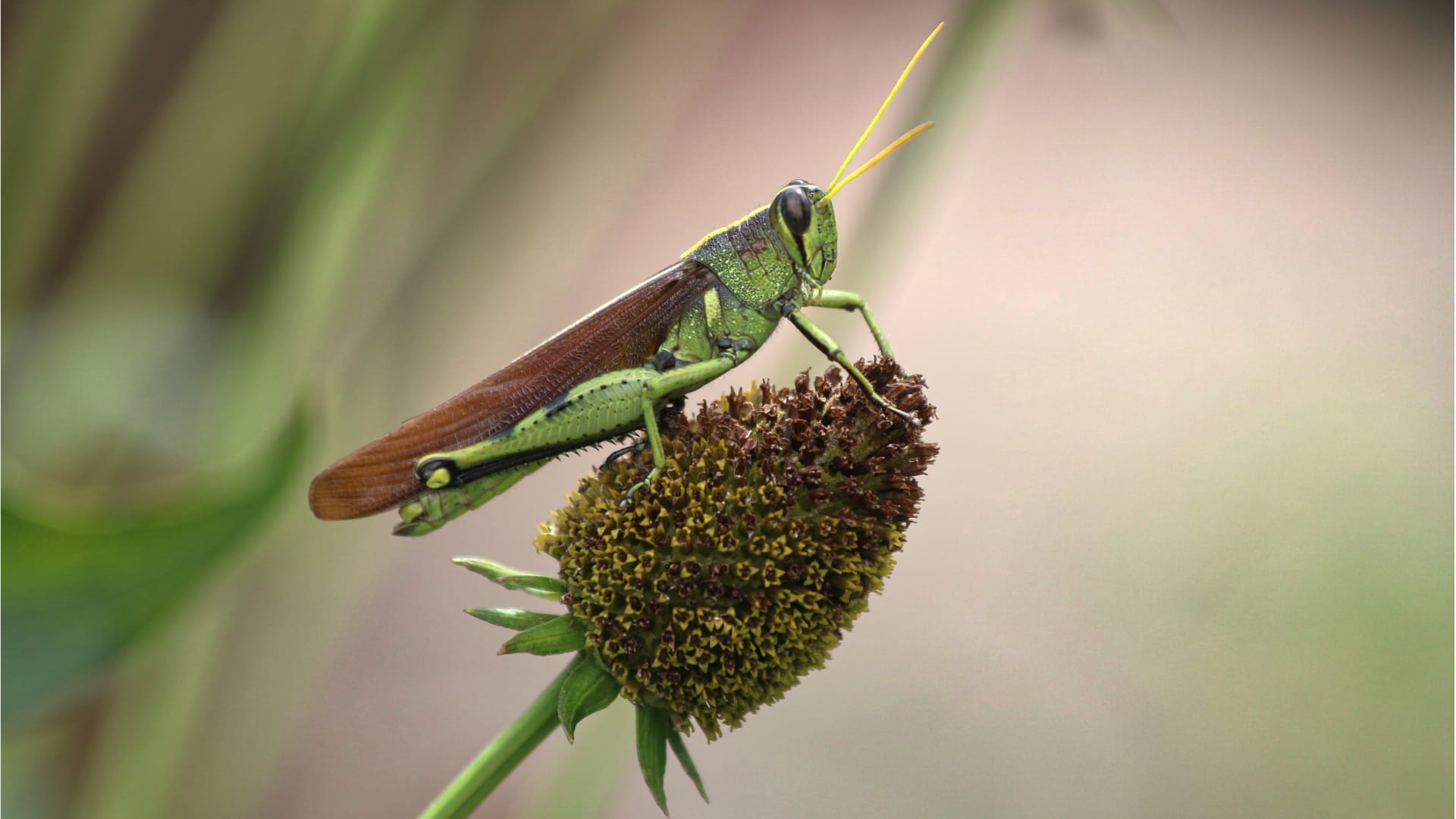
A bright green grasshopper sits on top of a brown, bumpy flower head. The grasshopper has long back legs, big eyes, and yellow antennas that stick up from its head. Its body is mostly green with brown wings folded on its back.
🔬 Scientific Phenomena
The Anchoring Phenomenon is a grasshopper using its specialized body parts to interact with its environment for survival. This is happening because grasshoppers have evolved specific adaptations - powerful hind legs for jumping, compound eyes for detecting movement, sensory antennae for gathering information about their surroundings, and mouthparts designed for chewing plant material. The grasshopper is demonstrating how animals use their external features to help them survive in their habitat by finding food and staying safe from predators.
📚 Core Science Concepts
- Animal Body Parts and Functions: Grasshoppers have specialized external features that help them survive - long hind legs for jumping away from danger, compound eyes for seeing in multiple directions, and antennae for sensing their environment.
- Animal Behaviors for Survival: The grasshopper's positioning on the flower demonstrates feeding behavior and camouflage - its green coloration helps it blend in with plants while it searches for food.
- Habitat and Basic Needs: This image shows how animals meet their basic needs in their environment - the grasshopper is in its natural habitat where it can find food (plants) and shelter.
- Structure and Function Relationship: The grasshopper's body parts are perfectly designed for its lifestyle - strong legs for escaping predators, chewing mouthparts for eating plants, and sensory organs for gathering information.
Pedagogical Tip: Use the "See-Think-Wonder" thinking routine with this image. Have students first observe what they see, then think about what the grasshopper might be doing, and finally wonder about questions they have. This builds observation skills and scientific curiosity.
UDL Suggestions: Provide multiple ways for students to demonstrate their understanding of animal adaptations - they could draw and label grasshopper parts, act out grasshopper movements, create a grasshopper habitat diorama, or record voice explanations of how each body part helps the grasshopper survive.
🔍 Zoom In / Zoom Out Concepts
- Zoom In: At the cellular level, the grasshopper's compound eyes are made up of thousands of tiny light-detecting units called ommatidia, each creating a small piece of the overall picture the grasshopper sees, like a mosaic made of many small tiles.
- Zoom Out: In the larger ecosystem, grasshoppers play important roles as both herbivores (eating plants and helping control plant growth) and prey animals (providing food for birds, spiders, and other predators), making them a vital link in food webs.
🤔 Potential Student Misconceptions
- Misconception: "Grasshoppers are harmful bugs that should be eliminated."
Clarification: Grasshoppers are important parts of ecosystems that help break down plant material and provide food for other animals.
- Misconception: "All insects look and act the same way."
Clarification: Different insects have different body parts and behaviors that match their specific needs and environments.
- Misconception: "Animals choose their body parts."
Clarification: Animals inherit their body parts from their parents, and these features help them survive in their specific environments.
🎓 NGSS Connections
- Performance Expectation: 3-LS4-3 - Construct an argument with evidence that in a particular habitat some organisms can survive well, some survive less well, and some cannot survive at all.
- Disciplinary Core Ideas: - Environmental changes affect organisms and habitats in different ways, - Different animals use their body parts in different ways to see, hear, grasp objects, protect themselves, move from place to place, and seek, find, and take in food, water and air.
- Crosscutting Concepts: ,
💬 Discussion Questions
- How do you think the grasshopper's long back legs help it survive in the wild? (Bloom's: Apply | DOK: 2)
- What would happen to this grasshopper if it lived in a place with no plants? (Bloom's: Analyze | DOK: 3)
- Compare the grasshopper's eyes to human eyes - what advantages might the grasshopper's eyes give it? (Bloom's: Analyze | DOK: 2)
- If you were designing a robot grasshopper, which body parts would be most important to include and why? (Bloom's: Evaluate | DOK: 3)
📖 Science Vocabulary
- Adaptation: A special body part or behavior that helps an animal survive in its environment.
- Compound eyes: Eyes made up of many small parts that help insects see movement and light.
- Antennae: Long, thin body parts on an insect's head used for smelling and feeling.
- Herbivore: An animal that eats only plants for food.
- Camouflage: Colors or patterns that help an animal blend in with its surroundings.
- Habitat: The natural place where an animal lives and finds everything it needs to survive.
🔗 Cross-Curricular Ideas
- Math - Measurement and Comparison: Have students measure and compare the body parts of a grasshopper to other insects or animals. They could create bar graphs showing the length of grasshopper legs versus cricket legs, or measure how far a grasshopper can jump compared to other animals using a tape measure and simple data recording.
- ELA - Descriptive Writing and Poetry: Students can write detailed descriptions of the grasshopper using sensory words (what it looks like, sounds like, feels like). They could also create acrostic poems using the word "GRASSHOPPER" where each line describes a different body part or behavior, building vocabulary and creative expression skills.
- Art - Color Mixing and Camouflage Artwork: Students can experiment with mixing green and brown paint colors to match the grasshopper's natural coloring, then create their own camouflaged insect artwork on a plant or flower background. This connects to understanding how color helps animals survive while developing fine motor skills.
- Social Studies - Food Sources and Community Roles: Discuss how grasshoppers are food sources for birds, spiders, and other animals in a community food web. Students can create a simple community diagram showing who eats grasshoppers and what grasshoppers eat, understanding how different organisms depend on each other.
🚀 STEM Career Connection
- Entomologist — Studies insects — how they live, what they eat, and the jobs they do in an ecosystem.
- Try it: Research the different types of mouthparts insects have and explain how they are used for eating. (Practice: Constructing Explanations and Designing Solutions)
- Tools: insect nets, a hand lens, pinning boards, microscopes
- Where they work: museums, farms, insect labs, universities
- Meet one: Corrie Moreau — How ants evolved together with the bacteria that live inside them.
- Median pay: /year — "Zoologists and wildlife biologists"
- Conservation Biologist — Works out which plants and animals are in trouble, and what would help them recover.
- Try it: Design a safe habitat for a grasshopper using a shoebox and natural materials, explaining why each item is important for its survival. (Practice: Constructing Explanations and Designing Solutions)
- Tools: population surveys, GPS trackers, habitat maps, trail cameras
- Where they work: nature reserves, conservation charities, government agencies, universities
- Meet one: Tierra Curry — Which plants and animals are closest to disappearing, and what it takes to save them.
- Median pay: /year — "Zoologists and wildlife biologists"
Wage figures are median annual wages for the U.S. occupation named after each one, from the U.S. Bureau of Labor Statistics, Occupational Employment and Wage Statistics (OEWS), national, May 2025. Several careers share one occupation, so their figures match.