📸 Photo Description
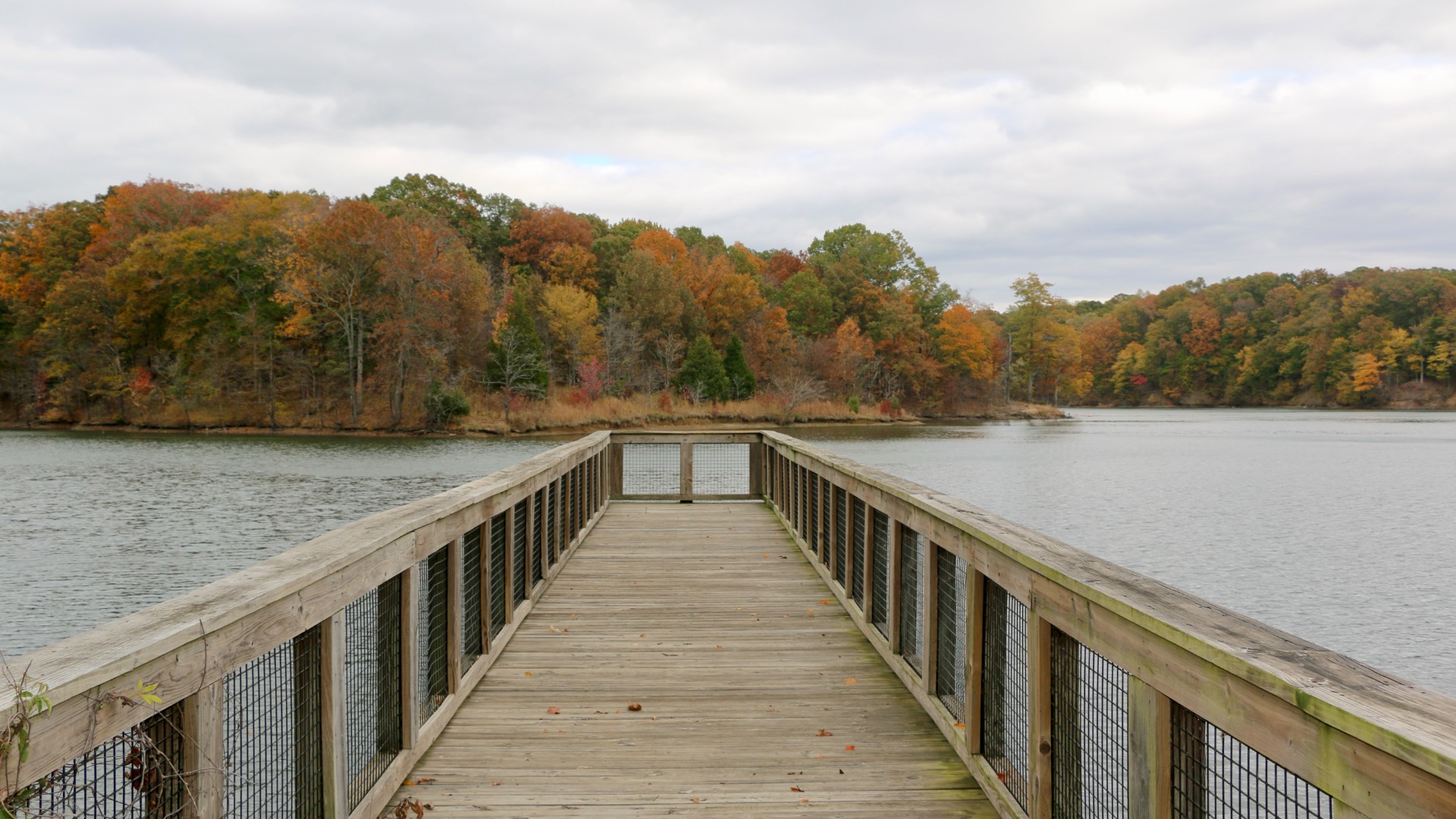
This picture shows a wooden walkway leading to a lake surrounded by trees with colorful fall leaves. The trees have changed from green to yellow, orange, and red colors. Some trees still have green leaves while others have already lost their leaves for winter.
🔬 Scientific Phenomena
The Anchoring Phenomenon is seasonal change in deciduous trees, specifically autumn leaf color change and leaf drop. This occurs because as daylight hours shorten and temperatures cool, trees stop producing chlorophyll (the green pigment that captures sunlight for photosynthesis). Without new chlorophyll being made, other pigments like carotenoids (yellows and oranges) and anthocyanins (reds and purples) become visible. Eventually, trees form an abscission layer at the base of each leaf stem, cutting off nutrients and causing leaves to fall. This is an adaptation that helps trees conserve energy and water during winter months when photosynthesis would be inefficient.
📚 Core Science Concepts
- Seasonal Adaptations: Trees change throughout the year to survive different weather conditions and amounts of sunlight.
- Plant Life Cycles: Deciduous trees follow predictable patterns of growth, reproduction, dormancy, and renewal each year.
- Photosynthesis and Pigments: Leaves contain different colored chemicals, but green chlorophyll usually covers up the other colors until autumn.
- Environmental Responses: Plants respond to changes in their environment like temperature, daylight hours, and water availability.
Pedagogical Tip: Use a "Wonder Wall" where students can post questions about what they observe in the photo. This builds scientific curiosity and gives you insight into their thinking before formal instruction begins.
UDL Suggestions: Provide multiple ways to explore this concept: tactile leaf collections, visual color wheels showing pigments, and kinesthetic activities like acting out the leaf-dropping process. This supports different learning preferences and processing styles.
🔍 Zoom In / Zoom Out Concepts
Zoom In: Inside each leaf cell, tiny structures called chloroplasts contain chlorophyll molecules that capture sunlight energy. When trees stop making new chlorophyll in fall, these green molecules break down and disappear, revealing yellow and orange pigments that were always there.
Zoom Out: This forest ecosystem depends on fallen leaves to create rich soil for next year's growth. The leaf litter provides food and shelter for insects, worms, and decomposers, which break down the leaves into nutrients that feed the trees and other plants in an endless cycle.
🤔 Potential Student Misconceptions
- Misconception: Trees "die" in winter when they lose their leaves.
Clarification: Deciduous trees are dormant (like sleeping) in winter and will grow new leaves in spring.
- Misconception: Leaves change color because they are sick or dying.
Clarification: Color change is a healthy, natural process that helps trees prepare for winter survival.
- Misconception: All trees lose their leaves in fall.
Clarification: Only deciduous trees lose leaves; evergreen trees keep their needle-like leaves year-round.
🎓 NGSS Connections
Performance Expectation: 3-LS1-1 - Develop models to describe that organisms have unique and diverse life cycles but all have in common birth, growth, reproduction, and death.
Disciplinary Core Ideas:
- - Growth and Development of Organisms
- - Biodiversity and Humans
Crosscutting Concepts:
- - Observable patterns in nature guide organization and classification
- - The way an object is shaped or structured determines many of its properties and functions
💬 Discussion Questions
- What patterns do you notice in how the trees are changing colors? (Bloom's: Analyze | DOK: 2)
- Why might some trees in the photo still be green while others have changed colors? (Bloom's: Evaluate | DOK: 3)
- How do you think these trees will look different in three months during winter? (Bloom's: Apply | DOK: 2)
- What would happen to this forest if trees never dropped their leaves? (Bloom's: Synthesize | DOK: 3)
📖 Science Vocabulary
- Deciduous: Trees that lose all their leaves each fall and grow new ones in spring.
- Chlorophyll: The green substance in leaves that helps plants make food from sunlight.
- Adaptation: A special feature that helps a living thing survive in its environment.
- Dormant: A resting state when plants stop growing and save energy, like sleeping.
- Photosynthesis: The process plants use to make food from sunlight, water, and air.
- Pigment: Natural coloring substances found in plants and animals.
🔗 Cross-Curricular Ideas
- Math + Science: Create a "Leaf Color Graph" where students collect fallen leaves, sort them by color (green, yellow, orange, red, brown), and make a bar graph showing which colors appear most often. Students can then count, compare quantities, and answer questions like "How many more orange leaves than green leaves did we find?"
- ELA + Science: Write descriptive sentences about the leaves using sensory words. Students can complete sentence frames like "The _____ leaves feel _____" or "The _____ leaves look like _____." Create a class autumn poetry book where each student contributes a simple rhyming couplet about fall changes.
- Art + Science: Create a mixed-media autumn collage using real fallen leaves, paint, and colored paper to show the color transformation from summer to winter. Students can arrange leaves in a gradient from green to yellow to orange to red to brown, demonstrating the sequence of seasonal change.
- Social Studies + Science: Discuss how people in your community prepare for fall and winter (wearing jackets, harvesting crops, decorating homes). Compare how humans adapt to seasonal changes versus how trees adapt. Students can create a Venn diagram showing similarities and differences.
🚀 STEM Career Connection
- Botanist — Studies plants — how they grow, how they reproduce, and how they survive where they live.
- Try it: Create a chart to record the colors of leaves from different deciduous trees over a two-week period. (Practice: Analyzing and Interpreting Data)
- Tools: a hand lens, a plant press, a soil probe, field guides
- Where they work: botanical gardens, herbariums, forests and fields, universities
- Meet one: Robin Wall Kimmerer — Mosses — which she calls the coral reefs of the forest — and what Indigenous knowledge teaches about bringing plants back.
- Median pay: /year — "Soil and plant scientists"
- Biologist — Studies living things of every kind and what keeps them alive.
- Try it: Compare the leaf structures of two different deciduous trees and note any differences in their veins or edges. (Practice: Analyzing and Interpreting Data)
- Tools: microscopes, sample jars, measuring tools, a field notebook
- Where they work: laboratories, field sites, museums, universities
- Meet one: Sandra Díaz — What a plant's leaves, wood and shape tell you about how it lives — and how those traits add up across a whole ecosystem.
- Median pay: /year — "Biological scientists, all other"
Wage figures are median annual wages for the U.S. occupation named after each one, from the U.S. Bureau of Labor Statistics, Occupational Employment and Wage Statistics (OEWS), national, May 2025. Several careers share one occupation, so their figures match.