📸 Photo Description
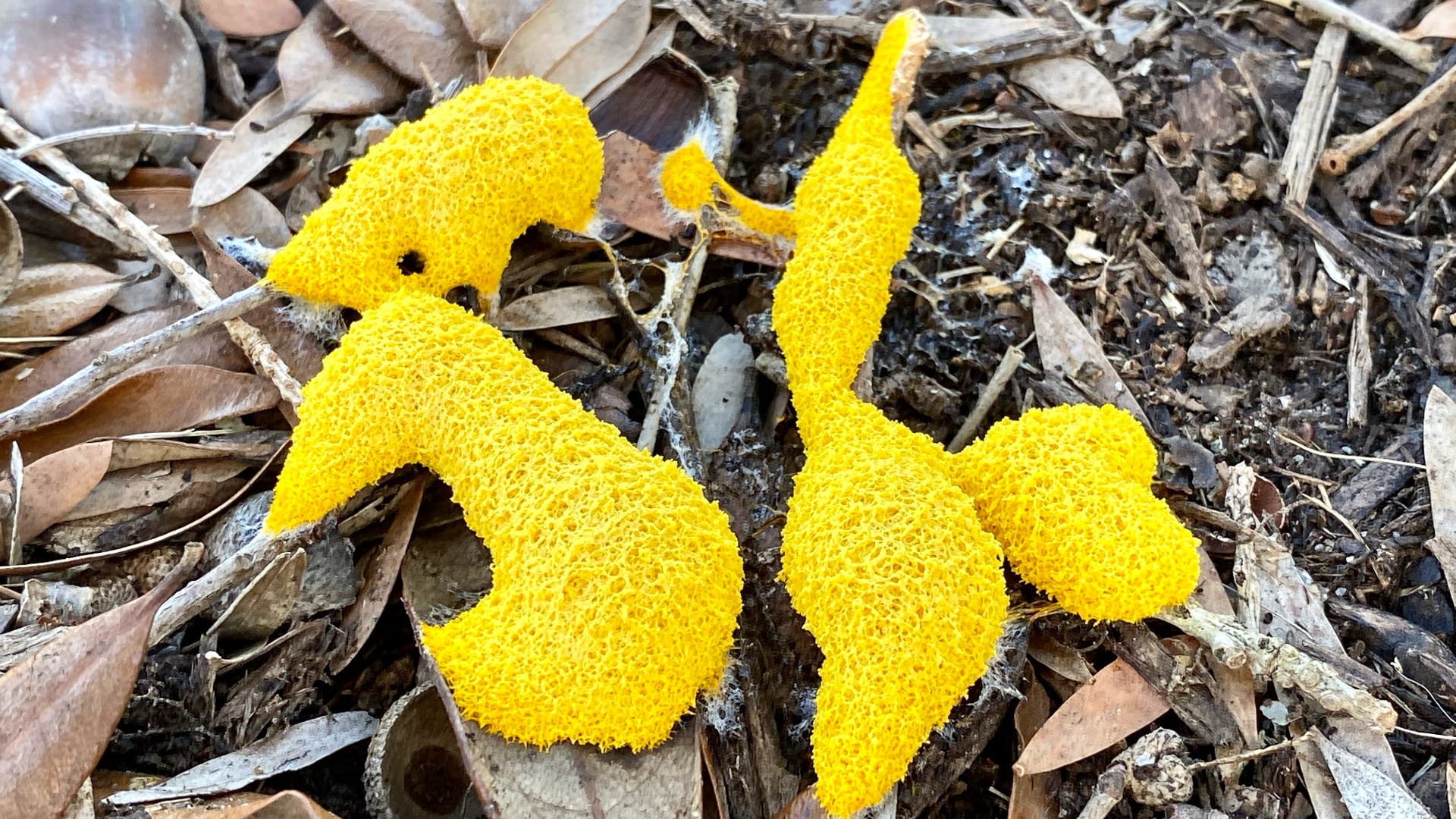
This bright yellow, bumpy organism is growing on dead leaves and wood on the forest floor. It has a spongy texture with many small holes and looks like it's spreading across the surface. This strange-looking yellow blob is actually a living thing called slime mold.
🔬 Scientific Phenomena
The anchoring phenomenon shown here is slime mold growth and feeding behavior. This organism (Physarum polycephalum or similar species) is in its plasmodium stage, where it actively moves and feeds on decaying organic matter. The bright yellow color indicates it's healthy and actively consuming bacteria, fungi, and decomposing plant material. Slime molds are unique because they can move without muscles, change shape, and solve simple problems like finding the shortest path to food sources. They represent a fascinating example of how living things can be very different from plants and animals while still carrying out essential life processes.
📚 Core Science Concepts
- Living vs. Non-living Characteristics: Slime molds demonstrate that living things can look very different from familiar plants and animals, yet still grow, move, respond to environment, and need food and water.
- Decomposition and Nutrient Cycling: These organisms play a crucial role in breaking down dead plant material, returning nutrients to the soil for new plants to use.
- Adaptation to Environment: The bright yellow color and spreading growth pattern help slime molds find food efficiently in their forest habitat.
- Life Cycles and Growth: Slime molds go through different stages of life, changing their appearance and behavior as they grow and reproduce.
Pedagogical Tip: Use this image to challenge students' preconceptions about what "counts" as a living thing. Have them apply the characteristics of living things checklist to determine if this mysterious organism is alive, encouraging scientific reasoning skills.
UDL Suggestions: Provide multiple ways for students to explore this concept: tactile models made from play dough, time-lapse videos showing movement, and hands-on observations of safe decomposing materials in your schoolyard to accommodate different learning preferences and abilities.
🔍 Zoom In / Zoom Out Concepts
Zoom In: At the microscopic level, slime molds are made of a single giant cell with thousands of nuclei that can coordinate movement and decision-making without a brain or nervous system. The cytoplasm flows like a slow river, carrying nutrients and information throughout the organism.
Zoom Out: In the forest ecosystem, slime molds are essential decomposers that work alongside bacteria, fungi, and insects to break down dead plant material, creating rich soil that supports new plant growth and maintains the health of the entire woodland community.
🤔 Potential Student Misconceptions
- Misconception: "It's not alive because it doesn't look like plants or animals."
Clarification: Living things come in many forms. This organism grows, moves, eats, and reproduces, making it definitely alive.
- Misconception: "It's a plant because it's growing on the ground."
Clarification: Unlike plants, slime molds cannot make their own food from sunlight. They must eat other organisms to survive.
- Misconception: "It's dangerous or yucky because it's slimy and weird-looking."
Clarification: Most slime molds are harmless and actually help keep forests healthy by cleaning up dead materials.
🎓 NGSS Connections
Performance Expectation: 3-LS1-1 - Develop models to describe that organisms have unique and diverse life cycles but all have in common birth, growth, reproduction, and death.
Disciplinary Core Ideas:
- - Growth and Development of Organisms
- - Adaptation
Crosscutting Concepts:
-
-
💬 Discussion Questions
- What evidence can you find in this photo that shows this organism is alive? (Bloom's: Analyze | DOK: 2)
- How might this yellow organism help other living things in the forest? (Bloom's: Evaluate | DOK: 3)
- What do you think would happen to this slime mold if all the dead leaves were removed? (Bloom's: Predict | DOK: 2)
- Why do you think this organism is bright yellow instead of green like most plants? (Bloom's: Analyze | DOK: 2)
📖 Science Vocabulary
- Organism: Any individual living thing that can grow and reproduce.
- Decomposer: A living thing that breaks down dead plants and animals.
- Plasmodium: The active, moving stage of a slime mold's life cycle.
- Habitat: The natural place where an organism lives and finds what it needs to survive.
- Nutrient: A substance that living things need to grow and stay healthy.
🔗 Cross-Curricular Ideas
- Math - Measurement & Patterns: Have students measure the size of the slime mold in the photo using non-standard units (paper clips, blocks) or standard measurements. Create a graph showing how slime molds might grow over time, connecting to patterns and data representation skills.
- ELA - Descriptive Writing: Ask students to write creative descriptions of what they see in the photo using sensory words (bumpy, bright, spongy, spreading). They could write a short story from the perspective of the slime mold or create a "wanted poster" for decomposers in the forest.
- Art - Nature Observation & Color: Have students create their own yellow spongy organisms using textured materials (crumpled tissue paper, bubble wrap, sponges, or playdough) to understand how the organism's bumpy surface helps it absorb nutrients and moisture from its environment.
- Social Studies - Community Helpers: Connect decomposers to human workers who help keep our communities clean (garbage collectors, recyclers, janitors). Discuss how slime molds are like nature's clean-up crew, managing waste in the forest ecosystem.
🚀 STEM Career Connection
- Ecologist — Studies how living things depend on each other and on the place they live.
- Try it: Create a simple diagram showing the slime mold in its environment and what it needs to survive. (Practice: Analyzing and Interpreting Data)
- Tools: quadrat frames, measuring tapes, GPS units, a field notebook
- Where they work: forests, grasslands, wetlands, universities
- Meet one: Sandra Díaz — What a plant's leaves, wood and shape tell you about how it lives — and how those traits add up across a whole ecosystem.
- Median pay: /year — "Environmental scientists and specialists, including health"
- Mycologist — Studies fungi — mushrooms, moulds and yeasts, and the hidden threads that connect them underground.
- Try it: Analyze how the slime mold changes shape when it encounters obstacles or food sources. (Practice: Analyzing and Interpreting Data)
- Tools: spore prints, petri dishes, microscopes, collecting baskets
- Where they work: forests, laboratories, botanical gardens, universities
- Meet one: Giuliana Furci — Fungi nobody had catalogued before, and getting them protected the way animals and plants are.
- Median pay: /year — "Microbiologists"
- Soil Scientist — Studies dirt seriously — what it is made of, what lives in it, and what will grow in it.
- Try it: Discuss how the slime mold's role in decomposition helps return nutrients to the soil. (Practice: Analyzing and Interpreting Data)
- Tools: soil augers, pH meters, sieve stacks, sample bags
- Where they work: farms and fields, testing laboratories, government agencies, universities
- Meet one: Asmeret Asefaw Berhe — How soil stores carbon, and why that makes dirt part of the climate story.
- Median pay: /year — "Soil and plant scientists"
Wage figures are median annual wages for the U.S. occupation named after each one, from the U.S. Bureau of Labor Statistics, Occupational Employment and Wage Statistics (OEWS), national, May 2025. Several careers share one occupation, so their figures match.