📸 Photo Description
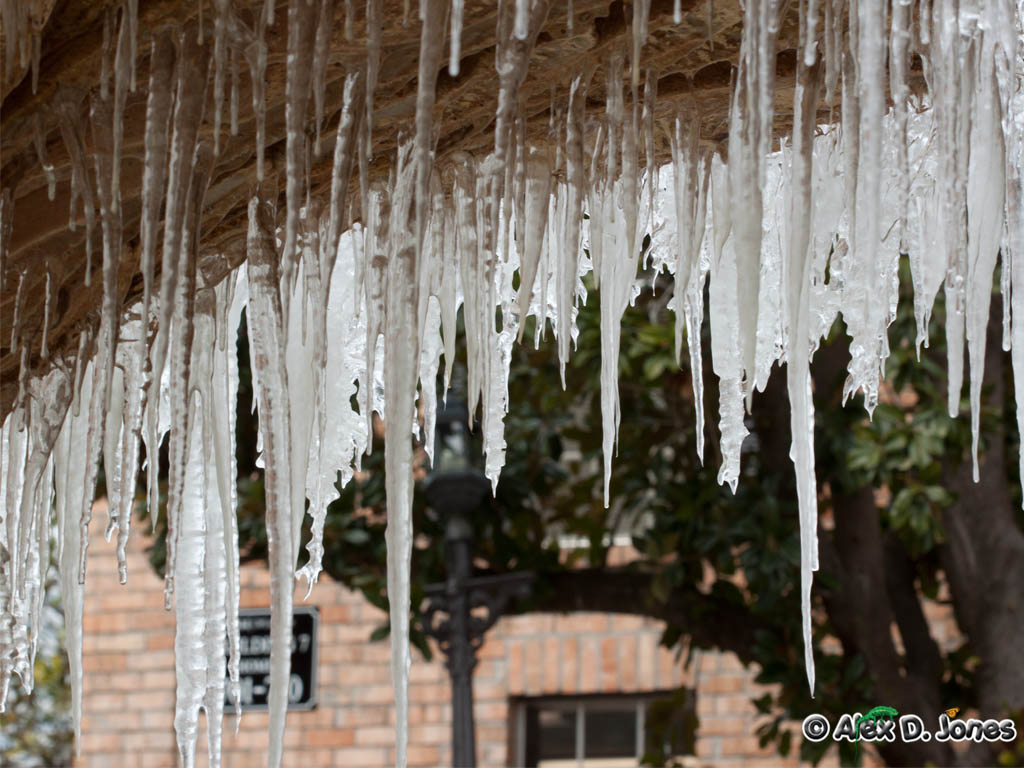
Long, white icicles hang down from the edge of a roof like frozen spears. The icicles are different sizes and shapes, with some being thick and others thin. They formed when water dripped and froze over and over again during cold weather.
🔬 Scientific Phenomena
This image represents the Anchoring Phenomenon of ice formation and the water cycle in action. The icicles form through a repeating process: snow or ice on the roof melts due to heat (from the sun or building), the liquid water drips down, and then freezes again when it meets the cold air. This cycle continues, building up layers of ice that create the long, pointed icicles we see. This demonstrates matter changing states from solid to liquid and back to solid again.
📚 Core Science Concepts
- States of Matter: Water exists in three forms - solid (ice), liquid (water), and gas (water vapor). The icicles show the transition between solid and liquid states.
- Temperature and Heat Transfer: Heat from the sun or building warms the ice/snow above, causing it to melt. When the liquid water meets cold air, it loses heat and freezes again.
- Gravity: The liquid water drips downward due to gravitational force, creating the downward-pointing shape of icicles.
- Patterns in Nature: Icicles form in predictable ways based on temperature, water flow, and time, showing how natural processes create observable patterns.
Pedagogical Tip: Use the "Think-Pair-Share" strategy when introducing icicles. Have students first think individually about what they notice, then discuss with a partner, and finally share with the class. This builds confidence and allows all learners to participate.
UDL Suggestions: Provide multiple ways for students to represent their understanding: drawing the icicle formation process, acting out water molecules changing states, or creating a digital presentation. This supports different learning preferences and abilities.
🔍 Zoom In / Zoom Out Concepts
- Zoom In: At the molecular level, water molecules are moving faster when heated (liquid state) and slower when cooled (solid state). The molecules arrange themselves in organized patterns when they freeze, creating the crystal structure of ice.
- Zoom Out: This icicle formation is part of the larger water cycle that moves water around Earth. The same water that forms these icicles will eventually melt, flow into streams and rivers, evaporate into clouds, and potentially fall as precipitation elsewhere.
🤔 Potential Student Misconceptions
- Misconception: "Icicles form because it's cold outside."
Clarification: Icicles need both warming (to melt ice/snow) AND cold temperatures (to refreeze). Just cold weather alone won't create icicles.
- Misconception: "Ice is not the same thing as water."
Clarification: Ice IS water, just in a different state. The same H₂O molecules are present whether water is liquid or frozen solid.
- Misconception: "Icicles grow from the bottom up."
Clarification: Icicles grow from the top down as new water drips and freezes onto the existing ice formation.
🎓 NGSS Connections
- Performance Expectation: 2-PS1-1 Plan and conduct an investigation to describe and classify different kinds of materials by their observable properties
- Disciplinary Core Ideas: - Different kinds of matter exist and many of them can be either solid or liquid, depending on temperature
- Crosscutting Concepts: - Patterns in the natural world can be observed and used as evidence
💬 Discussion Questions
- What do you think would happen to these icicles on a warm, sunny day? (Bloom's: Predict | DOK: 2)
- How are icicles similar to and different from ice cubes in your freezer? (Bloom's: Compare | DOK: 2)
- Why do you think some icicles are longer than others? (Bloom's: Analyze | DOK: 3)
- What evidence do you see that tells you water was involved in making these icicles? (Bloom's: Evaluate | DOK: 3)
📖 Science Vocabulary
- Icicle: A hanging piece of ice formed by dripping water that freezes
- Freeze: When liquid water becomes solid ice due to cold temperatures
- Melt: When solid ice becomes liquid water due to warm temperatures
- State of matter: The form that matter takes, such as solid, liquid, or gas
- Temperature: How hot or cold something is
- Drip: Small drops of liquid falling one at a time
🔗 Cross-Curricular Ideas
- Math - Measurement and Comparison: Have students measure the lengths of different icicles using non-standard units (like paper clips or craft sticks) or standard units (centimeters). Create a bar graph showing which icicles are longest, shortest, and medium-length. This connects to 3.MD.B.3 (Represent and interpret data).
- ELA - Descriptive Writing: Ask students to write or draw a story about the "life of an icicle" from formation to melting. They can use descriptive words like "sparkly," "pointy," "cold," and "dripping" to bring their writing to life. This supports 3.W.3 (Write narratives with descriptive details).
- Art - Nature Sculptures: Have students create their own icicles using white paint, glue, or paper strips hanging from a piece of blue or white poster board. They can explore color, texture, and symmetry while learning about natural ice formations. This connects to observational drawing and three-dimensional art creation.
- Social Studies - Weather and Community: Discuss how icicles and winter weather affect people in your community. Talk about how roads get icy, school closures, and how people prepare for cold weather. This helps students understand how science connects to their daily lives and local environment.
🚀 STEM Career Connection
- Chemist — Studies what substances are made of and what happens when you combine them.
- Try it: Observe how adding salt to ice changes its melting point, recording the difference in temperature. (Practice: Analyzing and Interpreting Data)
- Tools: fume hoods, balances, spectrometers, glassware
- Where they work: laboratories, manufacturing plants, testing facilities, universities
- Meet one: Tebello Nyokong — Dyes that can be switched on by laser light to destroy cancer cells and leave healthy ones alone.
- Median pay: /year — "Chemists"
- Materials Scientist — Invents and tests new materials — stronger, lighter, or able to do something the old ones could not.
- Try it: Test how different materials react to freezing water, observing if they expand or crack. (Practice: Analyzing and Interpreting Data)
- Tools: electron microscopes, stress testers, furnaces, X-ray diffractometers
- Where they work: research laboratories, manufacturing companies, national labs, universities
- Meet one: Ainissa Ramirez — How to make metal stick to glass and ceramics — she invented a solder that does it.
- Median pay: /year — "Materials scientists"
Wage figures are median annual wages for the U.S. occupation named after each one, from the U.S. Bureau of Labor Statistics, Occupational Employment and Wage Statistics (OEWS), national, May 2025. Several careers share one occupation, so their figures match.