📸 Photo Description
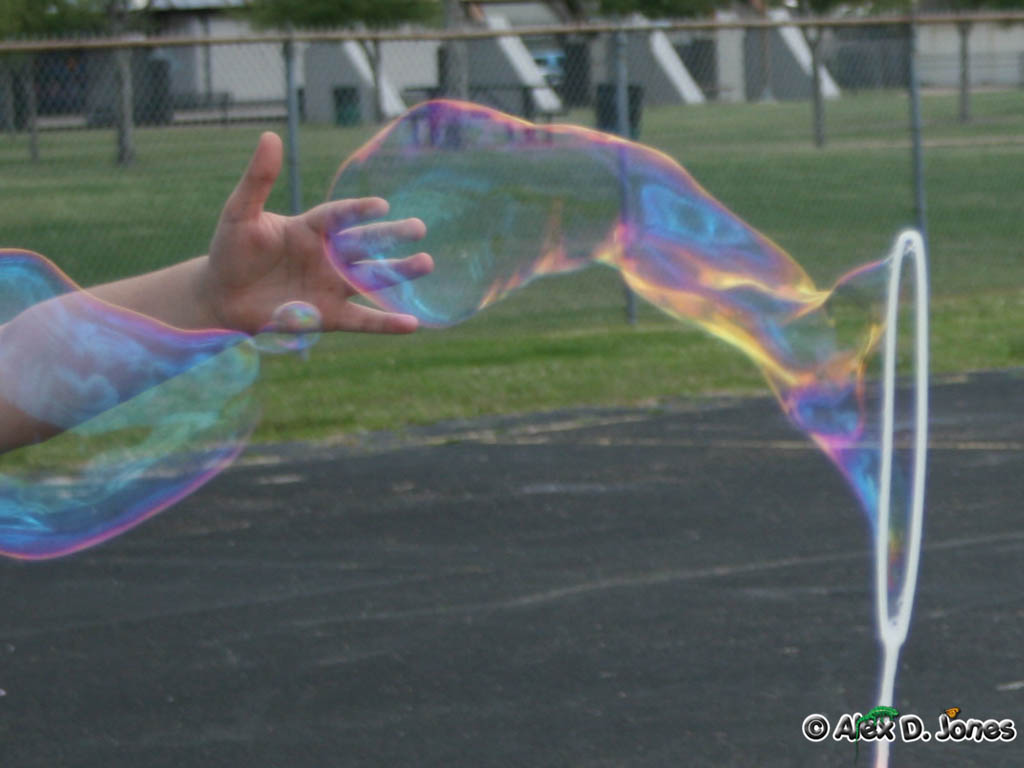
A person is reaching toward a large, colorful soap bubble floating in the air. The bubble shows rainbow colors like purple, blue, green, and yellow on its thin surface. The bubble is stretching and changing shape as it moves through the air above a paved area.
🔬 Scientific Phenomena
This image demonstrates the Anchoring Phenomenon of soap bubble formation and light interference. The rainbow colors appear because white light from the sun hits the thin soap film and splits into different colors. The soap film acts like a tiny prism, bending light waves at different angles. When light waves bounce off the front and back surfaces of the bubble wall, they interfere with each other, creating the brilliant color patterns we observe. The bubble's shape changes due to surface tension forces trying to minimize the surface area while air pressure keeps it inflated.
📚 Core Science Concepts
- Light and Color: White light contains all colors of the rainbow. When light hits the soap bubble's thin wall, it separates into different colors we can see.
- Surface Tension: Soap molecules create a stretchy "skin" that holds the bubble together. This force pulls the bubble into the most efficient shape possible.
- States of Matter: The bubble demonstrates three states - liquid soap film, gas (air inside), and the interaction between them.
- Forces and Motion: Air pressure inside the bubble pushes outward while surface tension pulls inward, creating a balance that maintains the bubble's structure.
Pedagogical Tip: Use bubble-making as a hands-on investigation where students can observe cause and effect relationships. Have them predict what will happen when they change variables like bubble solution concentration or blowing technique.
UDL Suggestions: Provide multiple ways for students to engage with bubble science: visual observation, tactile exploration of soapy water, and kinesthetic movement as they create bubbles. Use graphic organizers to help students record their observations about bubble colors, shapes, and movements.
🔍 Zoom In / Zoom Out Concepts
- Zoom In: At the molecular level, soap molecules arrange themselves in a special way - their "heads" love water while their "tails" avoid it. This creates an incredibly thin layer (only a few molecules thick) that can trap air and create the bubble wall.
- Zoom Out: Bubbles connect to larger weather and atmospheric systems. The same principles that create soap bubbles help explain how water droplets form in clouds, how rainbows appear after storms, and why oil creates colorful patterns on wet pavement.
🤔 Potential Student Misconceptions
- Misconception: "The colors are painted on the bubble or come from colored soap."
Scientific Clarification: The colors come from white light splitting apart when it hits the clear, thin bubble wall - similar to how a prism creates rainbows.
- Misconception: "Bigger bubbles are stronger than smaller bubbles."
Scientific Clarification: Larger bubbles are actually more fragile because their walls become thinner and the surface tension must stretch over a greater area.
- Misconception: "The air inside the bubble is different from regular air."
Scientific Clarification: The air inside bubbles is the same air we breathe - it's just trapped by the soap film barrier.
🎓 NGSS Connections
- Performance Expectation: 2-PS1-1: Plan and conduct an investigation to describe and classify different kinds of materials by their observable properties
- Disciplinary Core Ideas: - Different kinds of matter exist and many of them can be either solid or liquid, depending on temperature
- Crosscutting Concepts: - Patterns in the natural world can be observed and used as evidence
💬 Discussion Questions
- What do you think makes the colors appear on the bubble? (Bloom's: Analyze | DOK: 2)
- How might the bubble's shape change if you gently blow air near it? (Bloom's: Predict | DOK: 2)
- Why do you think some bubbles last longer than others? (Bloom's: Evaluate | DOK: 3)
- What other things in nature show rainbow colors like this bubble? (Bloom's: Apply | DOK: 2)
📖 Science Vocabulary
- Surface tension: The force that makes the outside of liquids act like a stretchy skin.
- Interference: When light waves mix together to create new patterns and colors.
- Transparent: Something you can see through clearly, like the bubble wall.
- Reflection: When light bounces off a surface, like a mirror or bubble.
- Molecule: The tiny building blocks that make up all materials.
🔗 Cross-Curricular Ideas
- Mathematics - Patterns and Shapes: Have students observe and draw the different shapes bubbles make (circles, ovals, irregular forms). Create a graph showing how many bubbles of each shape they can blow in one minute. Measure bubble sizes using non-standard units like hand spans or standard measurements with rulers.
- English Language Arts - Descriptive Writing: Ask students to write or dictate sensory descriptions of bubbles using adjectives (shiny, delicate, colorful, floating). Create acrostic poems using the word "BUBBLE" where each line describes something about bubbles. Read bubble-themed picture books and discuss how authors use words to paint pictures.
- Art - Color Mixing and Light Exploration: Have students create their own rainbow art inspired by bubble colors using watercolors, markers, or colored tissue paper. Investigate how light creates colors by making prisms with water-filled clear cups or using CD discs to reflect light and create rainbow patterns.
- Social Studies - Community and Play: Discuss how bubbles bring joy and are part of play and celebrations in different cultures. Take a neighborhood "bubble walk" to observe where bubbles naturally form (puddles, streams, fountains) and how people use bubbles for recreation and science learning.
🚀 STEM Career Connection
- Chemical Engineer — Scales a reaction up from a test tube to a factory without it going wrong.
- Try it: Build a model of a soap molecule using craft supplies and explain how its structure helps it trap air to form a bubble. (Practice: Developing and Using Models)
- Tools: reactor vessels, flow controllers, process models, safety systems
- Where they work: chemical plants, refineries, food factories, research labs
- Meet one: Tebello Nyokong — Dyes that can be switched on by laser light to destroy cancer cells and leave healthy ones alone.
- Median pay: /year — "Chemical engineers"
- Mechanical Engineer — Designs things that move — engines, turbines, joints and gears — and works out the forces on them.
- Try it: Create a model bubble wand using pipe cleaners and string, and test how different shapes and sizes of the wand affect the bubbles you can blow. (Practice: Developing and Using Models)
- Tools: CAD software, 3D printers, force sensors, wind tunnels
- Where they work: engineering firms, factories, design studios, research labs
- Meet one: Shini Somara — How air and water flow around things, worked out on a computer before anything is built.
- Median pay: /year — "Mechanical engineers"
Wage figures are median annual wages for the U.S. occupation named after each one, from the U.S. Bureau of Labor Statistics, Occupational Employment and Wage Statistics (OEWS), national, May 2025. Several careers share one occupation, so their figures match.