📸 Photo Description
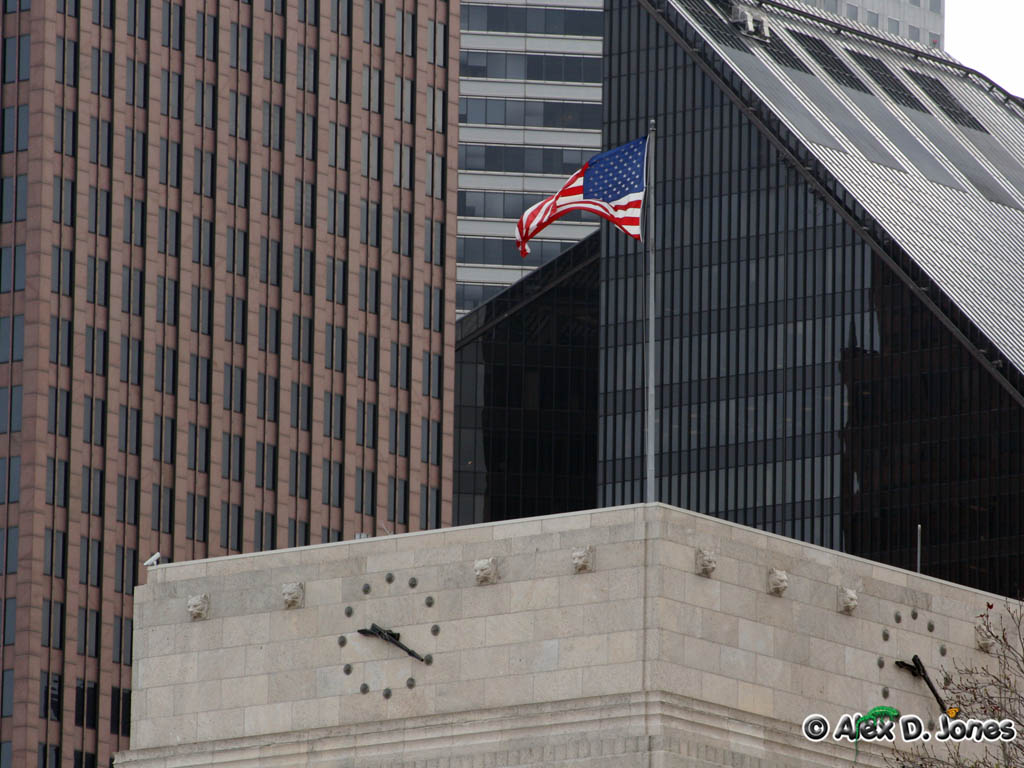
The image shows a tall building with a big clock on it and an American flag waving in the wind. The clock has black hands that point to different numbers to tell time. Behind the building, you can see other tall buildings made of brick and glass.
🔬 Scientific Phenomena
The Anchoring Phenomenon is the American flag waving and moving in the wind. This happens because moving air (wind) pushes against the fabric of the flag, causing it to flutter and change shape. Wind is created when air moves from areas of high pressure to areas of low pressure, and this moving air has enough force to make lightweight objects like flags move and dance.
📚 Core Science Concepts
- Forces and Motion: Wind is a force that can push and pull objects, causing them to move in different directions.
- Air as Matter: Even though we can't see air, it takes up space and has weight. When air moves, it can push against other objects.
- Cause and Effect: The movement of air (cause) creates the effect of the flag waving and changing position.
- Observable Properties: We can observe wind's effects on objects even though we cannot see the wind itself.
Pedagogical Tip: Use a fan and lightweight materials like ribbons, tissue paper, or scarves to demonstrate how moving air creates forces that cause objects to move. This hands-on experience helps students connect the abstract concept of wind to concrete observations.
UDL Suggestions: Provide multiple ways for students to experience wind effects: visual (watching flags wave), auditory (listening to wind sounds), and kinesthetic (feeling air from a fan on their skin). Consider students with mobility differences by bringing materials to them rather than requiring movement around the classroom.
🔍 Zoom In / Zoom Out Concepts
- Zoom In: Air is made up of tiny particles called molecules that are constantly moving and bumping into each other. When these invisible particles move together in the same direction, they create wind that pushes against the flag's fabric fibers.
- Zoom Out: This local wind is part of Earth's larger weather system, where air moves around the planet due to temperature differences between hot and cold areas, creating weather patterns that affect entire continents.
🤔 Potential Student Misconceptions
- Misconception: "Wind is made by trees moving their branches."
Clarification: Trees move because wind pushes them; trees don't create the wind.
- Misconception: "Air isn't real because I can't see it."
Clarification: Air is matter that takes up space and has weight, even though it's invisible to our eyes.
- Misconception: "The flag moves by itself."
Clarification: The flag needs a force (wind) to make it move; objects don't move without something pushing or pulling them.
🎓 NGSS Connections
- Performance Expectation: 3-PS2-1 Plan and conduct an investigation to provide evidence of the effects of balanced and unbalanced forces on the motion of an object.
- Disciplinary Core Idea: Forces and Motion - Each force acts on one particular object and has both strength and a direction.
- Crosscutting Concept: - Simple tests can be designed to gather evidence to support or refute student ideas about causes.
💬 Discussion Questions
- What evidence do you see that tells you wind is present in this picture? (Bloom's: Analyze | DOK: 2)
- How might the flag look different on a day with no wind? (Bloom's: Apply | DOK: 2)
- What other objects around our school might move the same way this flag moves? (Bloom's: Apply | DOK: 2)
- If you wanted to test how strong the wind is, what materials could you use and why? (Bloom's: Create | DOK: 3)
📖 Science Vocabulary
- Force: A push or pull that can make objects move or change direction.
- Wind: Moving air that can push against objects and make them move.
- Motion: When something changes position or moves from one place to another.
- Matter: Anything that takes up space and has weight, including air.
- Pressure: The force that air or other things push with against surfaces.
🔗 Cross-Curricular Ideas
- Math - Measuring and Comparing: Students can measure the length of different flags or ribbons and compare their sizes using standard and non-standard units. They can also estimate and measure how far a flag moves when exposed to different wind speeds using a fan, graphing their results.
- ELA - Descriptive Writing: Have students write or dictate sentences describing what they see the flag doing using action words (verbs) like "flutter," "wave," "dance," and "flutter." Students could also read and discuss "The Wind Blew" by Pat Hutchins, noticing how the author uses words to describe wind's effects on objects.
- Social Studies - Symbols and Citizenship: Discuss what the American flag represents and why it's displayed on important buildings. Students can learn basic facts about the flag's design, why we respect it, and where flags are displayed in their community (schools, government buildings, fire stations).
- Art - Movement and Expression: Students can create their own "flags" using tissue paper, ribbons, or fabric scraps attached to straws or sticks. They can then use their flags while moving around the classroom or near a fan, observing how their creations move and discussing what colors, shapes, and patterns look most interesting when moving.
🚀 STEM Career Connection
- Wind Turbine Technician — Climbs wind turbines to service them, hundreds of feet up, and keeps them turning.
- Try it: Build a pinwheel using paper and a pin, then blow on it to see how the force of your breath makes it spin. (Practice: Planning and Carrying Out Investigations)
- Tools: climbing harnesses, torque wrenches, diagnostic laptops, fibre-optic testers
- Where they work: wind farms, offshore platforms, energy companies, training centres
- Meet one: Shini Somara — How air and water flow around things, worked out on a computer before anything is built.
- Median pay: /year — "Wind turbine service technicians"
- Aerospace Engineer — Designs things that fly — aircraft, rockets and satellites — and keeps them pointed the right way.
- Try it: Design and test a paper airplane, observing how the air moving over its wings affects how it flies. (Practice: Planning and Carrying Out Investigations)
- Tools: wind tunnels, flight simulators, CAD software, vibration test rigs
- Where they work: space agencies, aircraft manufacturers, test facilities, universities
- Meet one: Aprille Ericsson — How to keep a spacecraft pointed the right way, on missions including the James Webb Space Telescope.
- Median pay: /year — "Aerospace engineers"
Wage figures are median annual wages for the U.S. occupation named after each one, from the U.S. Bureau of Labor Statistics, Occupational Employment and Wage Statistics (OEWS), national, May 2025. Several careers share one occupation, so their figures match.