📸 Photo Description
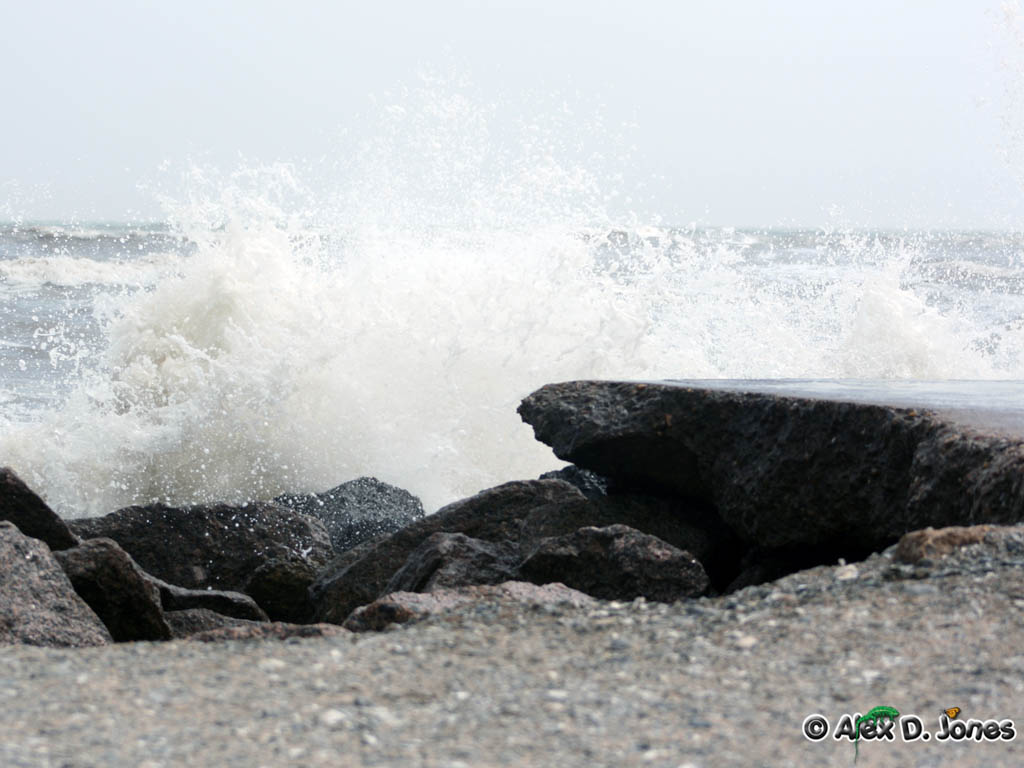
Ocean waves crash against dark rocks on a beach, creating white foam and spray. The water hits the rocks with great force, sending water droplets high into the air. You can see the sandy beach in front of the rocks and the ocean stretching far away.
🔬 Scientific Phenomena
This image captures the Anchoring Phenomenon of wave energy transfer and erosion. Ocean waves carry energy from wind across great distances. When this moving water hits solid objects like rocks, the energy is transferred on impact, creating the dramatic splash and spray visible in the photo. Over long periods of time, this constant force of water hitting rocks breaks them down into smaller pieces, which eventually become the sand on beaches. This is a perfect example of how energy can be transferred from one object to another and how forces can change the shape of Earth's surface.
📚 Core Science Concepts
- Energy Transfer: Moving water carries energy that gets transferred when it hits objects like rocks
- Forces and Motion: The force of moving water can change the motion of objects and break apart materials
- Weathering and Erosion: Water constantly hitting rocks breaks them down over time, creating smaller rock pieces and sand
- States of Matter: Water exists as a liquid in the ocean but creates tiny droplets in the air when it splashes
Pedagogical Tip: Use this image to help students make the connection between everyday experiences (like splashing in a bathtub) and larger Earth processes. Ask them to think about what happens when they jump in a pool - the same energy transfer is happening here, just on a much bigger scale!
UDL Suggestions: Provide multiple ways for students to explore this concept by having them create wave motions with their arms, use a spray bottle to demonstrate water droplets, or shake a container with water and small rocks to simulate the erosion process. This gives kinesthetic learners a hands-on way to understand the phenomena.
🔍 Zoom In / Zoom Out Concepts
- Zoom In: At the molecular level, water molecules are constantly moving and bumping into each other. When waves crash, these tiny particles hit the rock surface with tremendous force, gradually wearing away microscopic pieces of the rock's surface.
- Zoom Out: This wave action is part of the global water cycle and ocean current systems. Winds across entire ocean basins create these waves, and the erosion happening here contributes to the formation of beaches, coastal changes, and sediment that travels hundreds of miles through ocean currents.
🤔 Potential Student Misconceptions
- Misconception: "Rocks are too hard for water to break them."
Reality: Water may seem soft, but when it moves with force over long periods of time, it can break down even the hardest rocks.
- Misconception: "The splashing water just bounces off and doesn't change anything."
Reality: Each wave carries away tiny pieces of rock, and over many years, this creates significant changes to coastlines and beaches.
- Misconception: "Waves only move up and down."
Reality: Waves carry energy forward across the ocean, even though the water itself mostly moves in circular motions.
🎓 NGSS Connections
- Performance Expectation: 3-PS2-1 - Plan and conduct an investigation to provide evidence of the effects of balanced and unbalanced forces on the motion of an object
- Disciplinary Core Ideas: Forces and Interactions, The History of Planet Earth
- Crosscutting Concepts: ,
💬 Discussion Questions
- What do you think would happen if these waves hit the rocks every day for 100 years? (Bloom's: Analyze | DOK: 3)
- Where do you think the energy in these waves came from originally? (Bloom's: Analyze | DOK: 2)
- How is this wave crashing similar to what happens when you throw a ball against a wall? (Bloom's: Apply | DOK: 2)
- What evidence can you see in the photo that shows energy is being transferred? (Bloom's: Evaluate | DOK: 2)
📖 Science Vocabulary
- Energy: The ability to cause motion or create change in matter
- Force: A push or pull that can change how objects move
- Erosion: The process of breaking down rocks and moving the pieces to new places
- Transfer: To move something from one place or object to another
- Impact: When one object hits another object with force
🔗 Cross-Curricular Ideas
- Math Connection - Measurement & Data: Have students measure the height of wave splashes by taking photos at the same location over several days. They can create a bar graph showing which day had the biggest splashes. This connects to 3.MD.B.3 (Represent and interpret data).
- ELA Connection - Descriptive Writing: Ask students to write a short story or poem describing what it "feels like" to be a water droplet in a crashing wave. They can use sensory words (wet, cold, fast, loud) to describe the journey of water from the ocean to the rocks. This builds vocabulary and creative expression skills.
- Social Studies Connection - Coastal Communities: Discuss how people who live near the ocean experience waves and erosion. Students can research or discuss how communities protect their beaches and homes from wave erosion, introducing concepts of human-environment interaction and adaptation.
- Art Connection - Mixed Media: Students can create an artistic representation of wave energy using various materials (paint, sand, tissue paper, blue fabric) to show the movement and power of water. This helps them express scientific understanding through creative means.
🚀 STEM Career Connection
- Materials Scientist — Invents and tests new materials — stronger, lighter, or able to do something the old ones could not.
- Try it: Test how different liquids (water, oil, syrup) flow down a tilted surface to see which moves fastest. (Practice: Constructing explanations and designing solutions)
- Tools: electron microscopes, stress testers, furnaces, X-ray diffractometers
- Where they work: research laboratories, manufacturing companies, national labs, universities
- Meet one: Ainissa Ramirez — How to make metal stick to glass and ceramics — she invented a solder that does it.
- Median pay: /year — "Materials scientists"
- Mechanical Engineer — Designs things that move — engines, turbines, joints and gears — and works out the forces on them.
- Try it: Design and build a simple catapult using rubber bands and craft sticks to launch a small object. (Practice: Constructing explanations and designing solutions)
- Tools: CAD software, 3D printers, force sensors, wind tunnels
- Where they work: engineering firms, factories, design studios, research labs
- Meet one: Shini Somara — How air and water flow around things, worked out on a computer before anything is built.
- Median pay: /year — "Mechanical engineers"
Wage figures are median annual wages for the U.S. occupation named after each one, from the U.S. Bureau of Labor Statistics, Occupational Employment and Wage Statistics (OEWS), national, May 2025. Several careers share one occupation, so their figures match.