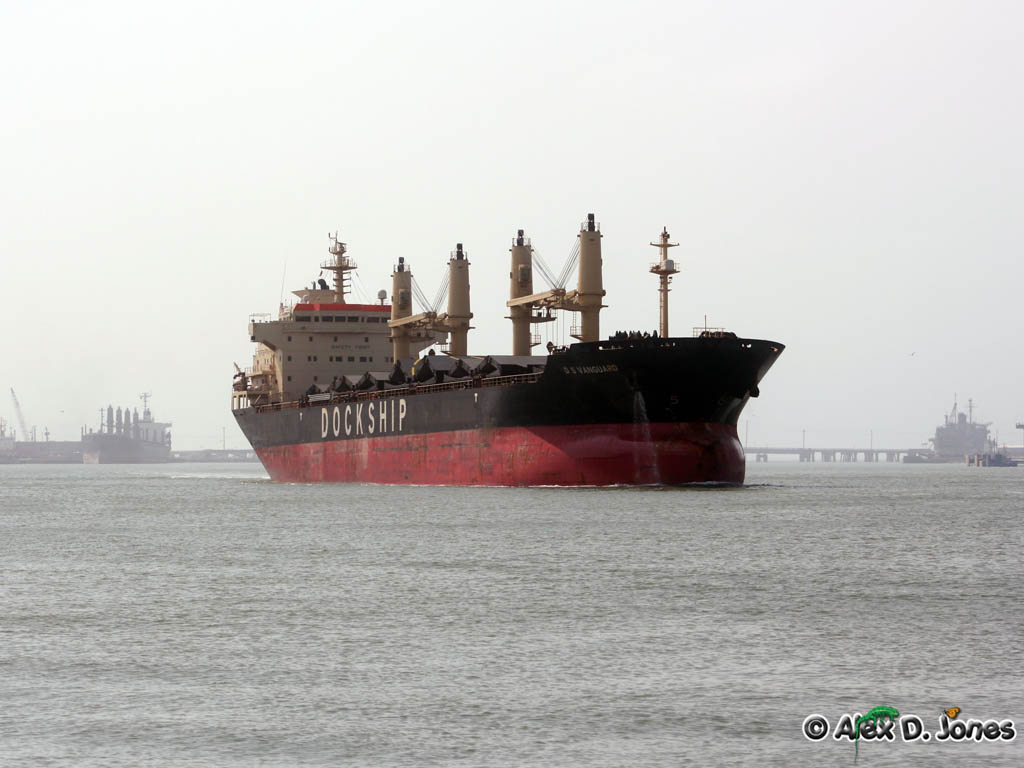
📸 Photo Description
A large cargo ship with a red bottom and black top floats on water. The ship has tall poles called cranes that help load and unload heavy things. You can see the word "DOCKSHIP" written on the side of this big boat.
🔬 Scientific Phenomena
The Anchoring Phenomenon is buoyancy - how massive, heavy objects like cargo ships can float on water. This happens because the ship displaces (pushes away) a volume of water that weighs more than the ship itself. The upward force from the water (buoyant force) balances the downward force of the ship's weight, allowing it to stay afloat rather than sink to the bottom.
📚 Core Science Concepts
- Buoyancy and Floating: Objects float when they displace water that weighs more than the object itself
- Forces in Balance: The upward push of water equals the downward pull of gravity on the floating ship
- Density Differences: Ships are designed with hollow spaces filled with air, making their overall density less than water
- Mass vs. Weight: Even though the ship has tremendous mass, it can still float due to its shape and design
Pedagogical Tip: Use a clear container with water and various objects (clay ball vs. clay boat shape) to demonstrate how shape affects floating. This concrete experience helps students understand the abstract concept of buoyancy.
UDL Suggestions: Provide multiple ways for students to explore floating: hands-on experiments, digital simulations, and drawing/labeling activities to accommodate different learning preferences and physical abilities.
🔍 Zoom In / Zoom Out Concepts
Zoom In: At the molecular level, water molecules are constantly pushing against the ship's hull. These tiny pushes add up to create the buoyant force that keeps the massive ship floating.
Zoom Out: This cargo ship is part of a global transportation system that moves goods across oceans. The same physics principles that keep this ship afloat also work for all floating objects in Earth's water cycle, from icebergs to leaves on a pond.
🤔 Potential Student Misconceptions
- Misconception: "Heavy things always sink in water."
Reality: Weight alone doesn't determine if something floats - it's about how much water the object pushes away compared to its weight.
- Misconception: "Ships float because they're made of special materials."
Reality: Ships float because of their shape and design, not the materials. Even steel ships can float if designed properly.
- Misconception: "Bigger objects sink faster than smaller ones."
Reality: Size doesn't determine floating - a huge ship can float while a small rock sinks.
🎓 NGSS Connections
- Performance Expectation: 2-PS1-2: Analyze data obtained from testing different materials to determine which materials have the properties that are best suited for an intended purpose
- Disciplinary Core Ideas: - Different kinds of matter exist and many of them can be either solid or liquid, depending on temperature
- Crosscutting Concepts: - Events have causes that generate observable patterns
💬 Discussion Questions
- What do you think would happen if we filled the ship completely with water instead of cargo? (Bloom's: Predict | DOK: 2)
- How is this big ship similar to a small toy boat floating in your bathtub? (Bloom's: Compare | DOK: 2)
- Why might the ship's designers make the bottom part red and the top part black? (Bloom's: Analyze | DOK: 3)
- What forces are working on this ship right now to keep it floating? (Bloom's: Identify | DOK: 1)
📖 Science Vocabulary
- Buoyancy: The upward push that water gives to objects, helping them float
- Displace: To push something out of the way and take its place
- Density: How tightly packed the matter in an object is
- Hull: The main body of a ship that touches the water
- Cargo: The goods or materials that ships carry from place to place
🔗 Cross-Curricular Ideas
- Mathematics - Measurement & Comparison: Have students measure the lengths of different toy boats and predict which ones will float. Create a class chart showing boat length vs. floating ability. Students can use rulers and record data in simple tables, connecting measurement skills to the buoyancy concept.
- English Language Arts - Descriptive Writing: Ask students to write or dictate sentences describing what they see in the ship photo using adjectives (big, red, heavy, tall). They could also create simple stories about cargo ships traveling to different ports, practicing narrative writing while reinforcing vocabulary.
- Social Studies - Global Trade & Shipping Routes: Discuss how cargo ships like this one carry toys, clothes, and food from one country to another. Show students a world map and trace simple shipping routes. This helps them understand how ships connect communities and cultures around the world.
- Art - Design & Color: Have students design their own cargo ship using markers or paint, deciding what colors to use and why. They could draw the ship from different angles (side view, top view) or create a diorama of a port with multiple floating vessels, exploring perspective and spatial relationships.
🚀 STEM Career Connection
- Civil Engineer — Designs the things a town runs on — roads, bridges, water pipes and drains.
- Try it: Design a simple floating platform that can support a specific weight, sketching your design and explaining how it would stay afloat. (Practice: Constructing Explanations and Designing Solutions)
- Tools: surveying equipment, CAD software, soil tests, load calculations
- Where they work: construction sites, city engineering departments, design firms, transport agencies
- Meet one: Roma Agrawal — How to hold a skyscraper up — she designed the foundations and the spire of the Shard.
- Median pay: /year — "Civil engineers"
- Materials Scientist — Invents and tests new materials — stronger, lighter, or able to do something the old ones could not.
- Try it: Test different types of clay, shaping some into balls and others into boat shapes, to see which shape floats better and why. (Practice: Constructing Explanations and Designing Solutions)
- Tools: electron microscopes, stress testers, furnaces, X-ray diffractometers
- Where they work: research laboratories, manufacturing companies, national labs, universities
- Meet one: Ainissa Ramirez — How to make metal stick to glass and ceramics — she invented a solder that does it.
- Median pay: /year — "Materials scientists"
Wage figures are median annual wages for the U.S. occupation named after each one, from the U.S. Bureau of Labor Statistics, Occupational Employment and Wage Statistics (OEWS), national, May 2025. Several careers share one occupation, so their figures match.