📸 Photo Description
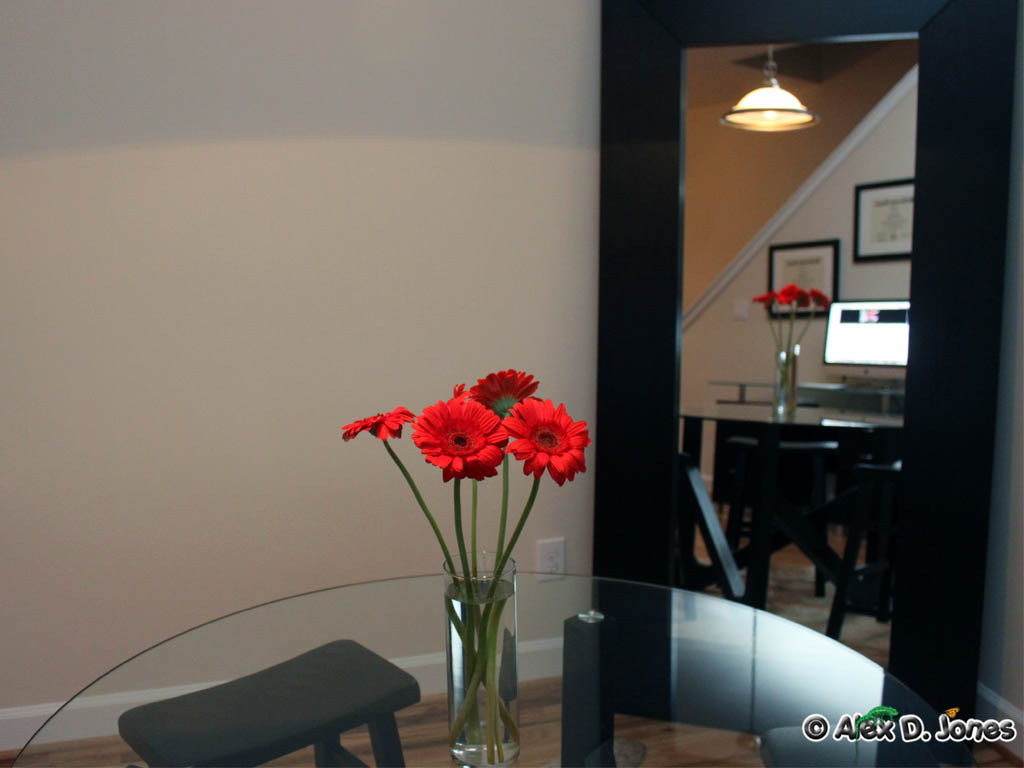
Red flowers sit in a clear glass vase on a shiny table. The flowers have long green stems and bright red petals. You can see the flowers reflected in the mirror behind the table.
🔬 Scientific Phenomena
The anchoring phenomenon is light reflection - we can see the flowers appearing twice because light bounces off the mirror's smooth surface back to our eyes. This happens because mirrors have a very smooth, shiny surface that reflects light rays at the same angle they hit it. The reflection creates what appears to be another set of flowers behind the mirror, even though they're not really there.
📚 Core Science Concepts
- Light travels in straight lines - Light moves from the flowers to our eyes and also bounces off the mirror
- Reflection occurs when light bounces off surfaces - Smooth, shiny surfaces like mirrors reflect light better than rough surfaces
- Mirrors create images that appear to be behind the surface - The reflected image looks like it's the same distance behind the mirror as the real object is in front
- Transparent materials allow light to pass through - We can see through the clear glass vase because light travels through it
Pedagogical Tip: Have students use flashlights and small mirrors to explore how light bounces at different angles. This hands-on experience helps them understand that reflection follows predictable patterns.
UDL Suggestions: Provide multiple ways for students to demonstrate understanding: drawing ray diagrams, acting out light's path with their bodies, or using digital tools to create before/after images showing objects and their reflections.
🔍 Zoom In / Zoom Out Concepts
- Zoom In: At the microscopic level, smooth mirror surfaces have tiny particles arranged in very even, flat patterns that bounce light rays back uniformly, while rough surfaces scatter light in many directions.
- Zoom Out: Reflection is essential in nature - animals use reflection in water to find drinking sources, and many creatures have evolved reflective surfaces for camouflage, communication, or protection from predators.
🤔 Potential Student Misconceptions
- Misconception: The flowers in the mirror are real objects behind the mirror.
Clarification: Reflections are images created by light bouncing off the mirror - nothing actually exists behind the mirror surface.
- Misconception: Only mirrors can create reflections.
Clarification: Any smooth, shiny surface can create reflections including water, polished metal, or even phone screens.
- Misconception: Light from our eyes helps us see the reflection.
Clarification: Light travels from light sources (like the room's lights) to objects, then bounces to our eyes - our eyes don't produce light.
🎓 NGSS Connections
- Performance Expectation: 1-PS4-3 Plan and conduct investigations to determine the effect of placing objects made with different materials in the path of a beam of light
- Disciplinary Core Ideas: - Objects can be seen if light is available to illuminate them or if they give off their own light
- Crosscutting Concepts: - Simple tests can be designed to gather evidence to support or refute student ideas about causes
💬 Discussion Questions
- What would happen to the reflection if we moved the flowers closer to the mirror? (Bloom's: Predict | DOK: 2)
- Why can we see through the glass vase but not through the table? (Bloom's: Analyze | DOK: 2)
- How is the reflection similar to and different from the real flowers? (Bloom's: Compare | DOK: 2)
- What other objects in this room might create reflections, and why? (Bloom's: Apply | DOK: 3)
📖 Science Vocabulary
- Reflection: When light bounces off a surface back to your eyes
- Transparent: Materials you can see through clearly, like glass or water
- Image: A picture or copy of something that appears in a mirror or reflection
- Light source: Something that makes its own light, like the sun or a lamp
- Surface: The outside or top part of something you can touch
🔗 Cross-Curricular Ideas
- Math - Symmetry and Patterns: Have students draw the flowers and their reflections, then fold their paper in half along the mirror line to discover symmetry. They can count the petals on real flowers versus reflected flowers to practice addition and comparison skills.
- ELA - Descriptive Writing: Students can write detailed descriptions of the flowers using sensory words (bright, shiny, smooth, colorful). They could also write a story from the perspective of the flowers looking at their own reflection and wondering what they see.
- Art - Mirror Self-Portraits: Students can stand in front of mirrors and sketch their own reflections, then compare their drawings to photographs. This helps them understand how mirrors show us accurate images while also exploring identity and self-awareness through art.
- Social Studies - Community Helpers: Connect to jobs like florists who arrange flowers and interior designers who use mirrors and reflections to make spaces feel larger and brighter. Students can research how these professionals use reflection and light in their work.
🚀 STEM Career Connection
- Optical Engineer — Designs lenses, mirrors and light paths so that an image or a beam lands exactly where it should.
- Try it: Design a way to use a mirror to direct a beam of light from a flashlight onto a specific spot on the wall. (Practice: Constructing Explanations and Designing Solutions)
- Tools: laser benches, interferometers, lens polishers, ray-tracing software
- Where they work: optics companies, telescope builders, camera manufacturers, research labs
- Meet one: Jess Wade — Materials that glow — the ones inside the screens we look at every day.
- Median pay: /year — "Engineers, all other"
- Architect — Designs buildings that work for the people inside and stand up to the weather outside.
- Try it: Draw a plan for a room that uses mirrors to make the space feel larger, explaining where you would place them. (Practice: Constructing Explanations and Designing Solutions)
- Tools: CAD software, scale models, site surveys, material samples
- Where they work: architecture practices, construction sites, city planning offices, design studios
- Meet one: Roma Agrawal — How to hold a skyscraper up — she designed the foundations and the spire of the Shard.
- Median pay: /year — "Architects, except landscape and naval"
Wage figures are median annual wages for the U.S. occupation named after each one, from the U.S. Bureau of Labor Statistics, Occupational Employment and Wage Statistics (OEWS), national, May 2025. Several careers share one occupation, so their figures match.