📸 Photo Description
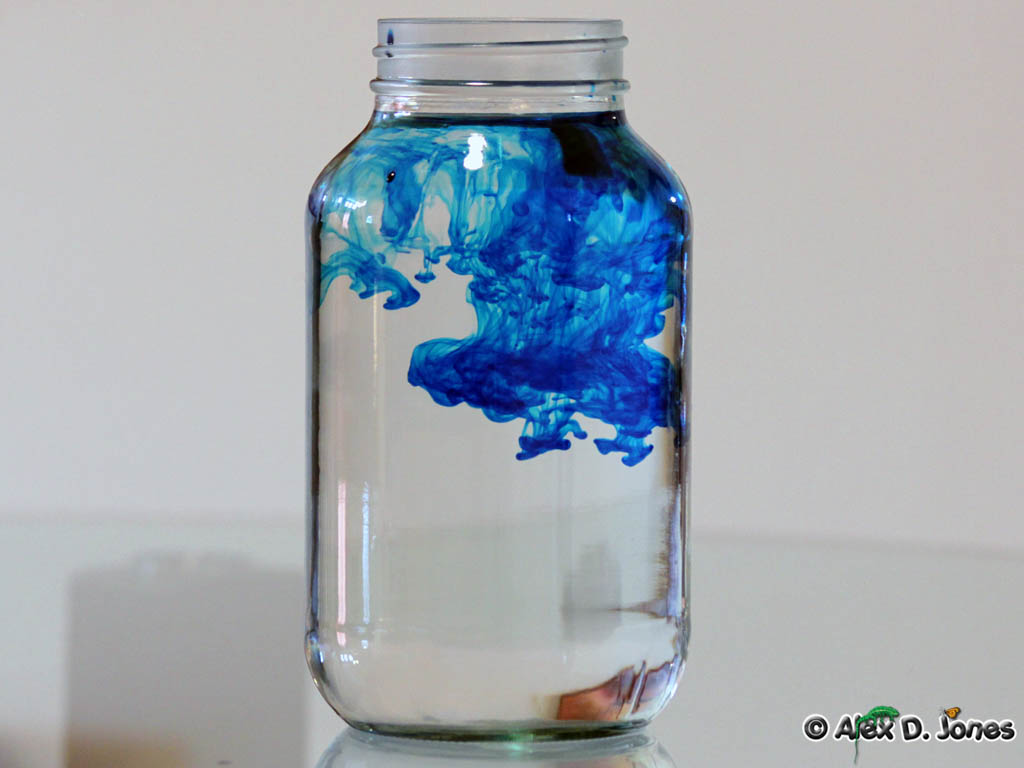
A glass jar filled with clear water shows bright blue liquid spreading and swirling through it. The blue color creates beautiful, cloud-like shapes as it moves through the water. The blue and clear liquids are mixing together but you can still see both colors.
🔬 Scientific Phenomena
This image demonstrates the anchoring phenomenon of diffusion and mixing of liquids. When a colored liquid (likely food coloring or dye) is added to clear water, the molecules of the colored substance begin to spread out and move throughout the water due to molecular motion. The blue dye particles are naturally moving from areas where there are many dye molecules to areas where there are fewer, eventually creating an even distribution throughout the water. This process happens because all molecules are constantly in motion, even when we can't see them moving.
📚 Core Science Concepts
- Matter and Its Properties: Liquids can be mixed together and take the shape of their container. Different liquids can have different colors and properties.
- Observable Changes: When substances are mixed, we can observe changes in color, appearance, and other properties using our senses.
- Particle Movement: Even though we can't see them, tiny particles in liquids are always moving and spreading out.
- Mixing and Solutions: Some substances can dissolve or spread evenly throughout other substances, creating mixtures.
Pedagogical Tip: Have students make predictions about what will happen before conducting mixing experiments. This activates prior knowledge and gives you insight into their thinking before instruction begins.
UDL Suggestions: Provide multiple ways for students to document observations by offering options like drawing, writing, or verbal descriptions with a partner. This supports different learning preferences and abilities.
🔍 Zoom In / Zoom Out Concepts
Zoom In: At the molecular level, individual dye molecules are bouncing around and colliding with water molecules. Each tiny particle is moving randomly in different directions, gradually spreading the blue color throughout the entire container through molecular motion.
Zoom Out: This same mixing process happens throughout nature - in oceans when rivers carry sediments, in our bloodstream when nutrients spread through our bodies, and in the atmosphere when gases mix in the air we breathe.
🤔 Potential Student Misconceptions
- Misconception: "The liquid stops moving once it looks still."
Reality: Molecules continue moving even when the liquid appears motionless to our eyes.
- Misconception: "Someone or something is pushing the blue color through the water."
Reality: The spreading happens naturally due to the constant motion of molecules, not from an outside force.
- Misconception: "The blue liquid disappears when it mixes."
Reality: The blue molecules are still there, just spread out evenly so the color looks lighter.
🎓 NGSS Connections
- Performance Expectation: 2-PS1-1 - Plan and conduct an investigation to describe and classify different kinds of materials by their observable properties.
- Disciplinary Core Ideas: - Different kinds of matter exist and many of them can be either solid or liquid, depending on temperature.
- Crosscutting Concepts: - Patterns in the natural and human designed world can be observed and used as evidence.
💬 Discussion Questions
- What do you think will happen if we add yellow food coloring to this blue mixture? (Bloom's: Apply | DOK: 2)
- How could we make the blue color spread faster or slower through the water? (Bloom's: Analyze | DOK: 3)
- Where else have you seen liquids mixing together in your daily life? (Bloom's: Apply | DOK: 2)
- Why do you think the blue color eventually spreads throughout all the water instead of staying in one spot? (Bloom's: Analyze | DOK: 3)
📖 Science Vocabulary
- Mixture: When two or more different materials are combined together but keep their own properties.
- Dissolve: When one substance spreads out completely and evenly in another substance.
- Properties: The characteristics of matter that we can observe, like color, shape, or texture.
- Molecules: Tiny particles that make up all matter, too small to see without special tools.
- Diffusion: The way particles naturally spread out from crowded areas to less crowded areas.
🔗 Cross-Curricular Ideas
- Mathematics - Patterns and Sequences: Have students observe the mixing process at different time intervals (0 minutes, 1 minute, 5 minutes, 10 minutes) and create a bar graph or picture graph showing how the color intensity changes over time. This connects to measurement and data representation standards.
- ELA - Descriptive Writing: Ask students to write or dictate sentences describing what they observe using sensory words (swirling, spreading, mixing, cloud-like, bright). Create a class word bank of descriptive adjectives and use them in collaborative storytelling about the "journey of the blue dye."
- Art - Color Mixing and Observation: Connect to color theory by experimenting with different food coloring colors in water and predicting what new colors will form when mixed (blue + yellow = green). Students can create watercolor paintings inspired by the swirling patterns they observe in the jar.
- Social Studies - Water Around Us: Discuss how water mixing is important in our communities - from water treatment plants that clean our drinking water to rivers carrying nutrients to farms. Invite students to think about where water comes from in their homes and how it's kept clean.
🚀 STEM Career Connection
- Chemical Engineer — Scales a reaction up from a test tube to a factory without it going wrong.
- Try it: Model how to mix two different colored liquids in a clear container to create a new color, thinking about how you'd do it in a big tank. (Practice: Developing and Using Models)
- Tools: reactor vessels, flow controllers, process models, safety systems
- Where they work: chemical plants, refineries, food factories, research labs
- Meet one: Tebello Nyokong — Dyes that can be switched on by laser light to destroy cancer cells and leave healthy ones alone.
- Median pay: /year — "Chemical engineers"
- Materials Scientist — Invents and tests new materials — stronger, lighter, or able to do something the old ones could not.
- Try it: Use a model with different colored beads to show how particles spread out evenly when mixed into a larger group. (Practice: Developing and Using Models)
- Tools: electron microscopes, stress testers, furnaces, X-ray diffractometers
- Where they work: research laboratories, manufacturing companies, national labs, universities
- Meet one: Ainissa Ramirez — How to make metal stick to glass and ceramics — she invented a solder that does it.
- Median pay: /year — "Materials scientists"
Wage figures are median annual wages for the U.S. occupation named after each one, from the U.S. Bureau of Labor Statistics, Occupational Employment and Wage Statistics (OEWS), national, May 2025. Several careers share one occupation, so their figures match.