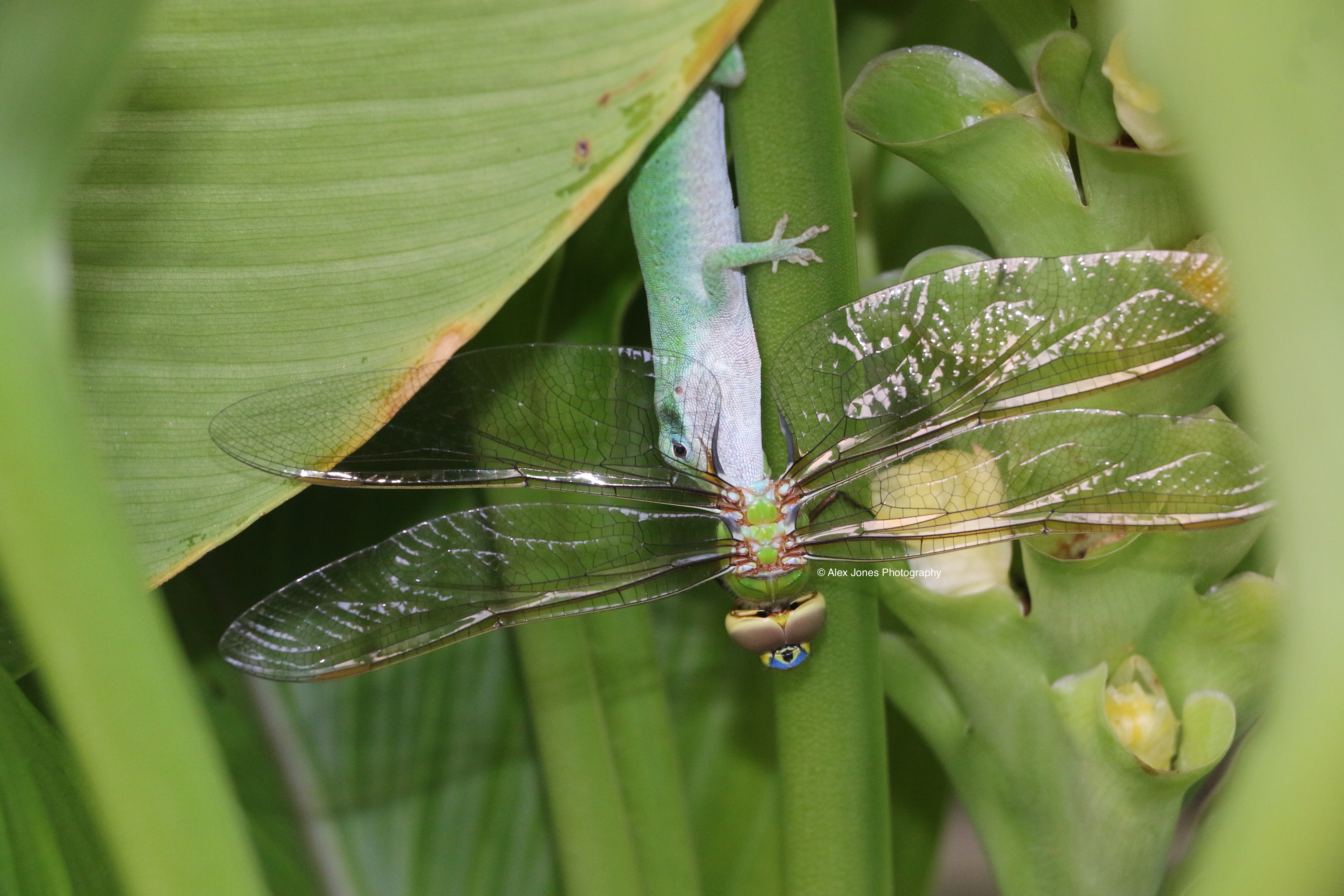
📸 Photo Description
A green gecko sits on top of a dragonfly that has clear wings with dark lines. The gecko and dragonfly are resting on green plant leaves. The gecko is using its sticky feet to hold onto the dragonfly it caught for food.
🔬 Scientific Phenomena
This image captures the predator-prey relationship phenomenon, where one animal (the gecko) hunts and catches another animal (the dragonfly) for survival. This is happening because all animals need energy from food to live and grow. The gecko is a carnivore that hunts insects like dragonflies. The gecko's specialized adaptations - including sticky toe pads, quick reflexes, and camouflage coloring - help it successfully catch prey in its natural habitat.
📚 Core Science Concepts
- Predator-Prey Relationships: Animals depend on other living things for food, creating feeding relationships in nature
- Animal Adaptations: Both animals have special body parts that help them survive - the gecko has sticky feet and camouflage, while the dragonfly has wings for flight and large eyes for spotting danger
- Food Chains: Energy flows from one living thing to another when animals eat plants or other animals
- Habitat Requirements: Animals live in places that provide food, water, shelter, and space they need to survive
Pedagogical Tip: Use this image to help students understand that being a predator or prey isn't "good" or "bad" - it's simply how nature works. Both roles are important for keeping ecosystems balanced and healthy.
UDL Suggestions: Provide students with multiple ways to express their understanding by offering choices: drawing their own food chain, acting out predator-prey relationships, or creating a digital presentation about animal adaptations.
🔍 Zoom In / Zoom Out Concepts
- Zoom In: At the microscopic level, the gecko's toe pads contain millions of tiny hairs called setae that use molecular forces to stick to any surface, even smooth glass or wet leaves.
- Zoom Out: This predator-prey interaction is part of a larger food web that includes plants, insects, reptiles, birds, and mammals all connected through feeding relationships that keep the ecosystem in balance.
🤔 Potential Student Misconceptions
- Misconception: "The gecko is being mean to the dragonfly."
Clarification: Predators aren't mean - they're following their natural instincts to survive and get the energy they need to live.
- Misconception: "All geckos eat the same things."
Clarification: Different gecko species eat different foods based on their size, habitat, and available prey in their environment.
- Misconception: "The dragonfly should have flown away faster."
Clarification: Predators often succeed because they have adaptations that help them catch prey, even when prey animals have their own escape adaptations.
🎓 NGSS Connections
- Performance Expectation: 3-LS4-3 - Construct an argument with evidence that in a particular habitat some organisms can survive well, some survive less well, and some cannot survive at all.
- Disciplinary Core Ideas: - Environmental changes affect organisms and - Social interactions and group behavior
- Crosscutting Concepts: and
💬 Discussion Questions
- What body parts help the gecko be a successful hunter? (Bloom's: Analyze | DOK: 2)
- How might this feeding relationship change if there were fewer dragonflies in this habitat? (Bloom's: Evaluate | DOK: 3)
- What adaptations does the dragonfly have that usually help it avoid predators? (Bloom's: Apply | DOK: 2)
- If you were designing an animal to live in this habitat, what features would you give it? (Bloom's: Create | DOK: 3)
📖 Science Vocabulary
- Predator: An animal that hunts and eats other animals for food
- Prey: An animal that is hunted and eaten by other animals
- Adaptation: A special body part or behavior that helps an animal survive in its habitat
- Carnivore: An animal that eats only other animals
- Habitat: The natural place where an animal lives and finds everything it needs to survive
- Food chain: The path that shows how energy moves from one living thing to another through eating
🔗 Cross-Curricular Ideas
- ELA - Story Writing: Have students write a short story from the perspective of either the gecko or the dragonfly. What happened before this moment? What will happen next? Students can illustrate their stories and share them with the class.
- Math - Food Chain Counting: Create a simple food chain scenario and have students solve word problems. For example: "If a gecko eats 5 insects a day, how many insects does it eat in one week?" This practices multiplication and real-world math applications.
- Art - Camouflage Collage: Students create artwork showing how animals use camouflage to hide from predators. They can use green, brown, and yellow materials to design their own camouflaged animal that blends into a habitat environment.
- Social Studies - Habitats Around the World: Research where geckos and dragonflies live in different countries and regions. Students can locate these places on a map and learn about different ecosystems and climates around the world.
🚀 STEM Career Connection
- Biologist — Studies living things of every kind and what keeps them alive.
- Try it: Research and share one interesting fact about how geckos find their food. (Practice: Obtaining, Evaluating, and Communicating Information)
- Tools: microscopes, sample jars, measuring tools, a field notebook
- Where they work: laboratories, field sites, museums, universities
- Meet one: Sandra Díaz — What a plant's leaves, wood and shape tell you about how it lives — and how those traits add up across a whole ecosystem.
- Median pay: /year — "Biological scientists, all other"
- Entomologist — Studies insects — how they live, what they eat, and the jobs they do in an ecosystem.
- Try it: Research and share one interesting fact about how dragonflies avoid becoming prey. (Practice: Obtaining, Evaluating, and Communicating Information)
- Tools: insect nets, a hand lens, pinning boards, microscopes
- Where they work: museums, farms, insect labs, universities
- Meet one: Corrie Moreau — How ants evolved together with the bacteria that live inside them.
- Median pay: /year — "Zoologists and wildlife biologists"
Wage figures are median annual wages for the U.S. occupation named after each one, from the U.S. Bureau of Labor Statistics, Occupational Employment and Wage Statistics (OEWS), national, May 2025. Several careers share one occupation, so their figures match.