📸 Photo Description
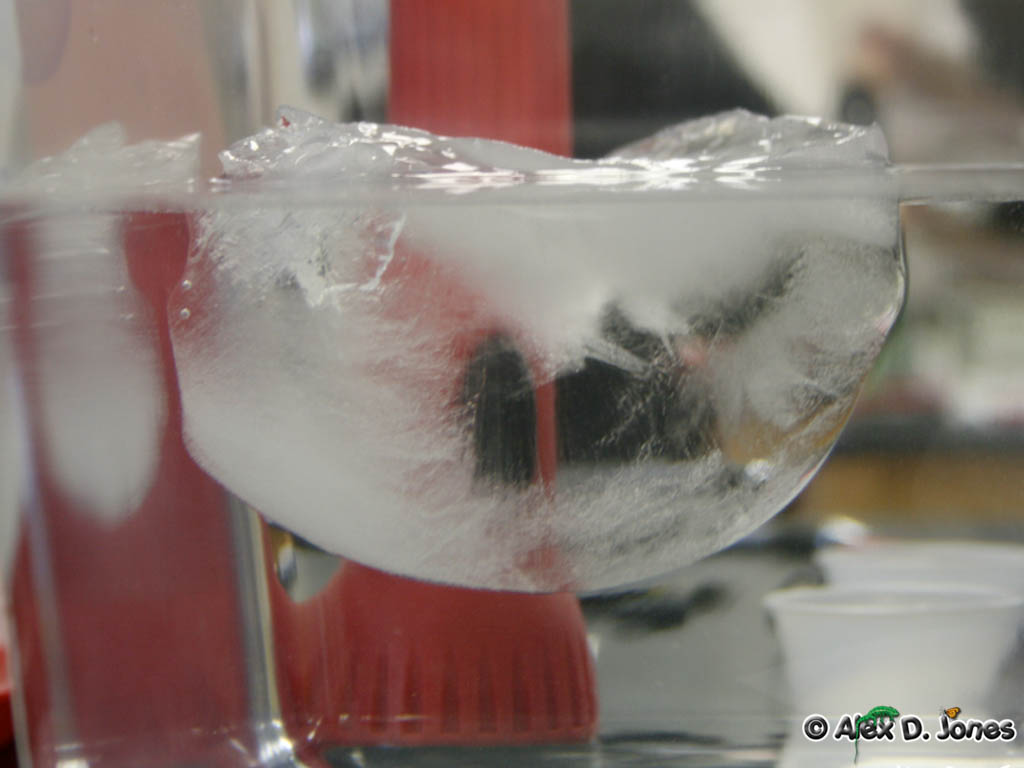
A clear glass bowl sits on a table with ice cubes floating in water. The ice cubes look cloudy and white in some parts. You can see bubbles or air trapped inside the ice, making it look different from the clear water around it.
🔬 Scientific Phenomena
This image shows the anchoring phenomenon of states of matter in equilibrium. The ice cubes (solid water) are slowly melting into liquid water due to heat energy from the surrounding environment. The cloudiness in the ice is caused by air bubbles that became trapped when the water froze quickly. As the ice absorbs thermal energy from the warmer air and water around it, the molecular bonds weaken and the solid ice transforms into liquid water through the process of melting.
📚 Core Science Concepts
- States of Matter: Water exists in different forms - solid (ice), liquid (water), and gas (water vapor), depending on temperature and energy.
- Heat Transfer: Thermal energy moves from warmer objects (room temperature air and water) to cooler objects (ice cubes), causing the ice to melt.
- Physical Changes: Melting is a reversible physical change where the substance (water) stays the same, but its form changes from solid to liquid.
- Air and Gases: The cloudy appearance in ice shows that air (a gas) can be trapped in solids when water freezes quickly.
Pedagogical Tip: Use this image to help students make connections between everyday experiences (ice in drinks) and scientific concepts. Ask them to share their observations about ice cubes at home before introducing scientific vocabulary.
UDL Suggestions: Provide multiple ways for students to engage with this concept: visual observation of the image, hands-on ice melting experiments, and kinesthetic activities where students act out water molecules in different states of matter.
🔍 Zoom In / Zoom Out Concepts
- Zoom In: At the molecular level, water molecules in ice are arranged in rigid, organized patterns held together by strong bonds. As heat energy is added, these molecules vibrate faster and break free from their fixed positions, allowing them to flow as liquid water.
- Zoom Out: This melting process connects to the larger water cycle system on Earth, where ice in glaciers, snow, and frozen lakes melts to provide fresh water for rivers, streams, and groundwater that supports all living things.
🤔 Potential Student Misconceptions
- Misconception: "Ice is not the same thing as water."
Clarification: Ice and liquid water are the same substance (H₂O) in different states - only the arrangement and movement of molecules changes.
- Misconception: "Cold makes ice melt."
Clarification: Heat energy causes ice to melt. Even at room temperature, there is enough thermal energy to melt ice.
- Misconception: "The bubbles in ice are water turning to gas."
Clarification: The cloudy areas are air bubbles that got trapped when the water froze, not water vapor forming.
🎓 NGSS Connections
- Performance Expectation: 2-PS1-1 - Plan and conduct an investigation to describe and classify different kinds of materials by their observable properties.
- Disciplinary Core Idea: - Different kinds of matter exist and many of them can be either solid or liquid, depending on temperature.
- Crosscutting Concept: - Patterns in the natural world can be observed and used as evidence.
💬 Discussion Questions
- What do you notice happening to the ice cubes in this bowl? (Bloom's: Observe | DOK: 1)
- Why do you think some parts of the ice look cloudy while the water looks clear? (Bloom's: Analyze | DOK: 2)
- How could you speed up or slow down the melting process? (Bloom's: Apply | DOK: 2)
- What would happen if we put this bowl in the freezer overnight? (Bloom's: Predict | DOK: 3)
📖 Science Vocabulary
- Melting: When a solid changes into a liquid because it gets warmer.
- States of matter: The different forms that materials can take, like solid, liquid, or gas.
- Thermal energy: Heat energy that can move from one object to another.
- Physical change: When something looks different but is still made of the same material.
- Molecules: Tiny particles that make up all materials, too small to see.
🔗 Cross-Curricular Ideas
- Math - Measuring and Graphing: Have students measure the height of ice cubes at different times (every 5 minutes) as they melt. Record the measurements on a chart and create a simple bar graph to show how the ice level changes over time. This connects to measurement standards and data representation.
- ELA - Descriptive Writing: Ask students to write or dictate detailed descriptions of what they observe happening to the ice cubes using sensory words (cloudy, cold, wet, slippery). Create a "melting ice" word wall together, then use these words in simple sentences or a class story about the ice's journey from solid to liquid.
- Art - Color Mixing and Texture: Have students create artwork showing ice cubes using white paint, glitter, and cotton balls to represent the cloudy, bubbly texture of ice. They can paint the water around it with blues and add reflections. This explores how artists show different states of matter visually.
- Social Studies - Water Conservation: Connect the melting ice to discussions about where water comes from and why it's important to conserve it. Students can learn that glaciers and ice in cold places around the world provide fresh water for people and animals, linking local observations to global water systems.
🚀 STEM Career Connection
- Physicist — Works out the rules that matter and energy follow, from the very small to the whole universe.
- Try it: Observe dry ice sublimating in water and record the rate of gas production. (Practice: Analyzing and Interpreting Data)
- Tools: lasers, detectors, vacuum chambers, computer simulations
- Where they work: research laboratories, particle accelerators, observatories, universities
- Meet one: Chanda Prescod-Weinstein — Dark matter — the invisible material that makes up most of the universe.
- Median pay: /year — "Physicists"
- Chemist — Studies what substances are made of and what happens when you combine them.
- Try it: Observe dry ice sublimating and record the visible changes and any sounds it makes. (Practice: Analyzing and Interpreting Data)
- Tools: fume hoods, balances, spectrometers, glassware
- Where they work: laboratories, manufacturing plants, testing facilities, universities
- Meet one: Tebello Nyokong — Dyes that can be switched on by laser light to destroy cancer cells and leave healthy ones alone.
- Median pay: /year — "Chemists"
Wage figures are median annual wages for the U.S. occupation named after each one, from the U.S. Bureau of Labor Statistics, Occupational Employment and Wage Statistics (OEWS), national, May 2025. Several careers share one occupation, so their figures match.