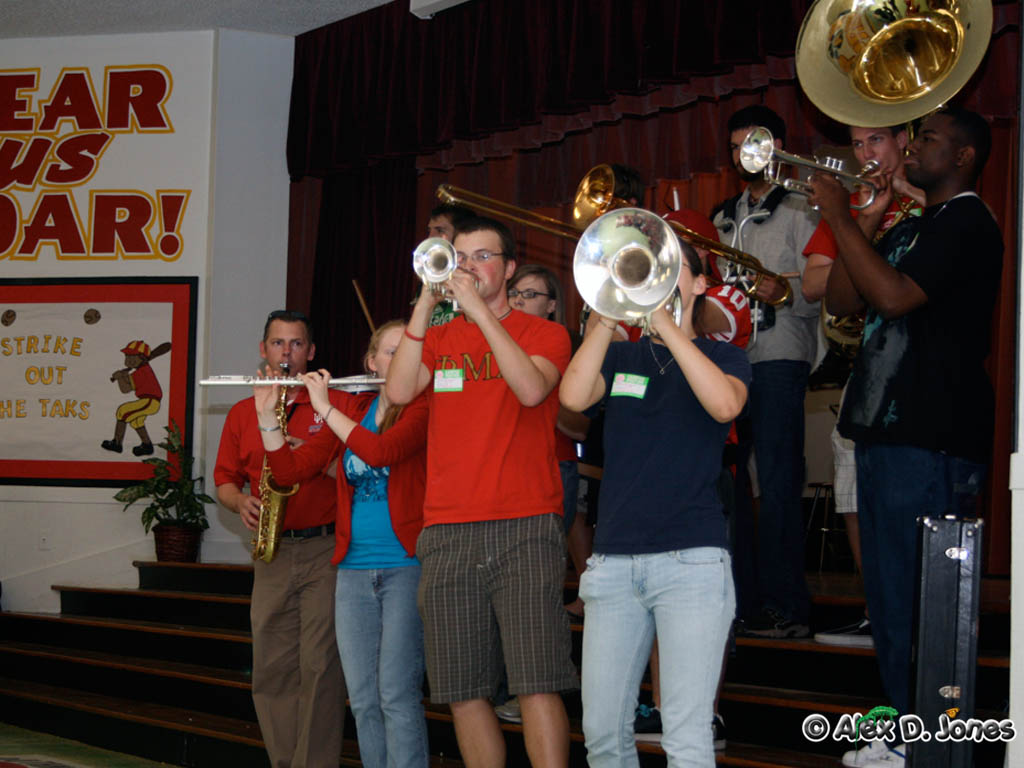
📸 Photo Description
Students and adults are playing different musical instruments together in what looks like a school event. The instruments include trumpets, trombones, flutes, and a tuba. When they blow air into these instruments, the instruments make different sounds and music.
🔬 Scientific Phenomena
The anchoring phenomenon here is sound production through vibration. When musicians blow air into brass and woodwind instruments, they create vibrations that travel through the air as sound waves. Different instruments produce different pitches based on the length of the air column inside them and how the air vibrates. Longer air columns (like in tubas) create lower sounds, while shorter air columns (like in trumpets) create higher sounds.
📚 Core Science Concepts
- Sound is produced by vibrations - All musical instruments create sound by making something vibrate, whether it's air, strings, or the instrument itself.
- Sound travels through air as waves - The vibrations created by instruments move through the air to reach our ears, allowing us to hear the music.
- Pitch depends on frequency of vibration - Faster vibrations create higher sounds, while slower vibrations create lower sounds.
- Different materials and shapes affect sound - The size, shape, and material of an instrument determines what kind of sound it makes.
Pedagogical Tip: Have students place their hands on their throats while humming to feel vibrations directly. This concrete experience helps them understand that all sound comes from something moving back and forth.
UDL Suggestions: Provide multiple ways for students to experience sound concepts: visual representations with wave drawings, kinesthetic activities like jumping fast/slow for high/low pitch, and auditory examples with various instruments or apps.
🔍 Zoom In / Zoom Out Concepts
Zoom In: Inside each instrument, air molecules are bumping into each other in patterns. When a musician blows into a trumpet, the air molecules start vibrating very quickly - about 440 times per second for the note A! These tiny, invisible movements create the sound waves we hear.
Zoom Out: This musical performance connects to communication systems in nature and human society. Just like these instruments send sound messages to an audience, animals use sound vibrations to communicate across distances, and humans have developed sound technologies like phones, radios, and speakers to share information across the world.
🤔 Potential Student Misconceptions
- Misconception: "Sound comes from the instrument itself, not from vibrations."
Clarification: All sound requires something to vibrate. The instrument is just the tool that creates and shapes the vibrations.
- Misconception: "Bigger instruments always make louder sounds."
Clarification: Size affects pitch (high or low), not volume (loud or soft). A small trumpet can be much louder than a large tuba.
- Misconception: "Sound travels instantly."
Clarification: Sound takes time to travel. That's why you see lightning before hearing thunder, and why large bands need to stay together in time.
🎓 NGSS Connections
Performance Expectation: 1-PS4-1 - Plan and conduct investigations to provide evidence that vibrating materials can make sound and that sound can make materials vibrate.
Disciplinary Core Ideas:
- - Sound can make matter vibrate, and vibrating matter can make sound
- - People use their senses to learn about the world around them
Crosscutting Concepts:
- - Simple cause and effect relationships can be predicted
- - Patterns in nature can be observed and used as evidence
💬 Discussion Questions
- What do you think would happen if we made the trumpet longer like a tuba? (Bloom's: Analyze | DOK: 2)
- How could we test whether different materials make different sounds? (Bloom's: Create | DOK: 3)
- Why do you think the musicians need to blow air into their instruments to make sound? (Bloom's: Understand | DOK: 2)
- What patterns do you notice about the size of instruments and the sounds they make? (Bloom's: Analyze | DOK: 2)
📖 Science Vocabulary
- Vibration: When something moves back and forth very quickly.
- Sound wave: The invisible pattern that sound makes as it travels through air.
- Pitch: How high or low a sound is.
- Frequency: How fast something vibrates.
- Amplitude: How big the vibrations are, which affects how loud or soft the sound is.
🔗 Cross-Curricular Ideas
- Math + Music: Have students measure the lengths of different instruments using rulers or tape measures. Create a bar graph showing which instruments are longest and shortest. Discuss how the length relates to the pitch of the sound. (Connection: Measurement & Data)
- ELA + Sound: Students can write descriptive sentences about the sounds different instruments make using sensory words (loud, soft, high, low, beautiful, squeaky). Create a class "Sound Words" chart and use these words in poetry or short stories about a school concert.
- Social Studies + Music: Research how different cultures around the world use musical instruments to communicate and celebrate. Create a simple map showing where different instruments come from (like the trombone from Europe, the didgeridoo from Australia) and why people play them.
- Art + Vibration: Students can create visual representations of sound waves using paint, markers, or string. Have them draw wavy lines to show high-pitched sounds (tight, quick waves) versus low-pitched sounds (wide, slow waves). Display these as a gallery walk.
🚀 STEM Career Connection
- Automotive Technician — Diagnoses why a vehicle is not working and fixes it — increasingly with a computer as well as a wrench.
- Try it: Listen to recordings of different car engine sounds and have students identify which sounds might indicate a problem based on pitch and rhythm. (Practice: Analyzing and Interpreting Data)
- Tools: diagnostic scanners, hydraulic lifts, torque wrenches, multimeters
- Where they work: repair shops, dealerships, fleet garages, racing teams
- Median pay: /year — "Automotive service technicians and mechanics"
- Biomimicry Engineer — Copies a solution nature already found — a burr, a beak, a leaf — and builds it into a design.
- Try it: Research how animals like whales or bats use sound for communication and navigation, and discuss how this could inspire human technology. (Practice: Analyzing and Interpreting Data)
- Tools: microscopes, 3D printers, prototype rigs, CAD software
- Where they work: design studios, research labs, product companies, universities
- Meet one: Ainissa Ramirez — How to make metal stick to glass and ceramics — she invented a solder that does it.
- Median pay: /year — "Engineers, all other"
Wage figures are median annual wages for the U.S. occupation named after each one, from the U.S. Bureau of Labor Statistics, Occupational Employment and Wage Statistics (OEWS), national, May 2025. Several careers share one occupation, so their figures match.