📸 Photo Description
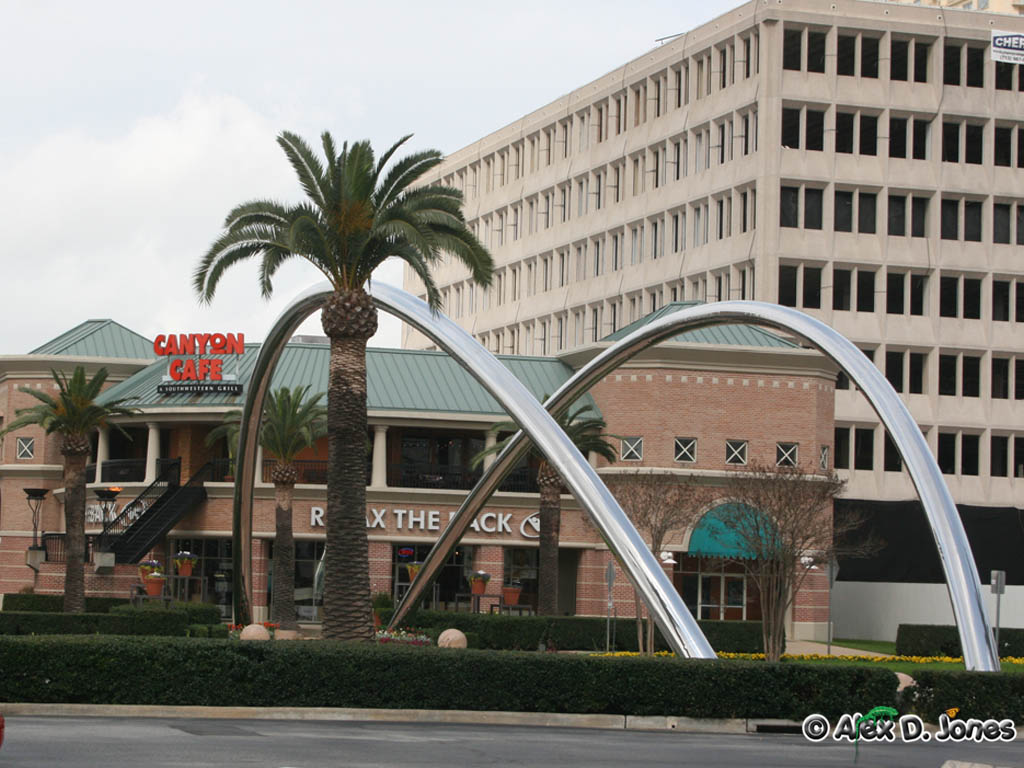
This picture shows tall metal arches that curve up and over like giant rainbows. The shiny silver arches are part of a sculpture in front of buildings with palm trees. The arches look smooth and reflect light from the sky.
🔬 Scientific Phenomena
The Anchoring Phenomenon is the structural stability and force distribution of curved arch structures. The metal arches maintain their shape and support their own weight through the physics of compression forces. When weight pushes down on an arch, the curved shape redirects those forces outward and downward to the ground, making arches incredibly strong and stable structures that can span large distances without collapsing.
📚 Core Science Concepts
- Forces and Motion: The arches demonstrate how forces (like gravity pulling down) can be redirected through curved shapes to create stable structures.
- Materials and Properties: The metal material has specific properties like strength, flexibility, and durability that make it suitable for outdoor sculptures and architectural elements.
- Engineering Design: The arch shape is an engineering solution that distributes weight evenly, allowing the structure to span wide spaces without breaking.
Pedagogical Tip: Use physical demonstrations with blocks or play dough to show how straight structures fall down easily, but curved arch shapes stay standing when weight is applied.
- Patterns in Nature and Design: Arch shapes appear in both natural formations (like rock arches) and human-made structures because this shape efficiently handles forces.
UDL Suggestions: Provide tactile experiences by having students build their own arches with clay or blocks, allowing kinesthetic learners to feel how the curved shape distributes forces differently than straight structures.
🔍 Zoom In / Zoom Out Concepts
Zoom In: At the molecular level, the metal atoms are arranged in crystal structures that give the material its strength. When forces are applied, these atomic bonds resist breaking and help transfer the force through the entire structure.
Zoom Out: This arch design connects to larger engineering systems found in bridges, doorways, and buildings worldwide. Ancient civilizations used arch principles to build structures that still stand today, and modern engineers continue using these same force-distribution principles in skyscrapers and bridges.
🤔 Potential Student Misconceptions
- Misconception: "The arches stay up because they're heavy."
Reality: The arches stay up because of their curved shape that redirects forces, not because of their weight.
- Misconception: "Only straight supports can hold things up."
Reality: Curved structures like arches can actually be stronger than straight supports because they spread forces over a wider area.
- Misconception: "The metal will break easily because it's thin."
Reality: The arch shape makes even thin materials very strong by distributing forces efficiently.
🎓 NGSS Connections
Performance Expectation: 3-5-ETS1-1 - Ask questions, make observations, and gather information about a situation people want to change to define a simple problem that can be solved through the development of a new or improved object or tool.
Disciplinary Core Ideas:
- - Defining and Delimiting Engineering Problems
- - Developing Possible Solutions
Crosscutting Concepts:
-
-
💬 Discussion Questions
- "What would happen if we tried to build these arches using straight pieces instead of curved ones?" (Bloom's: Evaluate | DOK: 3)
- "How do you think the curved shape helps the arches stay standing?" (Bloom's: Analyze | DOK: 2)
- "Where else have you seen arch shapes in buildings or nature?" (Bloom's: Apply | DOK: 2)
- "What materials would work best for building an arch and why?" (Bloom's: Evaluate | DOK: 3)
📖 Science Vocabulary
- Arch: A curved structure that spans an opening and supports weight above it.
- Force: A push or pull that can change how objects move or stay in place.
- Structure: Something that is built to support weight or serve a purpose.
- Material: The substance something is made from, like metal, wood, or stone.
- Support: To hold something up so it doesn't fall down.
- Compress: To squeeze or push together with force.
🔗 Cross-Curricular Ideas
- Math - Measurement and Geometry: Have students measure the heights and widths of classroom objects and draw their own arch designs on graph paper. They can count how many "arch blocks" it would take to build a structure like the ones in the photo, connecting to addition and skip-counting skills.
- ELA - Descriptive Writing: Ask students to write or dictate descriptions of the arches using sensory words (shiny, smooth, tall, curved). Create a class book titled "Structures Around Our Town" where students describe and illustrate different arches and curved structures they observe in their community.
- Art - Sculpture and Design: Have students create 3D arch sculptures using clay, pipe cleaners, or recyclable materials. They can paint their creations with metallic colors to match the shiny appearance of the arches in the photo, exploring how artists and engineers work together.
- Social Studies - Community Helpers: Invite a local architect, engineer, or construction worker to visit the classroom and explain how they design buildings and structures. Students can learn that people in their community use science and design to create the structures around them.
🚀 STEM Career Connection
- Architect — Designs buildings that work for the people inside and stand up to the weather outside.
- Try it: Sketch a building design that incorporates at least one arch for structural support and explain why you chose that shape. (Practice: Constructing explanations and designing solutions)
- Tools: CAD software, scale models, site surveys, material samples
- Where they work: architecture practices, construction sites, city planning offices, design studios
- Meet one: Roma Agrawal — How to hold a skyscraper up — she designed the foundations and the spire of the Shard.
- Median pay: /year — "Architects, except landscape and naval"
- Mechanical Engineer — Designs things that move — engines, turbines, joints and gears — and works out the forces on them.
- Try it: Build a simple arch from cardboard and test how much weight it can support before it collapses, then explain how the force is distributed. (Practice: Constructing explanations and designing solutions)
- Tools: CAD software, 3D printers, force sensors, wind tunnels
- Where they work: engineering firms, factories, design studios, research labs
- Meet one: Shini Somara — How air and water flow around things, worked out on a computer before anything is built.
- Median pay: /year — "Mechanical engineers"
Wage figures are median annual wages for the U.S. occupation named after each one, from the U.S. Bureau of Labor Statistics, Occupational Employment and Wage Statistics (OEWS), national, May 2025. Several careers share one occupation, so their figures match.