📸 Photo Description
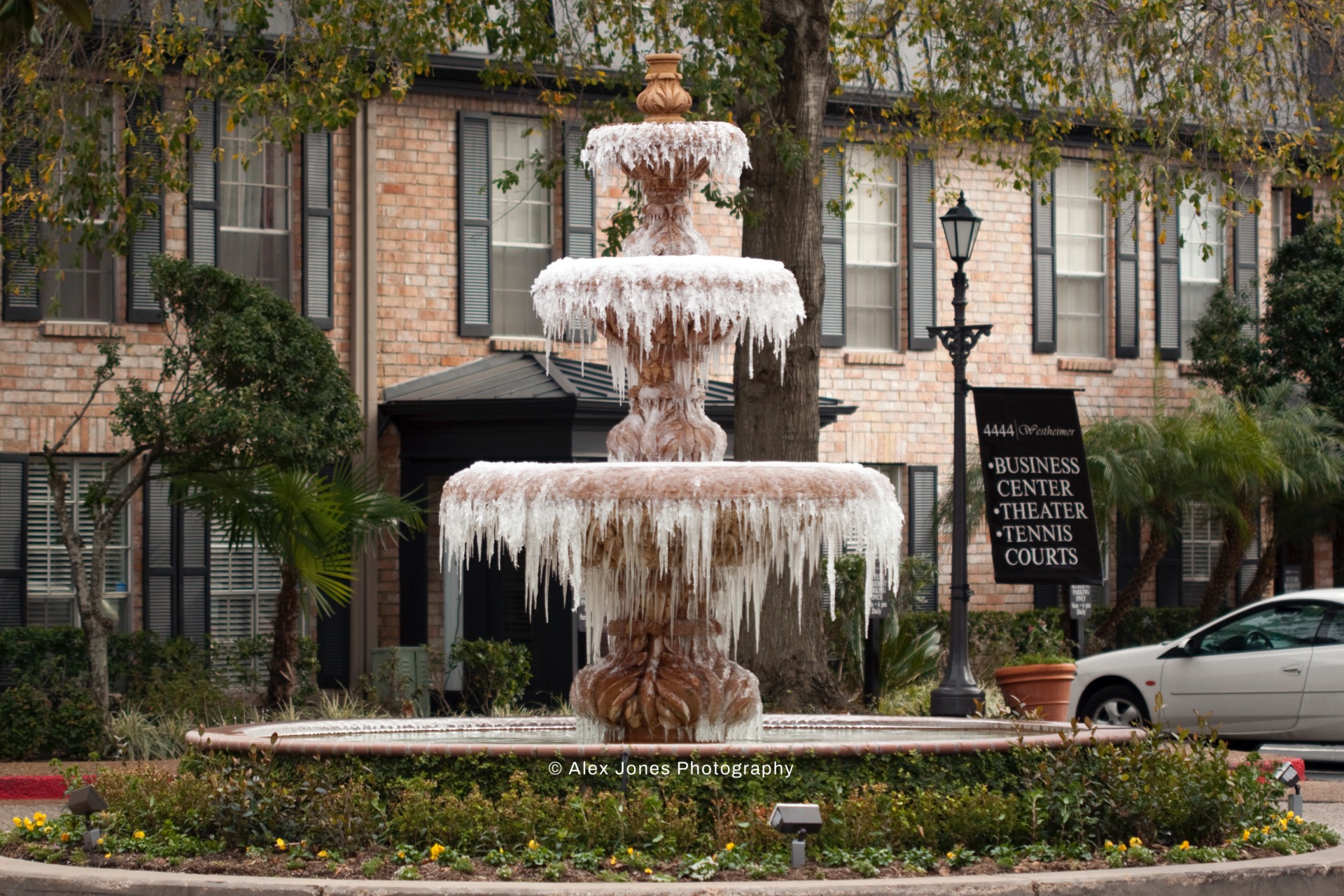
This fountain has water flowing down from the top through three different levels. The water starts at the top and falls down to each bowl below it. Ice has formed on the edges of each level, creating white icicles hanging down like frozen waterfalls.
🔬 Scientific Phenomena
The Anchoring Phenomenon here is the freezing of moving water in a fountain during cold weather. This occurs when the air temperature drops below 32°F (0°C), causing the water molecules to slow down and form solid ice crystals. The flowing water continues to move due to the pump system, but as it splashes and sits on the fountain's edges, it freezes and accumulates into icicles. This demonstrates the physical change between liquid and solid states of matter, which happens when thermal energy is removed from water.
📚 Core Science Concepts
- States of Matter: Water exists in different forms - liquid water flows through the fountain while solid ice forms the icicles
- Physical Changes: The water changing from liquid to solid (freezing) is a reversible physical change, not a chemical change
- Temperature and Heat Transfer: When air temperature drops below water's freezing point, thermal energy transfers from the warmer water to the colder air
- Gravity and Motion: Water flows downward from level to level due to gravitational force
Pedagogical Tip: Start the lesson by having students observe ice cubes melting in warm water, then connect this reverse process to what they see in the fountain photo. This concrete experience helps them understand that freezing and melting are opposite processes.
UDL Suggestions: Provide multiple ways for students to explore states of matter: visual diagrams showing water molecules in different states, hands-on ice experiments, and kinesthetic activities where students act out how molecules move differently in solids versus liquids.
🔍 Zoom In / Zoom Out Concepts
- Zoom In: At the molecular level, water molecules in liquid form are moving freely and sliding past each other. When temperature drops, these molecules slow down and arrange themselves into rigid, organized patterns to form ice crystals.
- Zoom Out: This fountain is part of a larger water cycle system. The water that freezes here will eventually melt, possibly evaporate, and contribute to precipitation that refills groundwater sources or surface water bodies in the community.
🤔 Potential Student Misconceptions
- Misconception: "Ice is not water anymore" → Clarification: Ice is still water, just in a different state. It's the same substance with the same chemical properties.
- Misconception: "Only still water can freeze" → Clarification: Moving water can freeze too, but it often takes colder temperatures or longer exposure to freezing air.
- Misconception: "Water always freezes at exactly 32°F" → Clarification: While pure water freezes at 32°F, moving water or water with dissolved substances might freeze at slightly different temperatures.
🎓 NGSS Connections
Performance Expectation: 2-PS1-1 - Plan and conduct an investigation to describe and classify different kinds of materials by their observable properties.
Disciplinary Core Ideas:
- - Different kinds of matter exist and many of them can be either solid or liquid, depending on temperature
- - Matter of any type can be subdivided into particles that are too small to see
Crosscutting Concepts:
- - Patterns in the natural world can be observed and used as evidence
- - Simple tests can be designed to gather evidence to support or refute student ideas about causes
💬 Discussion Questions
- What do you think would happen to these icicles if the temperature got warmer? (Bloom's: Predict | DOK: 2)
- Why do you think some parts of the fountain have more ice than others? (Bloom's: Analyze | DOK: 3)
- How is the water in this fountain similar to and different from the ice? (Bloom's: Compare | DOK: 2)
- What other places have you seen water change into ice in nature? (Bloom's: Apply | DOK: 1)
📖 Science Vocabulary
- Freezing: The process when liquid water becomes solid ice due to cold temperature
- Physical change: When matter changes its form but stays the same substance
- Temperature: A measure of how hot or cold something is
- State of matter: The form that matter takes, such as solid, liquid, or gas
- Thermal energy: The energy that comes from heat and makes molecules move
🔗 Cross-Curricular Ideas
- Mathematics - Measurement & Patterns: Have students measure the length of icicles on the fountain using non-standard units (like paper clips) or a ruler. Create a graph showing how icicle lengths change over several days as temperatures warm up. Students can predict patterns: "If the temperature goes up 5 degrees, what will happen to the icicles?"
- English Language Arts - Descriptive Writing: Ask students to write a sensory poem or short story about the frozen fountain. Encourage them to use vivid adjectives (sparkling, crystalline, delicate, frozen) and action verbs to describe how the water becomes ice. They could even write from the perspective of a water droplet's journey!
- Social Studies - Community Resources: Discuss how fountains are part of public spaces in cities and towns. Students can research or discuss why communities build fountains and how weather affects public places. Connect this to local landmarks: "Are there fountains in our town? What happens to them in winter?"
- Art - Ice Sculpture & Nature's Design: Examine the beautiful patterns and shapes created by the icicles. Students can create their own "ice sculptures" using paper, white paint, or salt dough to replicate the fountain's frozen formations. Discuss how nature creates art through freezing water.
🚀 STEM Career Connection
- Mechanical Engineer — Designs things that move — engines, turbines, joints and gears — and works out the forces on them.
- Try it: Build a simple water wheel using craft sticks and a plastic cup, and test how pouring water on it makes it spin. (Practice: Developing and Using Models)
- Tools: CAD software, 3D printers, force sensors, wind tunnels
- Where they work: engineering firms, factories, design studios, research labs
- Meet one: Shini Somara — How air and water flow around things, worked out on a computer before anything is built.
- Median pay: /year — "Mechanical engineers"
- Materials Engineer — Chooses and shapes the right material for a job, and tests it until it fails.
- Try it: Test how different materials, like foil, plastic wrap, and paper, insulate a cup of warm water from the cold air, measuring temperature changes over time. (Practice: Developing and Using Models)
- Tools: tensile testers, furnaces, microscopes, hardness testers
- Where they work: manufacturing plants, product design firms, testing labs, universities
- Meet one: Ainissa Ramirez — How to make metal stick to glass and ceramics — she invented a solder that does it.
- Median pay: /year — "Materials engineers"
Wage figures are median annual wages for the U.S. occupation named after each one, from the U.S. Bureau of Labor Statistics, Occupational Employment and Wage Statistics (OEWS), national, May 2025. Several careers share one occupation, so their figures match.