📸 Photo Description
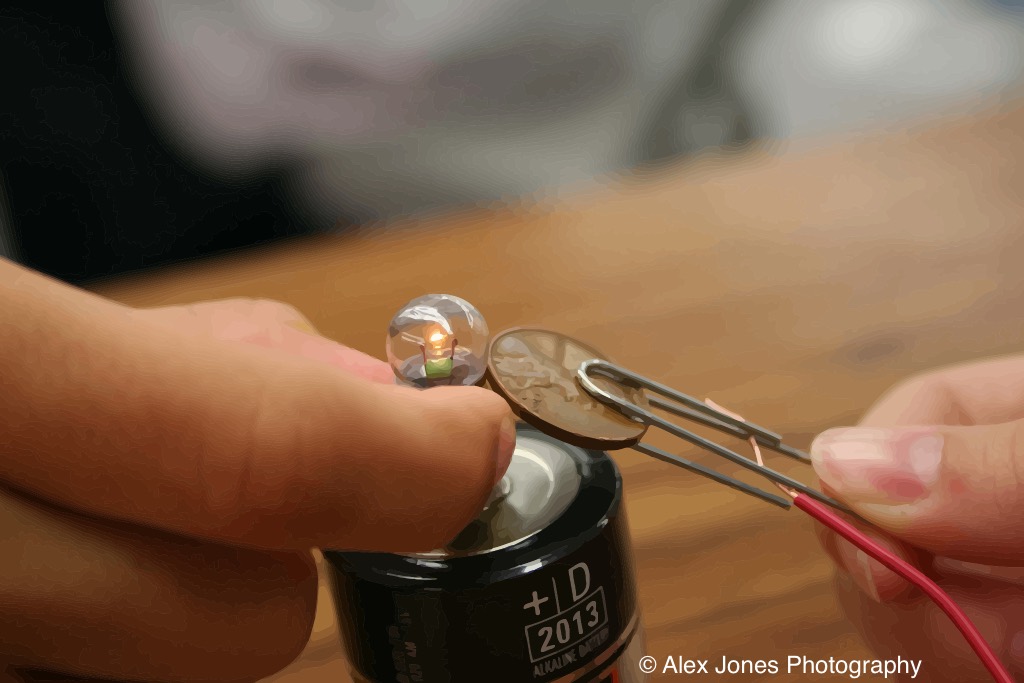
A person is using wires to connect a small light bulb to a battery. The light bulb is glowing, which shows that electricity is flowing through the wires from the battery to make the bulb light up.
🔬 Scientific Phenomena
This image demonstrates the Anchoring Phenomenon of electrical circuits and conductivity. The light bulb is illuminating because electrical current is flowing from the battery through the conducting wires to complete a circuit. When the circuit is complete (a closed loop), electrons flow from the negative terminal of the battery, through the wires and bulb filament, and back to the positive terminal. The resistance in the bulb's filament causes it to heat up and glow, producing visible light.
📚 Core Science Concepts
- Electric Circuits: Electricity needs a complete path (circuit) to flow from the power source back to itself
- Conductors: Materials like metal wires allow electricity to flow through them easily
- Energy Transfer: Chemical energy stored in the battery is converted to electrical energy, then to light and heat energy in the bulb
- Closed vs. Open Circuits: When the circuit is complete (closed), electricity flows; when broken (open), it stops
Pedagogical Tip: Start with hands-on exploration before introducing vocabulary. Let students experiment with connecting batteries and bulbs using different materials to discover which ones work before explaining why some materials conduct electricity.
UDL Suggestions: Provide multiple ways for students to demonstrate understanding: drawing circuit diagrams, building physical circuits, acting out electron flow with their bodies, or creating digital presentations about conductors and insulators.
🔍 Zoom In / Zoom Out Concepts
- Zoom In: Inside the metal wires, tiny particles called electrons are moving from atom to atom, carrying electrical energy through the conductor. The electrons bump into atoms in the bulb's filament, causing them to vibrate and give off light.
- Zoom Out: This simple circuit is the foundation for all electrical systems in our homes, schools, and communities. From light switches to computers, all electrical devices rely on the same principles of conductors, circuits, and energy transfer.
🤔 Potential Student Misconceptions
- Misconception: "Electricity gets used up in the light bulb"
Clarification: Electricity flows in a complete loop - the same amount that leaves the battery returns to it, but energy is transformed from electrical to light and heat
- Misconception: "The battery pushes electricity to the bulb"
Clarification: The battery creates a difference that causes electricity to flow through the complete circuit, including back to the battery
- Misconception: "Only metal can conduct electricity"
Clarification: While metals are excellent conductors, other materials like saltwater, graphite, and even the human body can conduct electricity
🎓 NGSS Connections
Performance Expectation: 4-PS3-2 Make observations to provide evidence that energy can be transferred from place to place by sound, light, heat, and electric currents.
Disciplinary Core Ideas:
- : Energy and Matter
- : Conservation of Energy and Energy Transfer
Crosscutting Concepts:
-
-
💬 Discussion Questions
- What do you think would happen if we removed one of the wires? (Bloom's: Predict | DOK: 2)
- Why do you think the wire is made of metal instead of plastic? (Bloom's: Analyze | DOK: 3)
- How is this simple circuit similar to the lights in our classroom? (Bloom's: Compare | DOK: 2)
- What other materials could we test to see if they conduct electricity? (Bloom's: Create | DOK: 2)
📖 Science Vocabulary
- Circuit: A complete path that electricity can flow through
- Conductor: A material that allows electricity to flow through it easily
- Current: The flow of electricity through a conductor
- Battery: A device that stores chemical energy and converts it to electrical energy
- Insulator: A material that does not allow electricity to flow through it easily
- Energy: The ability to do work or cause change
🔗 Cross-Curricular Ideas
- Math + Science: Have students measure the brightness of the bulb at different distances from a wall, or count how many batteries it takes to light multiple bulbs in a circuit. They can create bar graphs to show their findings.
- ELA + Science: Students can write "How-To" instructions for building a simple circuit, using sequencing words like "first," "next," and "last." They can also read non-fiction books about electricity and create fact posters with illustrations.
- Art + Science: Students can create colorful circuit diagrams using string, markers, and construction paper to show the path electricity travels. They can also design and decorate their own "invention" that uses batteries and light bulbs.
- Social Studies + Science: Explore how electricity powers our communities by investigating different ways people in our town use electricity (traffic lights, streetlights, homes, schools). Students can create a community map showing where electricity is used.
🚀 STEM Career Connection
- Electrical Engineer — Designs the circuits and systems that move electricity where it is needed.
- Try it: Construct a circuit with a switch that can turn a light bulb on and off, explaining how the switch affects the flow of electricity. (Practice: Constructing Explanations and Designing Solutions)
- Tools: oscilloscopes, circuit boards, multimeters, simulation software
- Where they work: power companies, electronics firms, research labs, universities
- Meet one: Danielle George — The radio receivers that let giant telescopes hear signals from space.
- Median pay: /year — "Electrical engineers"
- Physicist — Works out the rules that matter and energy follow, from the very small to the whole universe.
- Try it: Investigate how the length of a wire affects the brightness of a light bulb in a simple circuit. (Practice: Constructing Explanations and Designing Solutions)
- Tools: lasers, detectors, vacuum chambers, computer simulations
- Where they work: research laboratories, particle accelerators, observatories, universities
- Meet one: Chanda Prescod-Weinstein — Dark matter — the invisible material that makes up most of the universe.
- Median pay: /year — "Physicists"
Wage figures are median annual wages for the U.S. occupation named after each one, from the U.S. Bureau of Labor Statistics, Occupational Employment and Wage Statistics (OEWS), national, May 2025. Several careers share one occupation, so their figures match.