📸 Photo Description
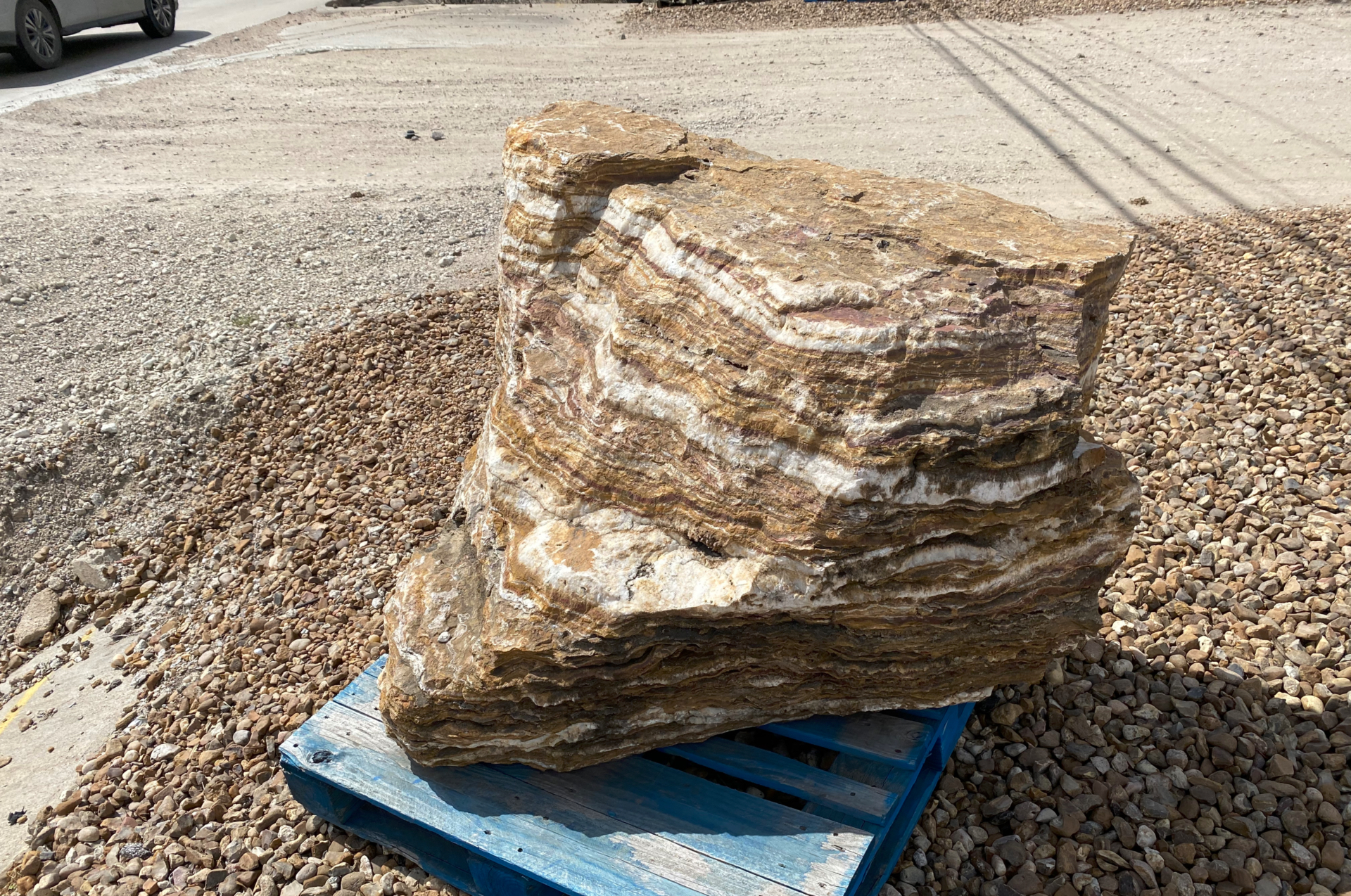
This photograph shows a layered rock formation with different colored stripes of brown and white minerals stacked on top of each other. The rock is sitting on a blue platform in an area covered with small rocks and gravel, next to a paved parking area. The different layers tell a story about how rocks form over a very, very long time.
🔬 Scientific Phenomena
This image represents rock layering and stratification—a key Earth science phenomenon showing how rocks are built up in layers over time. Each stripe in this rock represents a different time period when different materials were deposited (like sand, mud, or shells) in an ancient environment—often in an ocean, lake, or river. Over millions of years, pressure and heat squeezed these layers together and turned them into solid rock. The different colors show different types of materials or minerals that were present when each layer formed. This rock is evidence that Earth's surface changes very slowly over enormous amounts of time, and that the land we see today has a long history beneath our feet.
📚 Core Science Concepts
- Layers of Earth and Rock Formation: Rocks are made of different materials pressed together over time. Each layer in this rock formed at a different time in Earth's history, just like pages stacked in a book.
- Observable Features of Earth: We can learn about Earth by carefully observing rocks and landforms around us. The colors, textures, and patterns in rocks give us clues about what the environment was like long, long ago.
- Natural Materials and Properties: Different parts of this rock have different colors and textures because they are made of different materials and minerals. These properties help scientists understand what the rock is made of.
- How Humans Interact with Earth's Materials: Humans dig up, move, and use rocks and earth materials for building, paving roads, and creating structures—just like the gravel and paved area surrounding this rock sample.
Pedagogical Tip:
For kindergarteners, use concrete, sensory language when discussing rocks. Let students touch similar rocks (safely), describe how they feel (rough, smooth, bumpy), and notice colors. Create a simple "rock hunt" in your outdoor area where children collect different rocks and sort them by color or feel. This makes abstract concepts like "layers" tangible and memorable.
UDL Suggestions:
Representation: Provide tactile rock samples that students can handle to feel the texture differences between layers. Use magnifying glasses to help students zoom in on the details. Create a picture chart with photos of different rock types labeled with simple color words (brown, white, tan).
Action & Expression: Invite students to stack blocks or playdough in different colors to model how rock layers build up. Let them draw pictures of the rock and label the colors they see. Encourage dramatic play where some students are "rocks being pressed together" and others are "weather wearing them away."
Engagement: Connect the rock to things children know—ask "Have you seen rocks in your yard? On the playground? In a driveway?" This makes the science personally relevant and exciting.
🔍 Zoom In / Zoom Out Concepts
Zoom In – Microscopic Level:
If we could shrink down to see inside this rock, we would find tiny crystals of minerals packed tightly together. These crystals are so small we cannot see them with just our eyes, but they are the building blocks that make up the rock. Each mineral crystal has a special shape and color—some are clear, some are shiny, and some are dull. Scientists use special tools called microscopes to see these tiny crystals and learn what the rock is made of.
Zoom Out – Earth System Level:
This single rock is just one tiny piece of Earth's crust. All around our planet, rocks are constantly being formed, broken down, and recycled in what scientists call the rock cycle. Rocks get pushed up into mountains, wear away from wind and water, get buried deep underground, and melt. This rock was probably formed at the bottom of an ancient ocean or lake, and humans discovered it and brought it to this location. Understanding how this one rock formed helps us understand how our whole Earth works.
🤔 Potential Student Misconceptions
- Misconception: "Rocks never change—they are just hard and stay the same forever."
- Clarification: Rocks are always, very slowly, changing! Wind and water wear them down into sand and pebbles. Heat and pressure can change them into new types of rocks. Over millions of years, rocks are recycled and become brand new rocks. The layers in this rock show how rocks change over time.
- Misconception: "All rocks are the same—they're just rocks."
- Clarification: Rocks come in many different types, colors, and patterns. Each type of rock tells us a story about where it came from. The different colored layers in this rock show that it is made of different materials, and each layer has its own story from Earth's past.
- Misconception: "Rocks appear on Earth the same way toys appear in a store—humans just make them or they've always been there."
- Clarification: Rocks form naturally over millions of years through natural processes like weathering, erosion, and pressure deep underground. Humans don't make rocks; we find them and use them. This layered rock took an incredibly long time to form before anyone found it!
🎓 NGSS Connections
K-ESS2-2: Construct an argument supported by evidence for how plants and animals (including humans) can change the environment to meet their needs.
- This standard applies because the image shows how humans have excavated, moved, and positioned this rock in an urban setting (paved area, gravel landscaping) to meet needs like construction and display.
K-ESS3-1: Use a model to represent the relationship between the needs of different plants and animals (including humans) and the places they live.
- Students can understand that humans need rocks and earth materials for building structures, roads, and creating useful items—and we find these materials in specific places on Earth.
K-ESS3-3: Communicate solutions that will reduce the impact of humans on the land, water, air, and/or other living things in the local environment.
- This standard connects because students can discuss how carefully removing and displaying rocks (rather than carelessly destroying landscapes) is a responsible way to interact with Earth's materials.
Disciplinary Core Ideas Referenced:
(Earth Materials) – This rock is a clear example of natural Earth materials and their observable properties.
(Natural Resources) – Rocks are natural resources that humans find and use.
Crosscutting Concepts Embedded:
– The striped pattern of layers shows a pattern in how rocks form.
– This rock is very small compared to entire mountains and Earth itself, helping develop scale awareness.
💬 Discussion Questions
- What do you notice about the colors in this rock? Why do you think it has stripes? (Bloom's: Observe/Recall | DOK: 1)
- If we looked at this rock a million years ago, what might it have looked like? Where might it have been? (Bloom's: Imagine/Create | DOK: 2)
- How do you think humans moved this big, heavy rock to this parking area? What tools might they have used? (Bloom's: Analyze | DOK: 2)
- If we left this rock outside for many more years, do you think it would look different? What might happen to it? (Bloom's: Predict | DOK: 2)
📖 Vocabulary
- Layer: A flat sheet or piece of something that is laid on top of another piece, like pages in a book or stripes in a rock.
- Rock: A hard, solid material made of minerals that comes from Earth.
- Mineral: A natural, solid material that makes up rocks; minerals have their own special color, shape, and feel.
- Texture: The way something feels when you touch it—rough, smooth, bumpy, or shiny.
- Stripes: Lines of different colors or patterns that run across something, like the bands you see in this rock.
- Erosion: The slow wearing away of rocks and soil by wind, water, or weather over a very long time.
🌡️ Extension Activities
- Rock Layer Cake: Stack different colored playdough or modeling clay to create a model of rock layers. Press them together gently to show how pressure squeezes layers into solid rock. Talk about how each "layer" represents a different time in Earth's history. Students can eat the playdough cake afterward if it's food-safe clay, or simply admire their model!
- Outdoor Rock Hunt and Sort: Take students on a nature walk in your school yard, playground, or nearby park to collect rocks. Back in the classroom, help them sort rocks by color, size, texture (rough vs. smooth), or weight. Create a simple chart showing how many rocks fit in each category. Ask: "Why do you think rocks look so different?"
- Weathering Experiment: Place several rocks in a bucket of water and shake the bucket vigorously for 2–3 minutes (simulating water erosion). Examine the rocks before and after, and have students draw or describe what they observe. Discuss: "Do you think water can change rocks? What would happen if water did this for millions of years?" This demonstrates how rocks slowly wear away over time.
🔗 Cross-Curricular Ideas
- Math – Measuring and Counting: Have students measure the height and width of the rock using non-standard units (hand spans, blocks, string). Count the visible layers in the rock or in photos. Create a simple bar graph showing how many rocks of different colors were found on a rock hunt.
- ELA – Storytelling and Writing: Invite students to imagine the rock's "life story." What was this rock like in an ancient ocean? How did it get buried? How did it get dug up and brought here? Have them draw or dictate a simple story: "The Adventures of Rocky the Rock." Read aloud related picture books about rocks and Earth.
- Social Studies – Community Helpers: Discuss how construction workers, geologists, engineers, and miners use rocks to build our communities. Take a "built environment walk" around your school or neighborhood and identify things made from rocks (buildings, sidewalks, gravel paths). Talk about why humans need rocks and how we respect Earth's materials.
- Art – Rock Painting and Observation: Provide rocks for students to paint, decorate, or draw on. Have them closely observe the colors and patterns in the layered rock photo and try to recreate those designs. Create a classroom display of student-decorated rocks and the original photo to celebrate Earth's natural artistry.
🚀 STEM Career Connection
- Geologist — Reads rocks and landforms to work out what happened here long before anyone was watching.
- Try it: Use different colored construction paper to build a model of rock layers, explaining what each layer tells you about the past. (Practice: Analyzing and Interpreting Data)
- Tools: a rock hammer, a hand lens, a compass, core samplers
- Where they work: mountains and canyons, quarries and mines, government surveys, universities
- Meet one: Wendy Bohon — Earthquakes — how faults grow over time, and how to warn people clearly before one hits.
- Median pay: /year — "Geoscientists, except hydrologists and geographers"
Wage figures are median annual wages for the U.S. occupation named after each one, from the U.S. Bureau of Labor Statistics, Occupational Employment and Wage Statistics (OEWS), national, May 2025. Several careers share one occupation, so their figures match.