📸 Photo Description
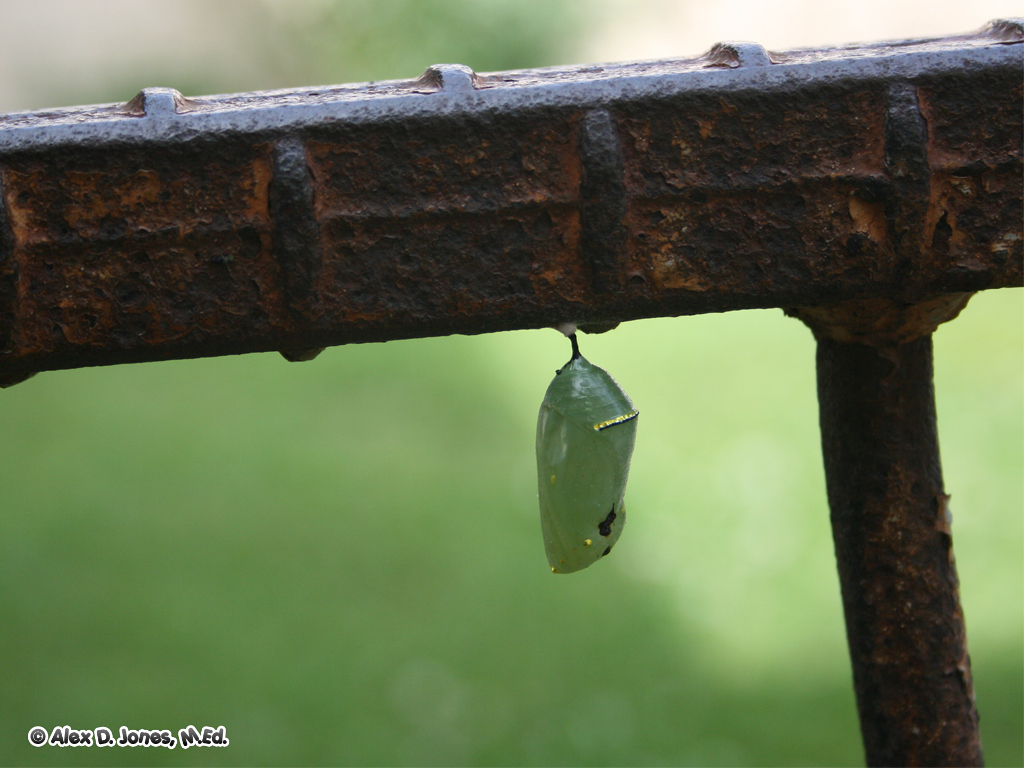
A green chrysalis hangs from a rusty metal bar. This protective casing holds an insect as it undergoes a significant change. The chrysalis is smooth and appears to have a few small, dark markings.
🔬 Scientific Phenomena
The image captures a chrysalis, which is a key stage in the life cycle of certain insects, most notably butterflies and moths. This stage represents metamorphosis, a biological process where an organism undergoes a dramatic transformation from its immature form to its adult form. Inside the chrysalis, the insect's body is reorganizing and developing into a winged adult.
📚 Core Science Concepts
- Life Cycles: Organisms go through distinct stages from birth to death.
- Metamorphosis: This is a process of transformation where an animal physically develops after birth or hatching, involving a conspicuous and relatively abrupt change in the animal's body structure through cell growth and differentiation.
- Incomplete vs. Complete Metamorphosis: Some insects have incomplete metamorphosis (egg, nymph, adult), while others, like butterflies, undergo complete metamorphosis (egg, larva, pupa/chrysalis, adult).
- Survival and Development: The chrysalis stage is a critical period for an organism's development and survival, protecting it during its most vulnerable transformation.
Pedagogical Tip: When discussing life cycles, encourage students to compare and contrast the stages of different organisms. This helps them identify both commonalities and unique features within life cycles.
UDL Suggestions: Provide visual aids such as diagrams, videos, and real-life examples of different insect life cycles to support diverse learning styles. Offer sentence starters or graphic organizers to help students articulate their understanding of metamorphosis.
🔍 Zoom In / Zoom Out Concepts
- Zoom In: Inside the chrysalis, cells are rapidly dividing and differentiating. Larval tissues are broken down and reorganized into adult structures, such as wings, legs, and antennae. This complex biological process is guided by genetic instructions.
- Zoom Out: The chrysalis is part of the larger ecosystem. Once the adult insect emerges, it will play a role in pollination, as a food source for other animals, or as a predator, contributing to the balance of its environment.
🤔 Potential Student Misconceptions
- Misconception: Students may think the insect inside the chrysalis is sleeping or inactive.
Clarification: While the insect is not actively moving outside the chrysalis, a tremendous amount of biological activity and change is happening internally as it transforms.
- Misconception: Students might believe that all insects transform in a similar way.
Clarification: There are different types of metamorphosis. Some insects, like grasshoppers, have simpler changes, while butterflies and moths undergo complete metamorphosis, which includes the chrysalis stage.
🎓 NGSS Connections
- 3-LS1-1: Develop models to describe that organisms have unique and diverse life cycles but all have in common birth, growth, reproduction, and death.
- 1-LS3-1 (Grade 1 — foundational connection): Make observations to construct an evidence-based account that young plants and animals are like, but not exactly like, their parents.
- 4-LS1-1 (Grade 4 — where this learning leads): Construct an argument that plants and animals have internal and external structures that function to support survival, growth, behavior, and reproduction.
💬 Discussion Questions
- What changes do you think are happening inside the chrysalis? (Bloom's: Analyze | DOK: 2 | SEP: Constructing Explanations and Designing Solutions)
- Why is the chrysalis important for the insect's survival? (Bloom's: Understand | DOK: 1 | SEP: Constructing Explanations and Designing Solutions)
- How is the life cycle shown in the picture similar to or different from other animal life cycles you know? (Bloom's: Analyze | DOK: 2 | SEP: Analyzing and Interpreting Data)
📖 Vocabulary
- Chrysalis: A protective casing formed by a larva before it transforms into an adult insect, especially a butterfly.
- Metamorphosis: A process of transformation where an insect changes its body form as it grows.
- Larva: An immature form of an insect that undergoes metamorphosis, such as a caterpillar or grub.
- Pupa: The stage in the life cycle of an insect between the larva and the adult, during which it is enclosed in a protective casing.
🌡️ Extension Activities
- Life Cycle Diorama: Have students create a diorama showing the different stages of a butterfly's life cycle, including the egg, larva (caterpillar), pupa (chrysalis), and adult butterfly.
- Observation Journal: If possible, obtain a butterfly or moth kit and have students observe and record the changes in a real chrysalis over time in a science journal.
- Metamorphosis Model: Students can create a 3D model of a chrysalis using clay, playdough, or paper mache, and then label the parts that will develop into adult structures.
🔗 Cross-Curricular Ideas
- ELA: Read books about the butterfly life cycle. Students can write their own stories from the perspective of a caterpillar transforming into a butterfly.
- Art: Students can draw or paint pictures of chrysalises, focusing on their shape, color, and texture. They can also create symmetrical butterfly wing designs.
- Math: Measure and graph the time it takes for a chrysalis to develop into a butterfly. Compare the lengths of different stages.
🚀 STEM Career Connection
- Entomologist — Studies insects — how they live, what they eat, and the jobs they do in an ecosystem.
- Try it: Compare and contrast the chrysalis stage with the caterpillar and butterfly stages, explaining the purpose of each. (Practice: Constructing explanations and designing solutions)
- Tools: insect nets, a hand lens, pinning boards, microscopes
- Where they work: museums, farms, insect labs, universities
- Meet one: Corrie Moreau — How ants evolved together with the bacteria that live inside them.
- Median pay: /year — "Zoologists and wildlife biologists"
- Botanist — Studies plants — how they grow, how they reproduce, and how they survive where they live.
- Try it: Research and draw the type of plant a butterfly caterpillar eats, and explain why it's important for the chrysalis stage. (Practice: Constructing explanations and designing solutions)
- Tools: a hand lens, a plant press, a soil probe, field guides
- Where they work: botanical gardens, herbariums, forests and fields, universities
- Meet one: Robin Wall Kimmerer — Mosses — which she calls the coral reefs of the forest — and what Indigenous knowledge teaches about bringing plants back.
- Median pay: /year — "Soil and plant scientists"
Wage figures are median annual wages for the U.S. occupation named after each one, from the U.S. Bureau of Labor Statistics, Occupational Employment and Wage Statistics (OEWS), national, May 2025. Several careers share one occupation, so their figures match.