📸 Photo Description
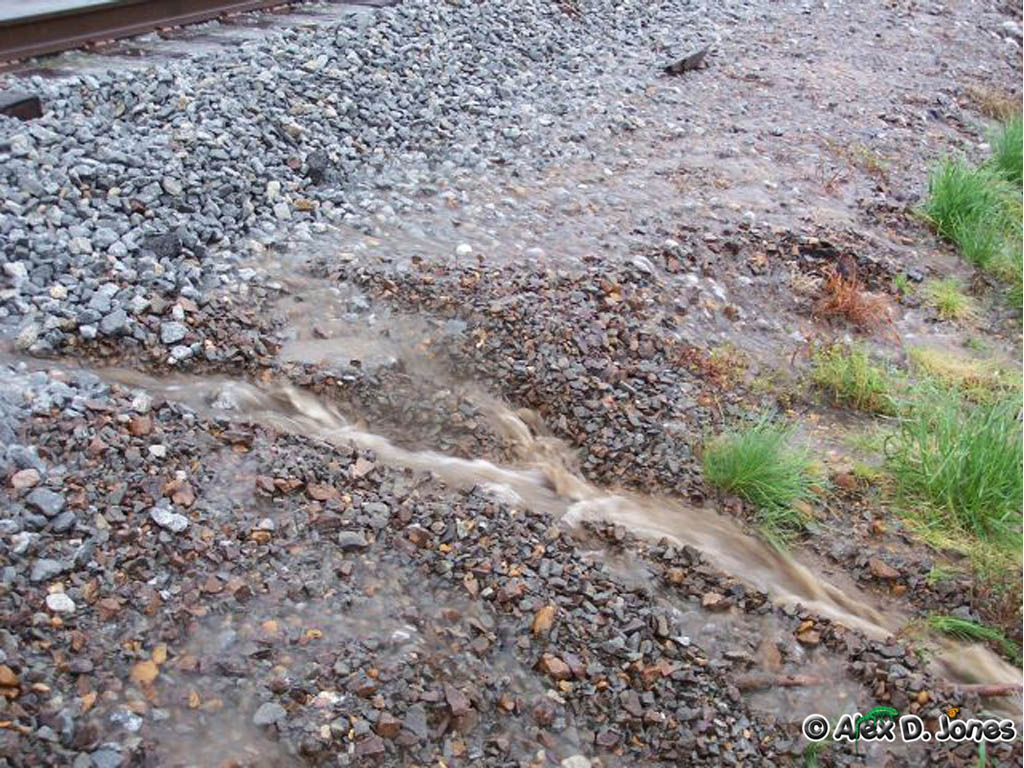
Water is flowing fast across railroad tracks and gravel. The muddy water looks brown and is moving quickly over the rocks and train tracks. Green grass grows along the edges where the water is not flowing.
🔬 Scientific Phenomena
This image shows flooding and erosion as the anchoring phenomenon. Heavy rainfall has caused water to flow rapidly across the landscape, carrying sediment (dirt and small rocks) that makes the water appear brown and muddy. The fast-moving water is demonstrating erosion by picking up and transporting loose materials like soil and small stones. This occurs because moving water has energy that can lift and carry particles, and the faster the water moves, the larger the particles it can transport.
📚 Core Science Concepts
- Erosion: Moving water picks up and carries away soil, rocks, and other materials from one place to another
- Weathering: Water breaks down rocks and soil into smaller pieces over time
- Sediment Transport: Fast-moving water can carry dirt and small rocks, which is why flood water often looks muddy or brown
- Surface Water Flow: When there is more water than the ground can absorb, it flows over the surface following gravity
Pedagogical Tip: Use a hands-on demonstration with a stream table or even a simple tray with sand and a watering can to show how water moves materials. Students can observe cause and effect relationships much better when they can manipulate variables themselves.
UDL Suggestions: Provide multiple ways for students to document their observations - drawing, photography, verbal descriptions, or simple data charts. This supports different learning preferences and abilities while maintaining the same learning objectives.
🔍 Zoom In / Zoom Out Concepts
Zoom In: At the microscopic level, water molecules are breaking the bonds between soil particles and rock fragments. The force of moving water creates friction that loosens individual grains of sand, silt, and clay, allowing them to be lifted and suspended in the flowing water.
Zoom Out: This local flooding event is part of the larger water cycle system. The water will eventually flow into streams, then rivers, and finally to the ocean. The sediments being carried will be deposited downstream, potentially creating new landforms like deltas or changing the shape of riverbanks and coastlines.
🤔 Potential Student Misconceptions
- Misconception: "Dirty water is always bad water" - Clarification: Muddy water during floods contains natural sediments and is part of how Earth moves materials to build new land features.
- Misconception: "Water always flows the same speed" - Clarification: Water speed depends on how much water there is and the steepness of the land. More water and steeper slopes make water flow faster.
- Misconception: "Rocks and soil stay in the same place forever" - Clarification: Earth's surface is constantly changing as water, wind, and ice move materials from place to place over time.
🎓 NGSS Connections
- Performance Expectation: 2-ESS1-1 (Use information from several sources to provide evidence that Earth events can occur quickly or slowly)
- Disciplinary Core Ideas: - The History of Planet Earth
- Crosscutting Concepts: and
💬 Discussion Questions
- What do you think caused the water to look brown and muddy? (Bloom's: Analyze | DOK: 2)
- How might this flooding change the landscape over time? (Bloom's: Evaluate | DOK: 3)
- Where do you predict this water and the materials it's carrying will end up? (Bloom's: Apply | DOK: 2)
- What patterns do you notice about where the grass is growing compared to where the water is flowing? (Bloom's: Analyze | DOK: 2)
📖 Science Vocabulary
- Erosion: The process of moving rocks and soil from one place to another by water, wind, or ice
- Sediment: Small pieces of rock, soil, and sand that are carried by moving water
- Flooding: When water covers land that is usually dry
- Surface runoff: Water that flows over the ground instead of soaking into the soil
- Weathering: The breaking down of rocks and soil into smaller pieces
🔗 Cross-Curricular Ideas
- Math - Measurement & Data: Students can measure how far water travels across the gravel or how wide the flow is. They can create simple bar graphs comparing water flow width in different locations, or measure rainfall amounts during storms to connect to flooding events.
- ELA - Descriptive Writing: Have students write sensory descriptions of a flood using words like "muddy," "rushing," "brown," and "fast." They can create a story from the perspective of a rock or grain of sand being carried by the water, describing its journey downstream.
- Social Studies - Community & Environment: Discuss how flooding affects communities near railroad tracks or rivers. Students can explore what people do to prepare for floods, where water goes in their own neighborhoods, and how communities work together to stay safe during storms.
- Art - Landscape Changes: Students can create two-part artwork showing "before the flood" and "after the flood" to illustrate how water changes Earth's surface. They could also use watercolor paints to show how water carries color and sediment, just like in the photo.
🚀 STEM Career Connection
- Civil Engineer — Designs the things a town runs on — roads, bridges, water pipes and drains.
- Try it: Build a small dam out of LEGOs or blocks in a tray and see how it changes the flow of water and erosion. (Practice: Analyzing and Interpreting Data)
- Tools: surveying equipment, CAD software, soil tests, load calculations
- Where they work: construction sites, city engineering departments, design firms, transport agencies
- Meet one: Roma Agrawal — How to hold a skyscraper up — she designed the foundations and the spire of the Shard.
- Median pay: /year — "Civil engineers"
- Landscape Architect — Designs outdoor spaces — deciding where water goes, what gets planted, and where people walk.
- Try it: Draw a plan for a park that includes paths and water features, thinking about where water will flow. (Practice: Analyzing and Interpreting Data)
- Tools: site plans, drainage models, plant palettes, CAD software
- Where they work: design practices, parks departments, university campuses, city planning offices
- Meet one: Kotchakorn Voraakhom — Parks built on a slope that soak up flood water — one of hers holds a million gallons.
- Median pay: /year — "Landscape architects"
Wage figures are median annual wages for the U.S. occupation named after each one, from the U.S. Bureau of Labor Statistics, Occupational Employment and Wage Statistics (OEWS), national, May 2025. Several careers share one occupation, so their figures match.