📸 Photo Description
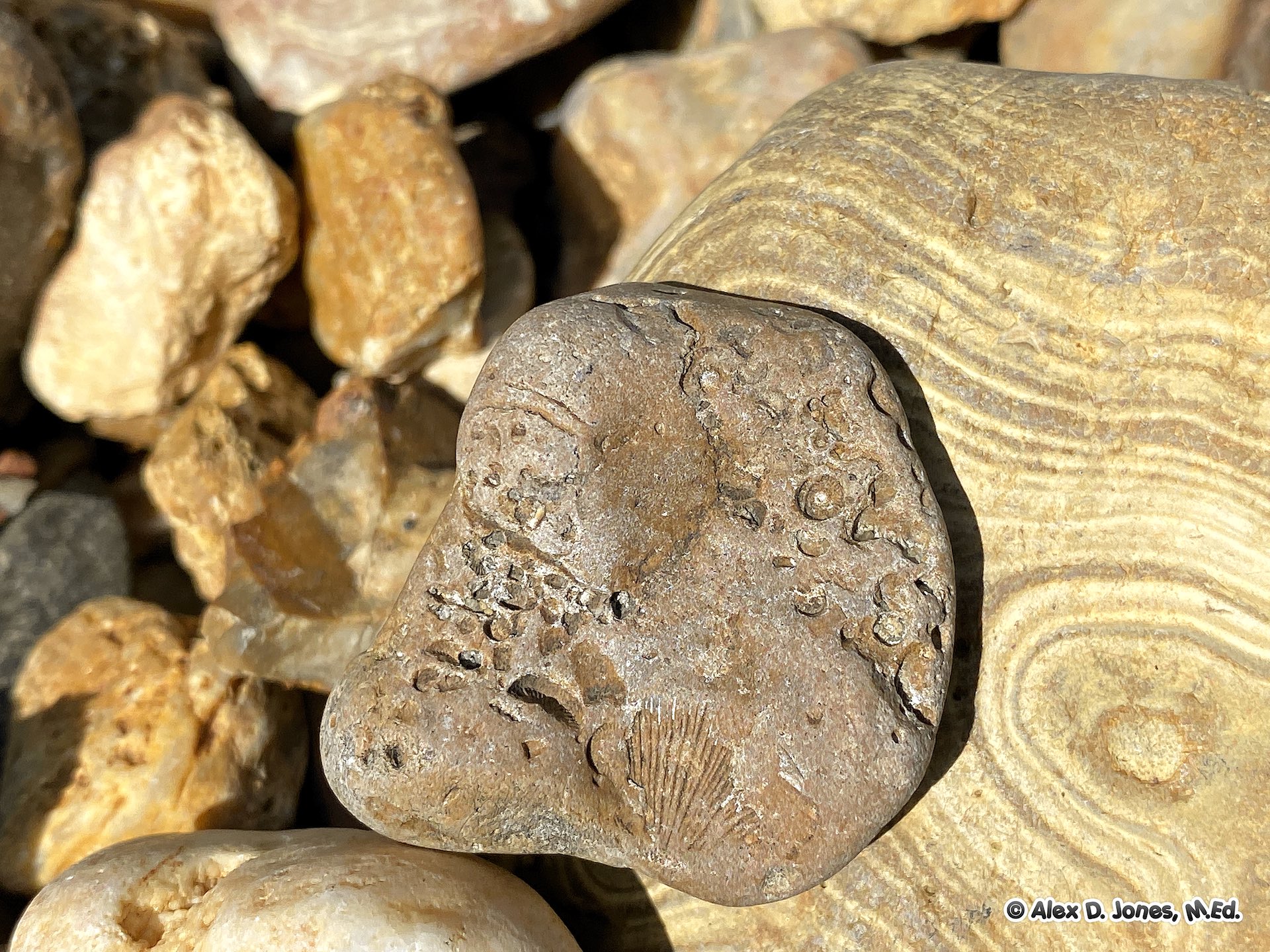
This image shows several fossil specimens that contain the preserved remains of ancient sea creatures. The fossils display detailed patterns and shapes of shells, including spiral and fan-like designs that lived millions of years ago. These stone-like objects were once living animals that got buried and turned into rock over a very long time.
🔬 Scientific Phenomena
The anchoring phenomenon here is fossilization - the process by which living organisms become preserved in rock over millions of years. This occurs when organisms (particularly those with hard shells or bones) are rapidly buried by sediment, preventing decay. Over time, minerals replace the organic material or create impressions, preserving the organism's structure. The fossils in this image appear to be marine invertebrates like brachiopods and crinoids, indicating this area was once covered by an ancient sea.
📚 Core Science Concepts
- Fossils as Evidence of Past Life: Fossils are the preserved remains or traces of organisms that lived long ago, providing direct evidence that different life forms existed in Earth's past.
- Environmental Change Over Time: The presence of sea creature fossils on land demonstrates that environments change dramatically over millions of years - areas that are now dry land were once underwater.
- Preservation Process: Only certain organisms under specific conditions become fossils, typically those with hard parts like shells, bones, or teeth that can withstand the fossilization process.
- Time Scales: Fossil formation requires enormous amounts of time - millions to hundreds of millions of years - which is difficult for students to comprehend but crucial for understanding Earth's history.
Pedagogical Tip: Use concrete analogies to help students understand deep time, such as comparing Earth's history to a 24-hour day, where humans appear only in the last few seconds.
UDL Suggestions: Provide hands-on fossil replicas or create fossil impressions using clay and shells to engage tactile learners and make abstract concepts more concrete for all students.
🔍 Zoom In / Zoom Out Concepts
- Zoom In: At the microscopic level, fossilization involves the replacement of organic molecules with minerals like silica, calcite, or pyrite. The original cellular structure is gradually replaced atom by atom, preserving the organism's form while completely changing its composition.
- Zoom Out: These fossils are part of Earth's rock record that tells the story of our planet's 4.6-billion-year history. They help scientists understand ancient climates, the movement of continents, mass extinction events, and the evolution of life on Earth.
🤔 Potential Student Misconceptions
- Misconception: Fossils are the actual bones or shells of dead animals.
Clarification: Fossils are rock formations that have taken the shape of ancient organisms - the original material has been replaced by minerals over millions of years.
- Misconception: All dead organisms become fossils.
Clarification: Fossilization is extremely rare and requires special conditions like rapid burial and the presence of hard parts that can be preserved.
- Misconception: Fossils are only a few thousand years old.
Clarification: Most fossils are millions to hundreds of millions of years old, formed over timescales far beyond human experience.
🎓 NGSS Connections
- Performance Expectation: 2-ESS1-1 - Analyze and interpret data from fossils to provide evidence of the organisms and the environments in which they lived long ago
- Disciplinary Core Ideas: - Some events happen very quickly; others occur very slowly, over a time period much longer than one can observe
- Crosscutting Concepts: - Patterns in the natural world can be observed and used as evidence
💬 Discussion Questions
- What can these fossils tell us about what this place was like millions of years ago? (Bloom's: Analyze | DOK: 3)
- Why do you think we find more fossils of shells and bones than of soft body parts like skin or leaves? (Bloom's: Evaluate | DOK: 2)
- If you found a fossil of a fish in your backyard, what would that suggest about your area's past environment? (Bloom's: Apply | DOK: 2)
- How might scientists use these fossils to learn about ancient climates and ecosystems? (Bloom's: Synthesize | DOK: 3)
📖 Science Vocabulary
- Fossil: The preserved remains or traces of an organism that lived long ago, usually found in rock.
- Sediment: Small pieces of rock, sand, and dirt that settle in layers and can bury organisms.
- Preservation: The process of keeping something from decaying or being destroyed over time.
- Ancient: Very, very old - from millions of years ago.
- Environment: The surroundings where an organism lives, including water, land, and climate.
- Marine: Related to or living in the ocean or sea.
🔗 Cross-Curricular Ideas
- Math + Science: Create a timeline showing when different fossil organisms lived. Students can practice ordering numbers and understanding that some fossils are older than others. Use a number line with millions of years marked to help visualize deep time in a mathematical way.
- ELA + Science: Write a creative story from the perspective of an ancient sea creature. Students imagine what life was like millions of years ago in the ocean and describe the creature's environment, food, and daily activities. This combines narrative writing with scientific thinking about past environments.
- Social Studies + Science: Explore how fossils help us understand where people lived in the past. Discuss how scientists use fossils to learn about ancient communities and environments, connecting to students' understanding of how places change over time.
- Art + Science: Create fossil replicas using air-dry clay and natural objects like shells, leaves, or twigs to make impressions. Students can paint their clay fossils to look like real fossils, combining artistic skills with hands-on understanding of how fossils form.
🚀 STEM Career Connection
- Geologist — Reads rocks and landforms to work out what happened here long before anyone was watching.
- Try it: Create a model showing how sediment layers can bury and protect an organism to explain how fossils form. (Practice: Constructing Explanations and Designing Solutions)
- Tools: a rock hammer, a hand lens, a compass, core samplers
- Where they work: mountains and canyons, quarries and mines, government surveys, universities
- Meet one: Wendy Bohon — Earthquakes — how faults grow over time, and how to warn people clearly before one hits.
- Median pay: /year — "Geoscientists, except hydrologists and geographers"
- Paleontologist — Digs up and studies fossils to work out what lived here millions of years ago.
- Try it: Design a hypothetical excavation plan for finding fossils in a sedimentary rock formation, considering what tools might be needed and where to look. (Practice: Constructing Explanations and Designing Solutions)
- Tools: rock hammers, dental picks, plaster jackets, brushes
- Where they work: fossil digs, natural history museums, universities, government surveys
- Meet one: Jingmai O'Connor — Fossils that catch dinosaurs in the middle of becoming birds.
- Median pay: /year — "Geoscientists, except hydrologists and geographers"
Wage figures are median annual wages for the U.S. occupation named after each one, from the U.S. Bureau of Labor Statistics, Occupational Employment and Wage Statistics (OEWS), national, May 2025. Several careers share one occupation, so their figures match.