📸 Photo Description
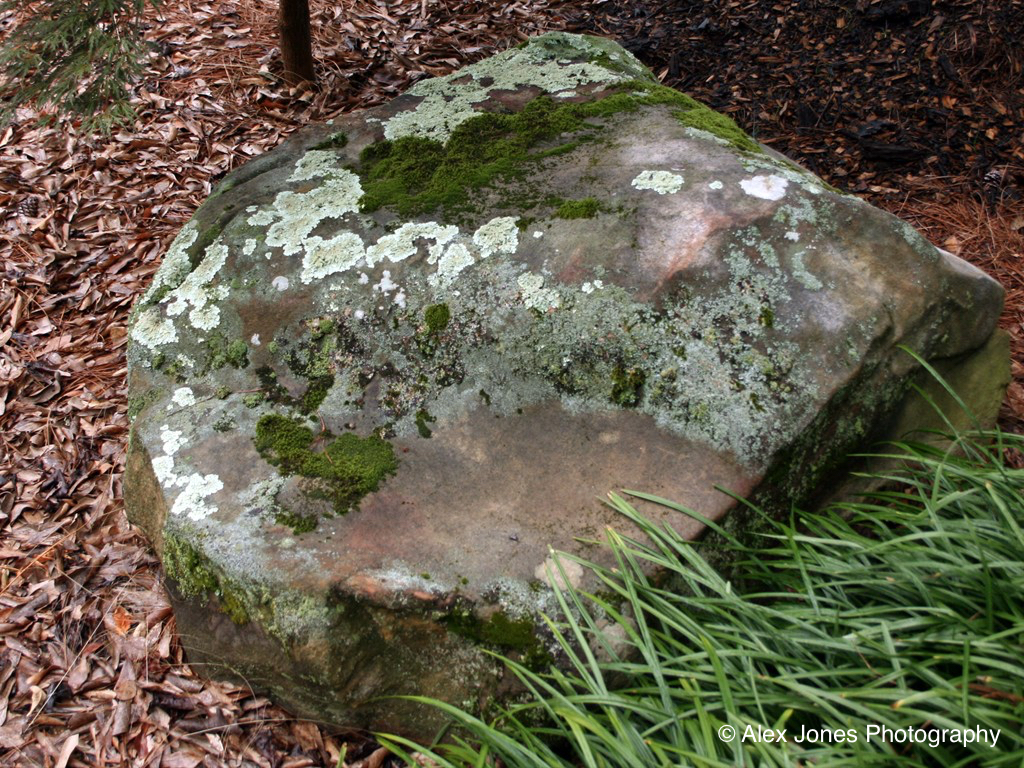
This large rock is covered with green moss and light-colored patches called lichen. The rock sits on the forest floor surrounded by fallen leaves and grass. Over time, living things have made their home on the hard rock surface.
🔬 Scientific Phenomena
The Anchoring Phenomenon is biological weathering - the process where living organisms break down rocks over time. The moss and lichen growing on this rock are slowly breaking it apart through chemical processes. These organisms produce weak acids that dissolve minerals in the rock, creating small cracks and spaces where they can grow. This is a form of weathering that happens very slowly, taking many years to create visible changes.
📚 Core Science Concepts
- Weathering: Natural processes break down rocks into smaller pieces over long periods of time
- Living vs. Non-living Interactions: Living things (moss, lichen) can change non-living things (rocks) in their environment
- Habitat: Rocks can provide homes for small organisms like moss and lichen
- Time and Change: Changes in nature happen over different time scales - some very slowly like rock weathering
Pedagogical Tip: Use a hand lens or magnifying glass to help students observe the detailed textures of moss and lichen. This makes the invisible more visible and engages students in authentic scientific observation practices.
UDL Suggestions: Provide multiple ways for students to document their observations: drawing, verbal descriptions, or taking photos. Some students may excel at artistic representation while others prefer written descriptions of what they observe.
🔍 Zoom In / Zoom Out Concepts
- Zoom In: At the microscopic level, lichen is actually two organisms (fungus and algae) living together. The fungus produces acids that slowly dissolve rock minerals, creating tiny spaces for growth and releasing nutrients.
- Zoom Out: This weathering process is part of the larger rock cycle where rocks are constantly being broken down and reformed. The small rock particles will eventually become soil that supports larger plants and entire forest ecosystems.
🤔 Potential Student Misconceptions
- Misconception: "Rocks never change because they are so hard and strong."
Clarification: Rocks do change, but very slowly over long periods of time through weathering processes.
- Misconception: "Only wind and water can break down rocks."
Clarification: Living things like plants, moss, and lichen can also break down rocks through biological weathering.
- Misconception: "Moss and lichen are the same thing."
Clarification: Moss is a small plant, while lichen is actually two different organisms (fungus and algae) living together.
🎓 NGSS Connections
- Performance Expectation: 2-ESS1-1 - Use information from several sources to provide evidence that Earth events can occur quickly or slowly
- Disciplinary Core Ideas: - Some events happen very quickly; others occur very slowly, over a time period much longer than one can observe
- Crosscutting Concepts: - Patterns in the natural world can be observed and used as evidence
💬 Discussion Questions
- What evidence do you see that this rock has been changing over time? (Bloom's: Analyze | DOK: 2)
- How might this rock look different in 100 years if the moss and lichen keep growing? (Bloom's: Predict | DOK: 3)
- What other living things might be able to break down rocks? (Bloom's: Apply | DOK: 2)
- Why do you think moss and lichen can grow on rocks but grass cannot? (Bloom's: Evaluate | DOK: 3)
📖 Science Vocabulary
- Weathering: The process of breaking down rocks into smaller pieces
- Lichen: A living thing made of fungus and algae growing together
- Moss: A small, soft green plant that grows in damp places
- Organism: Any living thing, like plants, animals, or fungi
- Habitat: The place where a living thing makes its home
- Minerals: The natural materials that make up rocks
🔗 Cross-Curricular Ideas
- Math - Measurement and Data: Students can use rulers or measuring tapes to measure the size of the rock and estimate how much it has changed. They could create a simple graph showing the different types of organisms (moss, lichen, bare rock) and their coverage percentages on the rock's surface.
- ELA - Descriptive Writing: Have students write detailed descriptions of the rock using sensory words (rough, bumpy, damp, green). They could create a "day in the life" narrative from the perspective of a tiny moss plant growing on the rock, describing what it experiences over time.
- Art - Texture and Observation Drawing: Students can create detailed pencil or charcoal drawings of the rock's surface, focusing on the different textures created by moss, lichen, and bare stone. They could also make rubbings by placing paper over the rock and rubbing with crayons to capture the texture patterns.
- Social Studies - Community and Change: Discuss how the forest community depends on rocks breaking down into soil to support trees and plants. Students could explore how different landscapes (mountains, deserts, forests) are shaped by weathering over long periods of time, connecting to geography concepts.
🚀 STEM Career Connection
- Ecologist — Studies how living things depend on each other and on the place they live.
- Try it: Observe a rock with moss and lichen and record where the organisms are growing most densely, explaining why. (Practice: Analyzing and Interpreting Data)
- Tools: quadrat frames, measuring tapes, GPS units, a field notebook
- Where they work: forests, grasslands, wetlands, universities
- Meet one: Sandra Díaz — What a plant's leaves, wood and shape tell you about how it lives — and how those traits add up across a whole ecosystem.
- Median pay: /year — "Environmental scientists and specialists, including health"
- Geologist — Reads rocks and landforms to work out what happened here long before anyone was watching.
- Try it: Look at pictures of different rocks and identify which ones show signs of weathering by living things. (Practice: Analyzing and Interpreting Data)
- Tools: a rock hammer, a hand lens, a compass, core samplers
- Where they work: mountains and canyons, quarries and mines, government surveys, universities
- Meet one: Wendy Bohon — Earthquakes — how faults grow over time, and how to warn people clearly before one hits.
- Median pay: /year — "Geoscientists, except hydrologists and geographers"
- Soil Scientist — Studies dirt seriously — what it is made of, what lives in it, and what will grow in it.
- Try it: Compare a sample of soil with tiny plant bits to a smooth rock and explain how they are different. (Practice: Analyzing and Interpreting Data)
- Tools: soil augers, pH meters, sieve stacks, sample bags
- Where they work: farms and fields, testing laboratories, government agencies, universities
- Meet one: Asmeret Asefaw Berhe — How soil stores carbon, and why that makes dirt part of the climate story.
- Median pay: /year — "Soil and plant scientists"
Wage figures are median annual wages for the U.S. occupation named after each one, from the U.S. Bureau of Labor Statistics, Occupational Employment and Wage Statistics (OEWS), national, May 2025. Several careers share one occupation, so their figures match.