📸 Photo Description
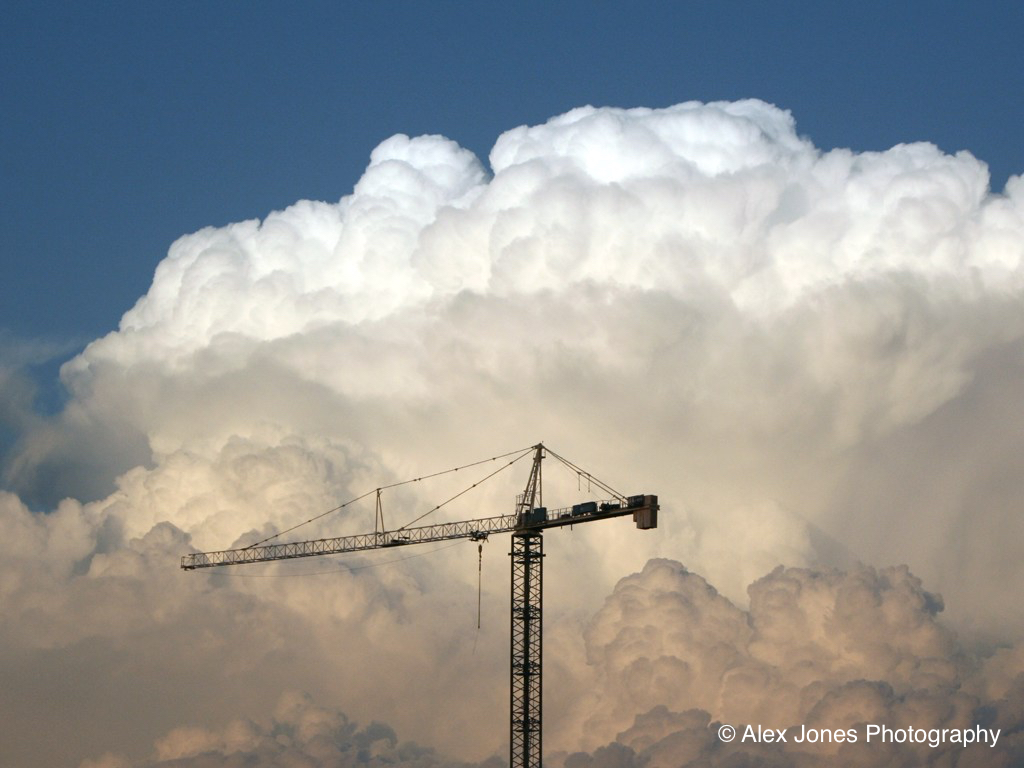
A tall construction crane stands against a sky filled with big, puffy white clouds. The crane has a long arm that reaches across the sky. The clouds look thick and fluffy like cotton balls stacked on top of each other.
🔬 Scientific Phenomena
This image represents the Anchoring Phenomenon of cloud formation and weather patterns. The large, towering cumulus clouds visible behind the crane are formed when warm, moist air rises high into the atmosphere, cools down, and water vapor condenses into tiny water droplets. These clouds can grow very tall when there are strong upward air currents, and they often signal changing weather conditions. The dramatic size and structure of these clouds demonstrates how water moves through Earth's atmosphere in the water cycle.
📚 Core Science Concepts
- Water Cycle Processes - Clouds form when water evaporates from Earth's surface, rises as invisible water vapor, then cools and condenses into visible water droplets
- Weather Patterns - Large cumulus clouds like these often indicate unstable atmospheric conditions and can develop into thunderstorms
- States of Matter - The transformation from invisible water vapor (gas) to visible cloud droplets (liquid) demonstrates how matter changes states based on temperature
- Air Movement - Rising warm air and sinking cool air create the conditions necessary for cloud formation and growth
Pedagogical Tip: Use cotton balls or marshmallows as hands-on models to help students visualize how water droplets cluster together to form clouds. This concrete representation helps make the abstract concept of condensation more accessible.
UDL Suggestions: Provide multiple ways for students to demonstrate understanding by offering options like drawing the water cycle, acting out water vapor rising and condensing, or building a 3D model with craft materials to support different learning preferences.
🔍 Zoom In / Zoom Out Concepts
- Zoom In: Inside the cloud, millions of tiny water droplets are constantly bumping into each other and joining together. These droplets are so small you would need a microscope to see individual ones, but when billions cluster together, they form the white puffy clouds we can see.
- Zoom Out: These clouds are part of Earth's global water cycle system. Water from oceans, lakes, and rivers around the world evaporates, forms clouds, and eventually falls as precipitation, providing fresh water for plants, animals, and humans across different continents and ecosystems.
🤔 Potential Student Misconceptions
- Misconception: Clouds are made of cotton or smoke
Clarification: Clouds are made of tiny water droplets or ice crystals suspended in the air
- Misconception: Clouds come from factory smokestacks or pollution
Clarification: Natural clouds form from water vapor in the air, though pollution can affect cloud formation
- Misconception: All clouds bring rain immediately
Clarification: Different types of clouds form under different conditions, and not all clouds produce precipitation
🎓 NGSS Connections
- Performance Expectation: 2-ESS1-1 - Use information from several sources to provide evidence that Earth events can occur quickly or slowly
- Disciplinary Core Ideas: - Some events happen very quickly, others occur very slowly, over a time period much longer than one can observe
- Crosscutting Concepts: - Patterns in the natural world can be observed and used as evidence
- Science and Engineering Practices:
💬 Discussion Questions
- What do you think would happen to these clouds if the temperature got much colder? (Bloom's: Predict | DOK: 2)
- How might the weather change if these clouds continue to grow bigger? (Bloom's: Analyze | DOK: 3)
- Where do you think the water in these clouds originally came from? (Bloom's: Apply | DOK: 2)
- What patterns do you notice in the shape and size of these clouds? (Bloom's: Observe | DOK: 1)
📖 Science Vocabulary
- Condensation: When water vapor cools down and changes into tiny water droplets
- Water vapor: Water in its invisible gas form that floats in the air
- Cumulus: A type of puffy, cotton-like cloud that forms when warm air rises
- Precipitation: Water that falls from clouds as rain, snow, sleet, or hail
- Atmosphere: The layer of air that surrounds Earth
- Evaporation: When liquid water changes into invisible water vapor and rises into the air
🔗 Cross-Curricular Ideas
- Math Connection - Measuring and Comparing: Have students use a ruler or measuring tape to measure the height of classroom objects and compare them to the height of the construction crane in the photo. They can create a simple bar graph showing "Objects Shorter Than the Crane" and "Objects Taller Than the Crane" to practice data representation and comparison skills.
- ELA Connection - Descriptive Writing: Ask students to write or dictate sentences describing the clouds using sensory words (fluffy, white, puffy, towering). Create a word wall with cloud descriptors and have students use these words in creative writing or poetry about weather and sky observations.
- Social Studies Connection - Community Builders: Discuss how construction cranes help build homes, schools, hospitals, and other buildings in our community. Take a virtual or real-world tour of a local construction site (if safe and possible) and have students draw pictures of workers and machines that help build things people need.
- Art Connection - Cloud Painting: Using white paint, cotton balls, or paper torn into cloud shapes, have students create artwork showing cumulus clouds at different stages of growth. They can layer materials to show how clouds build up, reinforcing the visual concept of cloud formation while developing fine motor skills.
🚀 STEM Career Connection
- Meteorologist — Studies the atmosphere to work out what the weather will do next.
- Try it: Track cloud types over a week and correlate them with recorded temperature and precipitation data. (Practice: Analyzing and Interpreting Data)
- Tools: weather balloons, radar, rain gauges, computer models
- Where they work: weather stations, airports, television studios, research centres
- Meet one: Marshall Shepherd — Why cities make their own weather, and why some neighbourhoods flood before others.
- Median pay: /year — "Atmospheric and space scientists"
- Hydrologist — Follows water — where it falls, where it goes underground, and where it comes out again.
- Try it: Draw a diagram showing how water evaporates, forms clouds, and returns to Earth as precipitation. (Practice: Analyzing and Interpreting Data)
- Tools: stream gauges, well probes, flow meters, rain gauges
- Where they work: rivers and reservoirs, water utilities, government surveys, universities
- Meet one: Newsha Ajami — How cities can use water more wisely, especially when there is not enough of it.
- Median pay: /year — "Hydrologists"
Wage figures are median annual wages for the U.S. occupation named after each one, from the U.S. Bureau of Labor Statistics, Occupational Employment and Wage Statistics (OEWS), national, May 2025. Several careers share one occupation, so their figures match.