📸 Photo Description
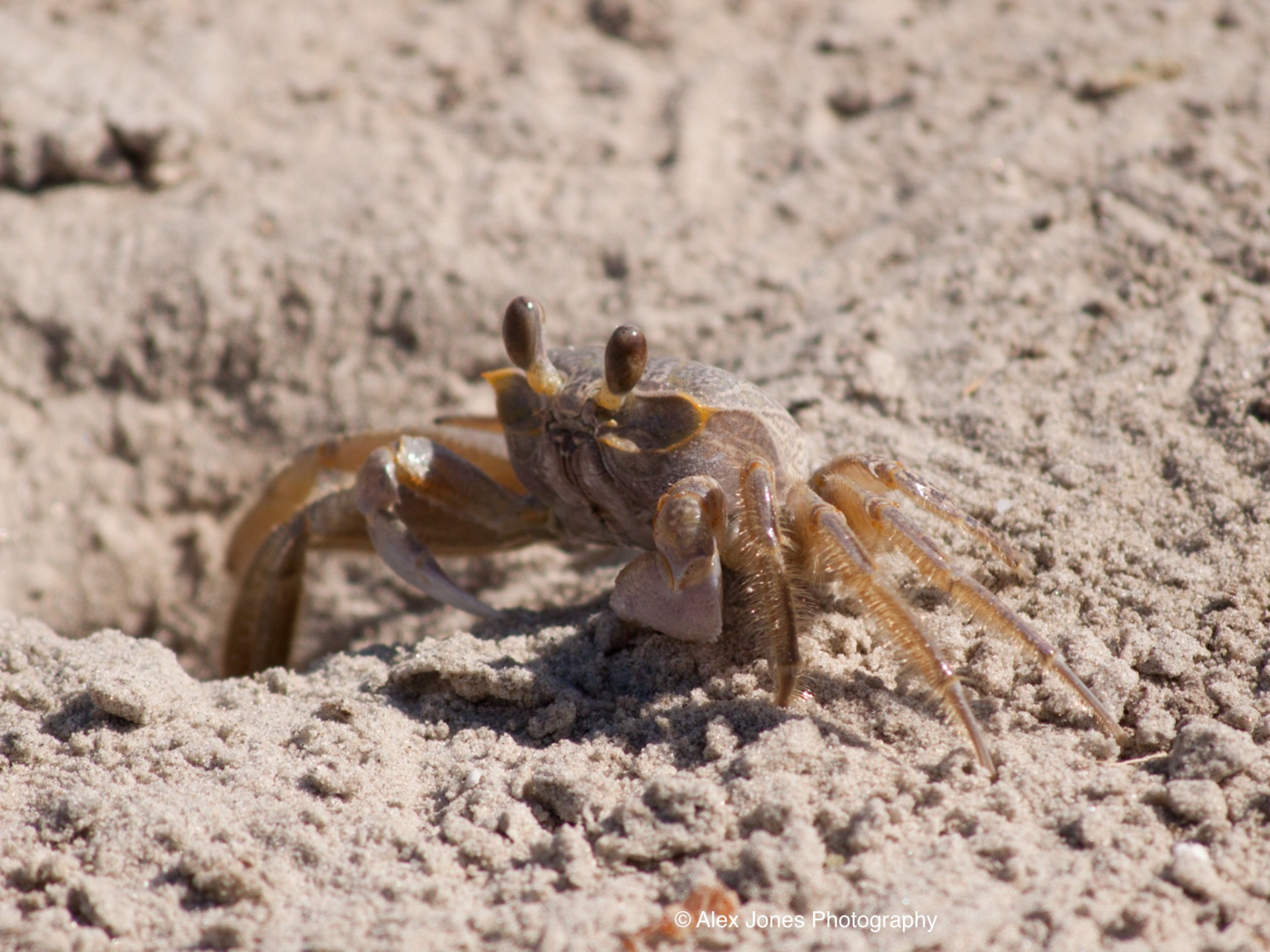
This photograph shows a ghost crab on sandy beach. The crab has two long eye stalks and brown claws, and it is walking on light tan sand with small rocks mixed in. The sandy beach is part of Earth's land and water systems where many living things make their homes.
🔬 Scientific Phenomena
Anchoring Phenomenon: Why do crabs live on sandy beaches?
This image illustrates how Earth's landforms—specifically beaches—are shaped by natural processes and provide habitats for living things. Beaches form over time as waves, wind, and water move and break down rocks into sand grains. The crab lives here because the sandy beach provides shelter (through burrowing), food access, and moisture from the nearby ocean. This demonstrates the interconnection between Earth's physical features (sand, water) and the organisms that depend on them for survival.
📚 Core Science Concepts
- Landforms and Earth Materials: Beaches are landforms made of sand (tiny pieces of rock and minerals broken down over time by water and wind action). Sand grains are observable Earth materials that shape where organisms can live.
- Habitats and Environments: Different organisms live in different places based on their needs. The beach—with its sand, moisture, and proximity to water—meets the specific needs of crabs and other beach-dwelling creatures.
- Weathering and Erosion: Over long periods, rocks are broken down into smaller pieces by water, wind, and waves. This natural process creates sand and continuously reshapes beach landforms.
- Water and Land Connection: Beaches exist where land meets water (the ocean). This boundary zone is shaped by water movement and provides resources for many living things.
Pedagogical Tip:
For Kindergarteners, focus on the observable, tangible aspects of sand and beaches rather than abstract geological time scales. Use sensory language: "What does sand feel like? What do you see when you look at sand up close? Why is the crab here?" Concrete observations build foundational understanding before introducing processes like erosion.
UDL Suggestions:
Universal Design for Learning Strategy: Provide multiple means of engagement and representation. Students can explore sand through hands-on play with kinetic sand or sandbox materials (tactile/kinesthetic learners), observe photographs and videos of beaches (visual learners), and listen to descriptions and sounds of waves (auditory learners). Allow students to choose how they investigate: by touching sand, drawing the beach, or discussing habitats aloud.
🔍 Zoom In / Zoom Out Concepts
Zoom In — The Microscopic View:
If you looked at a single grain of sand under a magnifying glass, you would see it is a tiny piece of rock or mineral. Long ago, this grain was part of a much larger rock. Water, waves, and wind broke the rock apart into millions of smaller pieces over many, many years. Each sand grain tells a story of weathering and erosion.
Zoom Out — The Larger System:
A beach is part of Earth's larger coastal ecosystem and water system. Beaches are shaped by the ocean's waves, tides, and currents. The sand on one beach may have come from rocks far inland that rivers carried to the sea. Beaches also connect to weather patterns—storms can reshape beaches, and the sun heats the sand. All these systems work together to create and maintain the beach environment where the crab and other organisms live.
🤔 Potential Student Misconceptions
- Misconception: "Sand is just dirt."
Clarification: Sand is made of tiny pieces of rock and minerals. It formed over a very long time as rocks were broken into smaller and smaller pieces by water, waves, and wind. Sand is a natural Earth material.
- Misconception: "The beach is always the same."
Clarification: Beaches change over time! Waves, wind, and storms can move sand around. Heavy rains can wash sand away. In winter, beaches may look different than in summer. Earth's landforms are always slowly changing.
- Misconception: "The crab can live anywhere—it doesn't need sand."
Clarification: The crab lives on the sandy beach because it needs sand to burrow in for shelter and safety. The crab also needs to be close to water to stay moist. Different animals have different needs, and they live in places where those needs are met.
🎓 NGSS Connections
K-ESS3-1: Use a model to represent the relationship between the needs of different plants and animals (including humans) and the places they live.
- Connection: The ghost crab is standing at the mouth of its own burrow. Students can ask what this animal needs — loose sand it can dig, cool damp shelter below the surface, food washed up near the water — and see that the beach supplies all of it.
-
-
K-LS1-1: Use observations to describe patterns of what plants and animals (including humans) need to survive.
- Connection: Look closely at the crab and list what it needs. Its pale sandy colour, its stalked eyes held above the sand, and the burrow behind it are all visible clues about surviving in this one place.
-
-
💬 Discussion Questions
- "Why do you think the crab lives on the sandy beach and not in the grass or on a rock?" (Bloom's: Analyze | DOK: 2)
Encourages students to think about how organisms match their habitats.
- "What do you think happened to make all this sand? Where did it come from?" (Bloom's: Evaluate | DOK: 3)
Promotes thinking about processes like erosion and weathering over time.
- "If a big storm came and moved all the sand on this beach, what might happen to the crab?" (Bloom's: Analyze | DOK: 2)
Helps students understand that changes to landforms affect the organisms living there.
- "How is the beach different from your classroom? What do you see here that you don't see at school?" (Bloom's: Understand | DOK: 1)
Activates prior knowledge and encourages observation of landforms and environments.
📖 Vocabulary
- Sand: Very tiny pieces of rock and minerals that are found on beaches and in deserts.
- Beach: A sandy or rocky area of land where the ocean or a large lake meets the land.
- Habitat: The place where a plant or animal lives that gives it everything it needs to survive.
- Burrow: A hole or tunnel in the ground where an animal digs to make a home and stay safe.
- Erosion: When wind, water, or rain slowly wears away rocks and soil and moves it to another place.
- Landform: A natural shape of land, like a mountain, valley, or beach.
🌡️ Extension Activities
Activity 1: Sand Exploration Station
Provide students with kinetic sand, a sandbox, or beach sand in a sensory bin. Include magnifying glasses, small containers, and funnels. Students can dig, pour, observe, and describe the sand's texture, color, and how it moves. Ask: "What do you notice about the sand? How does it feel? What can you build with it?" This builds tactile understanding of Earth materials and erosion concepts.
Activity 2: Crab Habitat Model
Students create a simple crab habitat in a shallow container using sand, rocks, and water in a cup (to represent the ocean nearby). They can draw a crab on paper, cut it out, and place it in their model habitat. Discuss: "What does the crab need to live? Does our model have sand for burrowing? Is there water nearby? Why does the crab need these things?" This reinforces the relationship between organisms and their environments.
Activity 3: Beach Walk Observation & Documentation
If possible, take students on a nature walk to a local beach, sandy area, or even a sandy playground. Have them observe and collect observations (draw or dictate descriptions) about: What do you see? What does the sand feel like? What animals or signs of animals do you find? What shapes does the sand make? Back in class, create a class chart or book of observations. This connects abstract learning to real-world phenomena.
🔗 Cross-Curricular Ideas
- Math: Measure and compare sand textures using sieves of different sizes. Sort sand by grain size. Count how many shells or rocks are in a handful of sand. Create simple graphs showing "things we found on the beach."
- ELA & Literacy: Read beach-themed stories. Have students dictate or write descriptions of the beach using sensory words: bumpy, smooth, wet, dry, warm. Create a class book titled "What Lives at the Beach?" with student-drawn illustrations and simple captions.
- Social Studies & Community: Discuss who visits beaches and how humans use them. Explore the concept of caring for shared natural spaces. Create a "Beach Safety & Care" poster showing how to protect beach habitats and organisms.
- Art & Creative Expression: Create beach scenes using sand, paint, shells, and other natural materials. Make sand art in jars with different colored sand layers. Draw or paint pictures of crabs and other beach animals in their habitats.
🚀 STEM Career Connection
- Coastal Engineer — Designs seawalls, dunes and barriers that slow the ocean down before it takes the shore.
- Try it: Build a small model of a beach using sand and water, and then test how waves affect your model. (Practice: Developing and Using Models)
- Tools: wave models, sediment surveys, tide gauges, CAD software
- Where they work: coastlines and harbours, engineering firms, government coastal agencies, research labs
- Meet one: Yewande Akinola — How to get clean water to places that do not have it, and how to design buildings that waste less of it.
- Median pay: /year — "Civil engineers"
- Hydrologist — Follows water — where it falls, where it goes underground, and where it comes out again.
- Try it: Create a model to show how water moves sand, using a tray, sand, and a pitcher of water. (Practice: Developing and Using Models)
- Tools: stream gauges, well probes, flow meters, rain gauges
- Where they work: rivers and reservoirs, water utilities, government surveys, universities
- Meet one: Newsha Ajami — How cities can use water more wisely, especially when there is not enough of it.
- Median pay: /year — "Hydrologists"
Wage figures are median annual wages for the U.S. occupation named after each one, from the U.S. Bureau of Labor Statistics, Occupational Employment and Wage Statistics (OEWS), national, May 2025. Several careers share one occupation, so their figures match.