📸 Photo Description
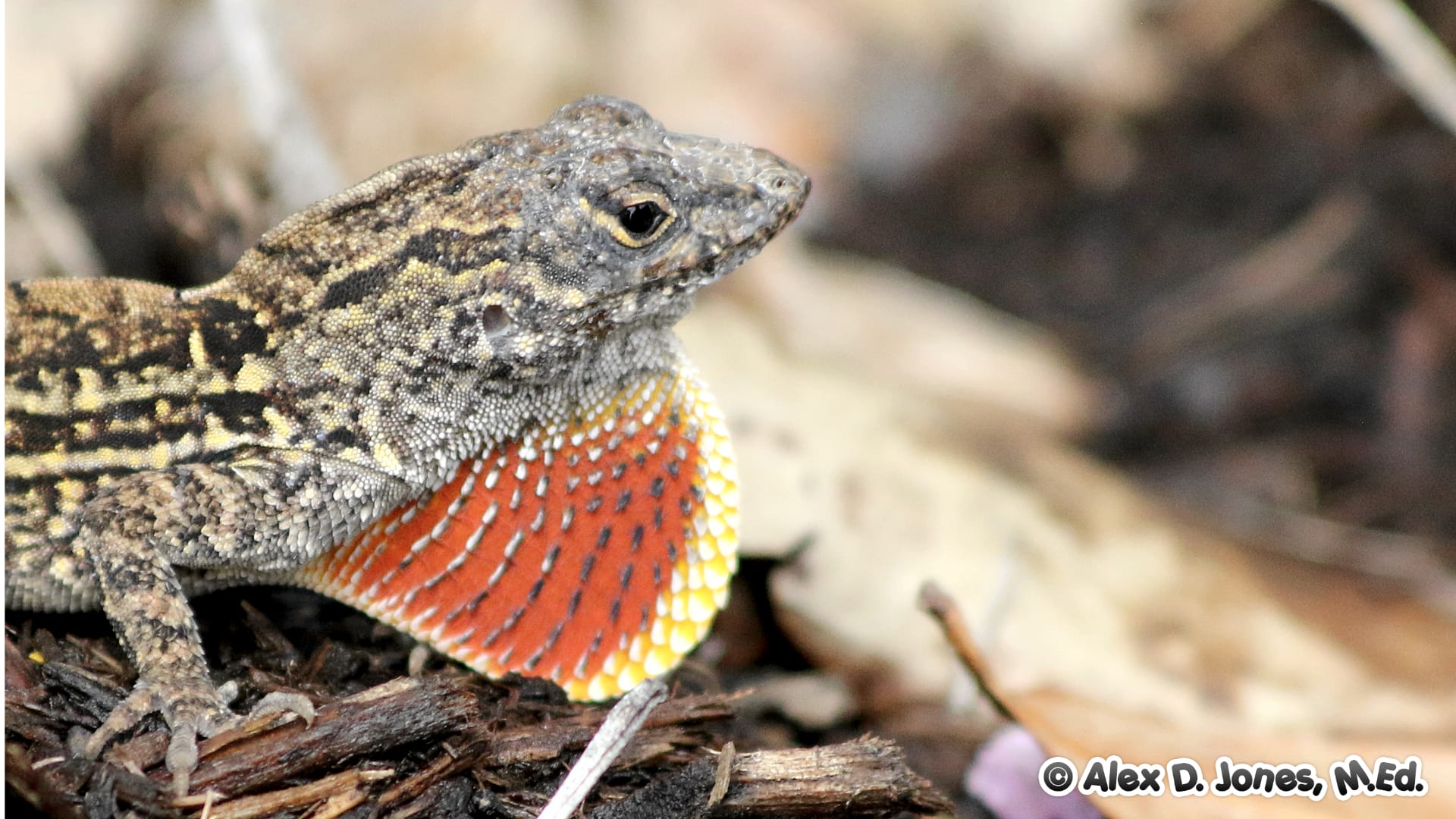
This lizard has a bright orange and red flap of skin under its neck called a dewlap. The lizard is showing off its colorful dewlap by puffing it out. The rest of its body is brown and gray with spots that help it blend in with rocks and dirt.
🔬 Scientific Phenomena
The Anchoring Phenomenon is animal communication through visual displays. This lizard (likely an anole) is extending its dewlap as a form of communication - either to attract a mate, defend territory, or warn other animals. This behavior happens because animals have evolved different ways to "talk" to each other without making sounds. The bright colors and sudden movement of the dewlap catches attention and sends a clear message to other lizards nearby.
📚 Core Science Concepts
- Animal Communication: Animals use body parts, colors, sounds, and movements to communicate with each other for survival needs like finding mates and protecting territory.
- Adaptation and Camouflage: The lizard's brown and spotted body helps it blend into its environment, while the bright dewlap is hidden until needed for communication.
- Animal Behavior: Animals have specific behaviors that help them survive, including territorial displays and mating rituals.
- Body Structures and Functions: Different animal body parts have special jobs - the dewlap's function is communication, while the camouflaged skin provides protection.
Pedagogical Tip: Use think-pair-share when introducing animal communication concepts. Have students first think of ways they communicate without words, then discuss how animals might do the same. This builds connection between human and animal experiences.
UDL Suggestions: Provide multiple ways for students to demonstrate understanding of animal communication - they could draw, act out, create sounds, or build models. Some students may better understand through kinesthetic movement rather than just visual observation.
🔍 Zoom In / Zoom Out Concepts
Zoom In: At the cellular level, special cells called chromatophores contain pigments that create the bright orange and red colors in the dewlap. Muscles contract to extend the dewlap, stretching the skin and making the display visible.
Zoom Out: This communication behavior is part of a larger ecosystem where many animals compete for resources like food, shelter, and mates. The lizard's ability to communicate effectively affects its survival and the balance of the entire habitat community.
🤔 Potential Student Misconceptions
- Misconception: "The lizard is angry or trying to hurt something."
Clarification: The dewlap display is communication, not aggression. It's more like waving hello or showing off than being mean.
- Misconception: "Only big animals need to communicate."
Clarification: All animals, even tiny ones, need to communicate for survival. Small animals often have very creative ways to send messages.
- Misconception: "Animals can only communicate by making sounds."
Clarification: Animals communicate through colors, movements, smells, and body language - not just sounds.
🎓 NGSS Connections
Performance Expectation: 3-LS4-3 - Construct an argument with evidence that in a particular habitat some organisms can survive well, some survive less well, and some cannot survive at all.
Disciplinary Core Ideas:
- - Environmental changes affect organisms and populations
- - Variation of traits over time
Crosscutting Concepts:
- - The dewlap display causes other lizards to respond
- - The dewlap's structure allows it to function as a communication tool
💬 Discussion Questions
- "What do you think this lizard is trying to tell other animals with its colorful display?" (Bloom's: Analyze | DOK: 2)
- "How might this lizard's ability to show and hide its bright colors help it survive?" (Bloom's: Evaluate | DOK: 3)
- "What other animals have you seen that use bright colors or special body parts to communicate?" (Bloom's: Apply | DOK: 2)
- "If you were designing an animal that needed to communicate danger to its family, what body parts would you give it?" (Bloom's: Create | DOK: 4)
📖 Science Vocabulary
- Dewlap: A flap of skin under an animal's throat that can be stretched out to show bright colors
- Communication: The way animals send messages to each other using sounds, colors, or movements
- Camouflage: Colors or patterns that help animals blend in with their surroundings to hide
- Adaptation: A special body part or behavior that helps an animal survive in its environment
- Territory: An area that an animal claims and defends as its own space
- Display: When an animal shows off special colors or behaviors to communicate with others
🔗 Cross-Curricular Ideas
- ELA - Descriptive Writing: Have students write a short story from the lizard's perspective, describing why it's showing its dewlap and what message it wants to send. Students can use the vocabulary words (dewlap, territory, communication) in their writing to reinforce science concepts.
- Art - Color and Design: Students create their own imaginary animal with a special body part for communication. They can draw or paint their animal using bright colors like the dewlap, then explain to a partner what their animal is trying to communicate and why those colors were chosen.
- Math - Measurement and Patterns: Examine the pattern of spots on the lizard's body. Students can count the spots, create their own spotted pattern using graph paper, or measure how long they think the lizard is compared to familiar objects (like a pencil or their hand).
- Social Studies - Animal Habitats and Communities: Research where anole lizards live and what other animals share their habitat. Create a simple habitat map showing where different animals would live in a desert or tropical area and how they interact with one another.
🚀 STEM Career Connection
- Biologist — Studies living things of every kind and what keeps them alive.
- Try it: Explain how the anole's dewlap is a body structure that helps it communicate. (Practice: Structure and Function)
- Tools: microscopes, sample jars, measuring tools, a field notebook
- Where they work: laboratories, field sites, museums, universities
- Meet one: Sandra Díaz — What a plant's leaves, wood and shape tell you about how it lives — and how those traits add up across a whole ecosystem.
- Median pay: /year — "Biological scientists, all other"
- Zoologist — Studies animals — their bodies, their behaviour, and how they are related to each other.
- Try it: Describe how the anole's skin color is a body structure that helps it survive. (Practice: Structure and Function)
- Tools: observation blinds, animal tags, cameras, a field notebook
- Where they work: zoos, research stations, national parks, universities
- Meet one: Rae Wynn-Grant — Where black bears and people run into each other, and how to keep both safe.
- Median pay: /year — "Zoologists and wildlife biologists"
Wage figures are median annual wages for the U.S. occupation named after each one, from the U.S. Bureau of Labor Statistics, Occupational Employment and Wage Statistics (OEWS), national, May 2025. Several careers share one occupation, so their figures match.