📸 Photo Description
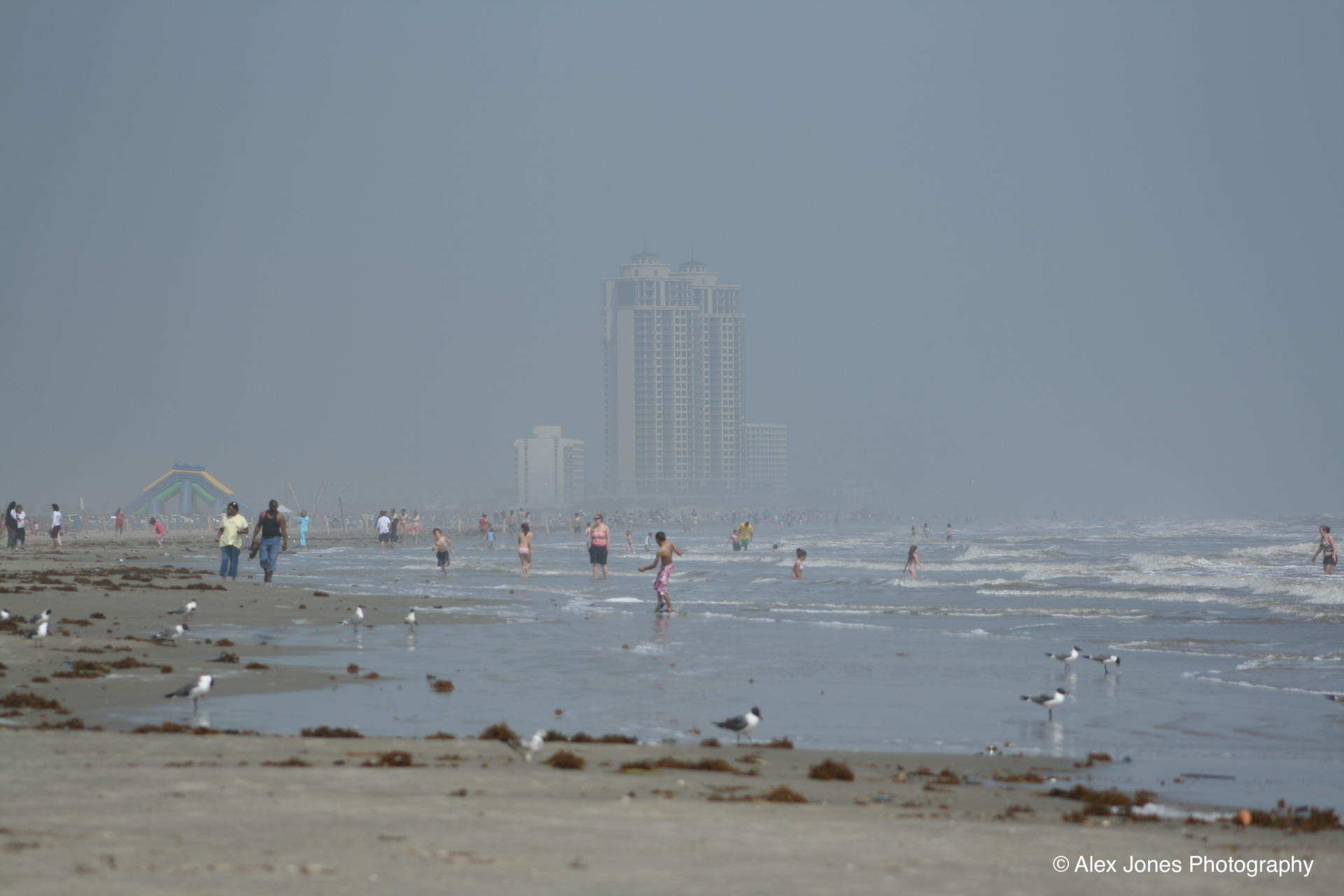
This beach scene shows people playing in the ocean water on a foggy day. A tall building in the background is partly hidden by thick fog or mist. Seagulls are walking on the wet sand where waves have washed up seaweed and other things from the ocean.
🔬 Scientific Phenomena
The Anchoring Phenomenon is coastal fog formation. This occurs when warm, moist air from the ocean meets cooler air temperatures near the shore. The water vapor in the warm air condenses into tiny water droplets that float in the air, creating the thick fog that obscures the buildings. This is a common weather pattern at beaches, especially during certain times of day when temperature differences are greatest.
📚 Core Science Concepts
- Water Cycle in Action: The fog demonstrates evaporation from the ocean and condensation in the air
- Weather Patterns: Coastal areas experience unique weather due to the interaction between land and water temperatures
- States of Matter: Water exists as liquid (ocean), gas (water vapor), and tiny liquid droplets (fog) all in the same location
- Ocean-Land Interactions: The beach ecosystem shows how waves deposit materials like seaweed onto shore
Pedagogical Tip: Use this image to help students make connections between weather they observe locally and the water cycle. Ask them to trace where the water in the fog came from and where it might go next.
UDL Suggestions: Provide multiple ways for students to represent their understanding: drawing the water cycle, acting out water molecules changing states, or creating a simple diagram showing how fog forms.
🔍 Zoom In / Zoom Out Concepts
- Zoom In: Individual water molecules are moving faster when warm (evaporating from ocean) and slower when cool (condensing into fog droplets). These invisible molecular movements create the visible weather we observe.
- Zoom Out: This coastal fog is part of larger global weather systems where oceans regulate Earth's temperature by absorbing and releasing heat, affecting weather patterns across continents.
🤔 Potential Student Misconceptions
- Misconception: "Fog is smoke or pollution from buildings"
Clarification: Fog is made of tiny water droplets, just like clouds, formed naturally through the water cycle
- Misconception: "The ocean water disappears when it evaporates"
Clarification: Water changes form but doesn't disappear - it becomes invisible water vapor that can later become visible as fog or clouds
- Misconception: "Fog only happens when it's cold outside"
Clarification: Fog forms when warm, moist air meets cooler air, which can happen even on relatively warm days at the beach
🎓 NGSS Connections
- Performance Expectation: 2-ESS1-1 - Use information from several sources to provide evidence that Earth events can occur quickly or slowly
- Disciplinary Core Ideas: - Some events happen very quickly; others occur very slowly, over a time period much longer than one can observe
- Crosscutting Concepts: - Patterns in the natural world can be observed and used as evidence
💬 Discussion Questions
- What do you think would happen to the fog if the sun came out strongly? (Bloom's: Predict | DOK: 2)
- How is the fog in this picture similar to and different from clouds in the sky? (Bloom's: Compare | DOK: 2)
- Why might some beaches have more fog than others? (Bloom's: Analyze | DOK: 3)
- What evidence can you see that shows water is constantly moving and changing in this picture? (Bloom's: Evaluate | DOK: 3)
📖 Science Vocabulary
- Condensation: When water vapor cools down and turns back into tiny water droplets
- Evaporation: When liquid water changes into invisible water vapor and rises into the air
- Water vapor: Water in its invisible gas form floating in the air
- Fog: A cloud that forms close to the ground made of tiny water droplets
- Coastal: Areas where the land meets the ocean or sea
🔗 Cross-Curricular Ideas
- Math - Measuring and Graphing: Have students collect data about foggy days at your local beach or area over several weeks. Create a simple bar graph showing how many foggy days occur each week. Students can count, compare, and answer questions like "Which week had the most fog?"
- ELA - Weather Descriptive Writing: Ask students to write or dictate sentences describing what they see, hear, and feel in a foggy place. Use sensory words like "misty," "damp," "cool," and "gray." Students can create a "Fog Day" class book with illustrations and their own foggy weather descriptions.
- Social Studies - Coastal Communities: Explore how people who live near beaches adapt to foggy weather. Students can learn about different jobs people do at the beach (lifeguards, beach cleaners, surfers) and discuss how fog might affect their work. Compare beach life to life in other environments students know.
- Art - Perspective and Atmosphere: Create artwork showing how fog makes distant objects (like the building in the photo) look lighter and less clear than objects up close. Students can paint or draw a beach scene using lighter colors and softer details in the distance to show how fog affects what we see.
🚀 STEM Career Connection
- Meteorologist — Studies the atmosphere to work out what the weather will do next.
- Try it: Record the fog's thickness and visibility every 15 minutes for an hour, noting any changes in the ocean. (Practice: Obtaining, Evaluating, and Communicating Information)
- Tools: weather balloons, radar, rain gauges, computer models
- Where they work: weather stations, airports, television studios, research centres
- Meet one: Marshall Shepherd — Why cities make their own weather, and why some neighbourhoods flood before others.
- Median pay: /year — "Atmospheric and space scientists"
- Hydrologist — Follows water — where it falls, where it goes underground, and where it comes out again.
- Try it: Trace the path of water from the ocean, to the air as vapor, and then as fog, drawing a diagram. (Practice: Obtaining, Evaluating, and Communicating Information)
- Tools: stream gauges, well probes, flow meters, rain gauges
- Where they work: rivers and reservoirs, water utilities, government surveys, universities
- Meet one: Newsha Ajami — How cities can use water more wisely, especially when there is not enough of it.
- Median pay: /year — "Hydrologists"
Wage figures are median annual wages for the U.S. occupation named after each one, from the U.S. Bureau of Labor Statistics, Occupational Employment and Wage Statistics (OEWS), national, May 2025. Several careers share one occupation, so their figures match.