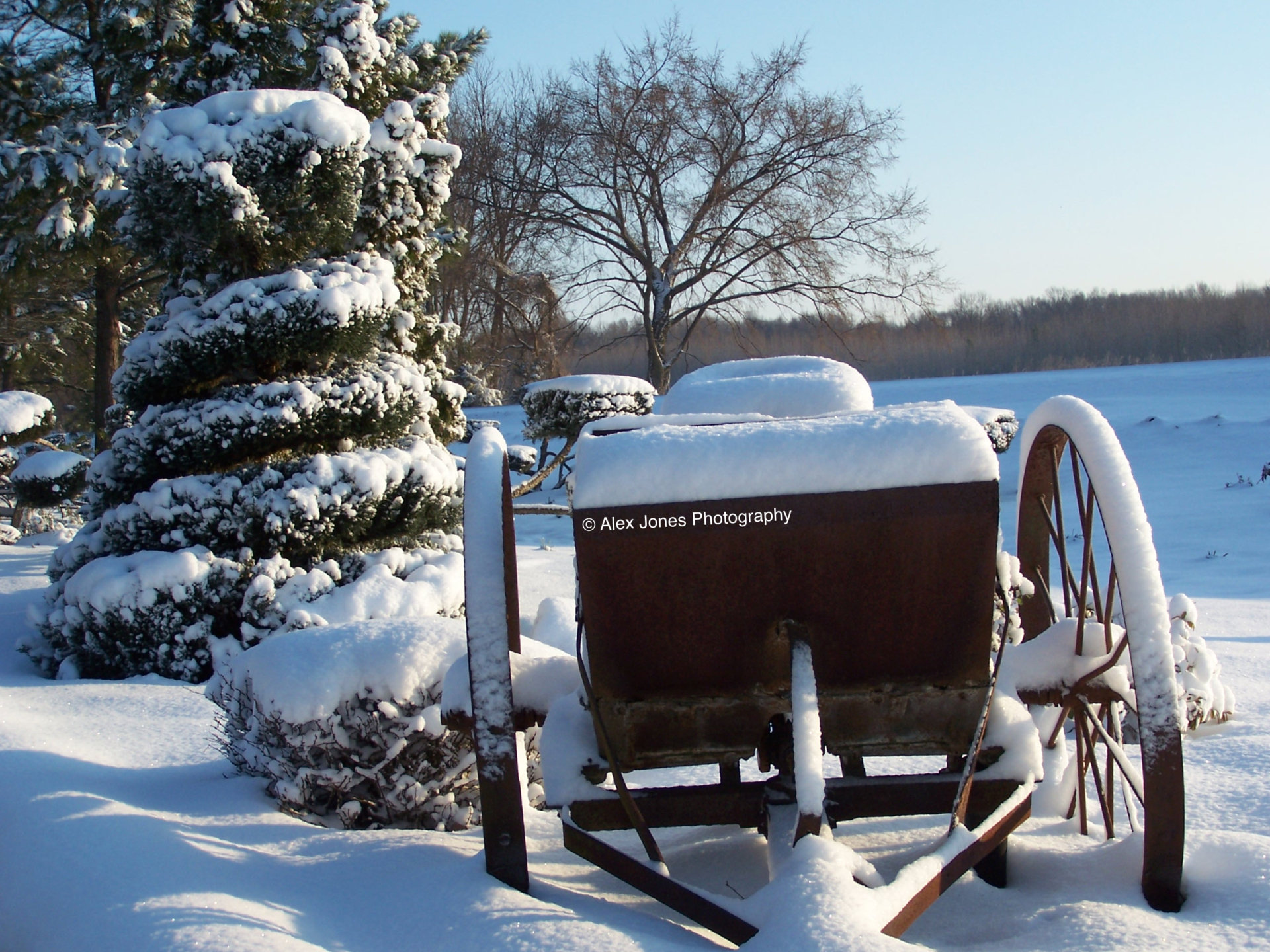
📸 Photo Description
This picture shows an old wagon covered with thick white snow. The snow sits on top of the wagon like a fluffy blanket. You can also see snow-covered trees and bushes in the background on a sunny winter day.
🔬 Scientific Phenomena
The Anchoring Phenomenon is snow accumulation and its interaction with different surfaces and objects. Snow forms when water vapor in clouds freezes into ice crystals, then falls to Earth and accumulates on surfaces. The snow appears thicker and more rounded on the wagon because wind patterns, surface temperature, and the wagon's shape affect how snow collects and stays in place. The evergreen trees hold more snow on their branches due to their needle structure, while bare deciduous trees show less accumulation.
📚 Core Science Concepts
- States of Matter Transformation: Snow demonstrates water changing from gas (water vapor) to solid (ice crystals) through the freezing process in clouds.
- Weather Patterns and Precipitation: Snow is a form of precipitation that occurs when atmospheric conditions include freezing temperatures and sufficient moisture.
- Surface Interactions: Different materials and shapes collect and hold snow differently - the wagon's flat surfaces allow thick accumulation while sloped surfaces may shed snow.
Pedagogical Tip: Use this image to help students make connections between their everyday winter experiences and scientific concepts. Ask them to compare how snow collects on different objects in their own yards or neighborhoods.
- Seasonal Changes: This scene represents winter conditions that are part of Earth's cyclical seasonal patterns caused by our planet's tilt and orbit around the sun.
UDL Suggestions: Provide multiple ways for students to engage with this content by offering hands-on snow experiments (using cotton balls or foam), digital simulations of snow formation, and opportunities to draw or act out the water cycle in winter conditions.
🔍 Zoom In / Zoom Out Concepts
Zoom In: At the microscopic level, each snowflake is made of tiny ice crystals with unique six-sided patterns. These crystals form when water molecules arrange themselves in hexagonal structures as they freeze in the clouds.
Zoom Out: This snowy scene is part of Earth's larger water cycle system. The snow will eventually melt and flow into streams, rivers, and groundwater, providing fresh water for plants, animals, and humans throughout the ecosystem.
🤔 Potential Student Misconceptions
- Misconception: Snow is just frozen rain.
Clarification: Snow forms directly from water vapor in clouds, while frozen rain (sleet) is liquid rain that freezes as it falls.
- Misconception: All snow is the same temperature.
Clarification: Snow can exist at different temperatures, and its texture and behavior change based on air temperature and humidity.
- Misconception: Snow only melts when the sun shines on it.
Clarification: Snow melts when air temperature rises above freezing (32°F), regardless of whether the sun is shining.
🎓 NGSS Connections
Performance Expectation: 3-ESS2-1 - Represent data in tables and graphical displays to describe typical weather conditions expected during a particular season.
Disciplinary Core Ideas:
- - Weather and Climate
- - Structure and Properties of Matter
Crosscutting Concepts:
-
-
💬 Discussion Questions
- What do you think will happen to this snow when spring arrives? (Bloom's: Predict | DOK: 2)
- Why do you think the snow is piled higher on the wagon than on the tree branches? (Bloom's: Analyze | DOK: 3)
- How might animals in this area find food and shelter during snowy weather? (Bloom's: Apply | DOK: 2)
- What patterns do you notice about where snow collects in this picture? (Bloom's: Analyze | DOK: 2)
📖 Science Vocabulary
- Precipitation: Water that falls from clouds to Earth in forms like rain, snow, or sleet.
- Accumulation: The process of snow or other materials building up and collecting in one place.
- Freezing point: The temperature at which water changes from liquid to solid (32°F or 0°C).
- Water cycle: The continuous movement of water through Earth's atmosphere, land, and oceans.
- Seasonal change: Regular patterns of weather and temperature that repeat each year.
🔗 Cross-Curricular Ideas
- Math - Measurement and Data: Have students measure snow depth on different objects in your schoolyard (wagon, fence post, tree branch) using rulers or sticks. Create a bar graph to compare which objects collected the most snow. This connects to 3.MD.3 (drawing scaled picture graphs and bar graphs).
- ELA - Descriptive Writing: Ask students to write or draw about their own winter experiences. Encourage them to use sensory words (cold, crunchy, fluffy, white) to describe what snow looks like, feels like, and sounds like. This supports 3.W.3 (narrative writing) and vocabulary development.
- Social Studies - How People Adapt: Discuss how people in snowy climates dress differently, build special structures, and use tools like wagons and sleds. Compare how communities in cold places adapt compared to warm places. This connects to understanding human-environment interaction.
- Art - Mixed Media Collage: Students can create a winter landscape using cotton balls, white paper, markers, and other materials to represent snow on objects. This allows creative expression while reinforcing the science concepts about snow accumulation on different surfaces.
🚀 STEM Career Connection
- Climate Scientist — Studies how weather patterns change over many years, and what is driving the change.
- Try it: Create a chart showing the average snowfall for each month over the past five years. (Practice: Analyzing and Interpreting Data)
- Tools: ice cores, satellite data, computer models, long temperature records
- Where they work: research institutes, government climate offices, universities, polar stations
- Meet one: Carlos Nobre — How close the Amazon rainforest is to the point where it stops being a rainforest.
- Median pay: /year — "Atmospheric and space scientists"
- Conservation Scientist — Looks after land, forests and water so they stay healthy for the people and animals who use them.
- Try it: Discuss how snow accumulation affects plant and animal habitats in winter. (Practice: Analyzing and Interpreting Data)
- Tools: soil samplers, aerial photographs, measuring tapes, mapping software
- Where they work: forests and rangelands, parks departments, government agencies, land trusts
- Meet one: Tierra Curry — Which plants and animals are closest to disappearing, and what it takes to save them.
- Median pay: /year — "Conservation scientists"
Wage figures are median annual wages for the U.S. occupation named after each one, from the U.S. Bureau of Labor Statistics, Occupational Employment and Wage Statistics (OEWS), national, May 2025. Several careers share one occupation, so their figures match.