📸 Photo Description
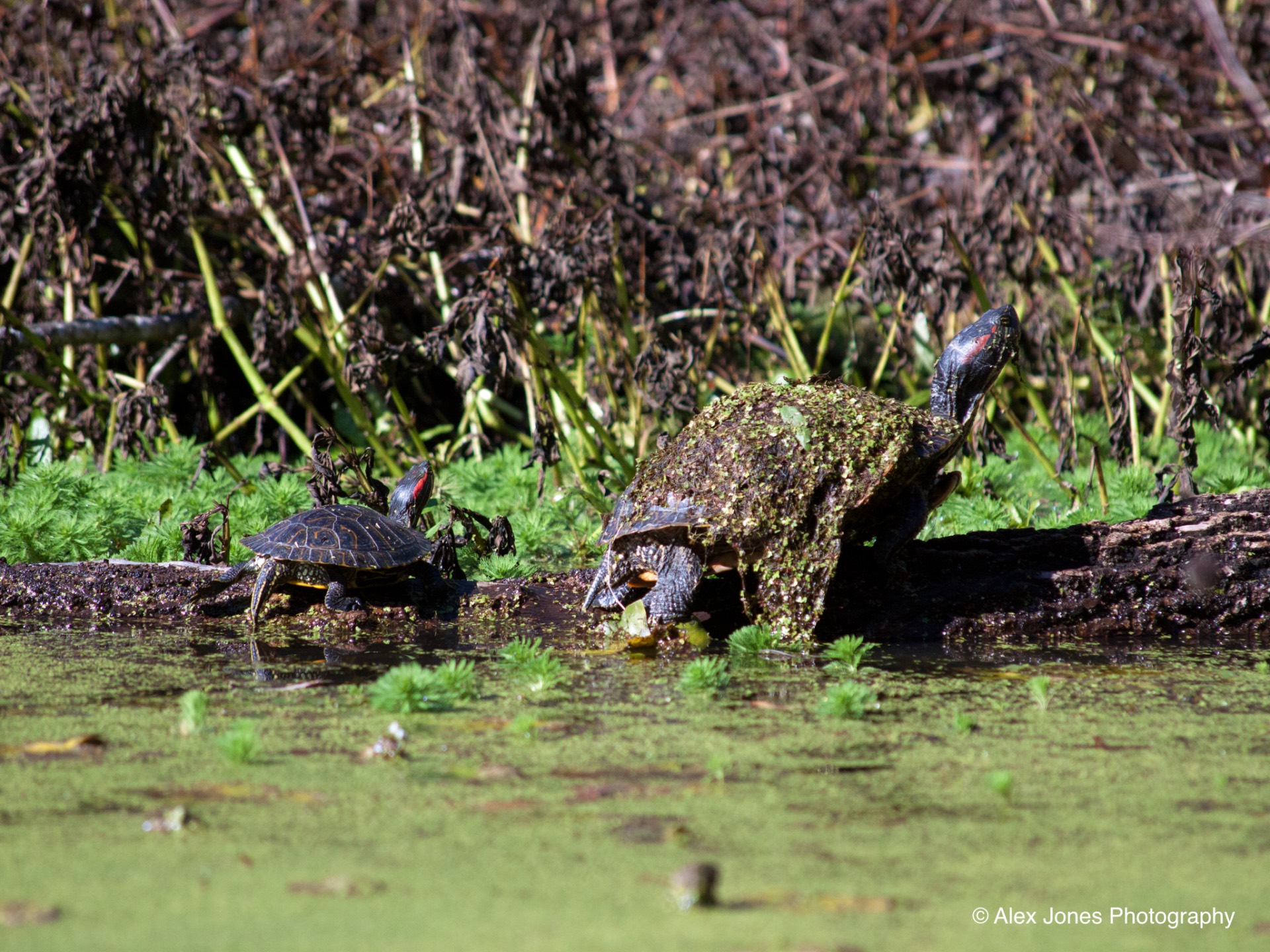
Two turtles are sitting on a log near the water's edge. One turtle is smaller and darker, while the other turtle is larger with a shell covered in green moss or algae. Both turtles have their heads and legs sticking out of their shells, and they appear to be resting in the sunshine.
🔬 Scientific Phenomena
The Anchoring Phenomenon shown here is habitat adaptation and symbiotic relationships in aquatic ecosystems. The larger turtle's shell is covered with algae or moss because it provides a perfect growing surface - the algae gets sunlight when the turtle basks, and the turtle gets camouflage protection. This happens because the turtle's shell stays moist from water and provides nutrients that help plants grow. The turtles are also demonstrating thermoregulation by basking in the sun to warm their cold-blooded bodies.
📚 Core Science Concepts
- Animal Adaptations: Turtles have shells for protection and can pull their heads and legs inside when threatened. Their ability to live both in water and on land helps them survive.
- Symbiotic Relationships: The algae growing on the turtle's shell benefits both organisms - the algae gets a place to live and sunlight, while the turtle gets camouflage.
- Habitat Requirements: Turtles need both water and land areas to meet their survival needs including food, shelter, and temperature regulation.
- Thermoregulation: As cold-blooded animals, turtles must bask in the sun to warm their bodies and become active.
Pedagogical Tip: Use the "Think-Pair-Share" strategy when introducing this image. Have students first observe quietly, then discuss with a partner what they notice, before sharing observations with the whole class. This builds scientific observation skills.
UDL Suggestions: Provide magnifying glasses or zoomed-in photos so students can examine the algae on the turtle's shell more closely. Create tactile models using clay and fake moss so students with visual impairments can feel the texture differences.
🔍 Zoom In / Zoom Out Concepts
- Zoom In: At the microscopic level, tiny algae cells are using photosynthesis to make their own food using sunlight, water, and carbon dioxide. These single-celled organisms attach to the turtle's shell and form the green coating we can see.
- Zoom Out: These turtles are part of a larger wetland ecosystem that includes fish, birds, insects, and plants. The pond or marsh they live in connects to streams and rivers that flow to larger bodies of water, creating a network that supports many different species.
🤔 Potential Student Misconceptions
- Misconception: "The turtle is dirty and needs to be cleaned."
Clarification: The green growth is natural and actually helps the turtle survive by providing camouflage and doesn't harm the turtle.
- Misconception: "Turtles are always slow."
Clarification: While turtles move slowly on land, they can be quite fast swimmers in water where they catch fish and escape predators.
- Misconception: "All turtles can go inside their shells completely."
Clarification: Some turtle species cannot fully retract their heads and legs into their shells due to their shell shape and size.
🎓 NGSS Connections
- Performance Expectation: 3-LS4-3 - Construct an argument with evidence that in a particular habitat some organisms can survive well, some survive less well, and some cannot survive at all.
- Disciplinary Core Ideas: - Environmental changes affect organisms and populations in various ways
- Crosscutting Concepts: - Students can identify the relationship between turtle behaviors and their survival needs
💬 Discussion Questions
- "What do you think would happen to these turtles if their pond dried up?" (Bloom's: Analyze | DOK: 3)
- "How does the algae growing on the turtle's shell help both the turtle and the algae survive?" (Bloom's: Evaluate | DOK: 2)
- "What evidence can you find in the photo that shows these turtles are well-adapted to their environment?" (Bloom's: Analyze | DOK: 2)
- "Why do you think the turtles are sitting in the sun instead of staying in the water?" (Bloom's: Apply | DOK: 2)
📖 Science Vocabulary
- Adaptation: A special feature that helps an animal survive in its environment.
- Habitat: The natural place where an animal lives and finds everything it needs.
- Camouflage: Colors or patterns that help an animal blend in and hide from predators.
- Cold-blooded: Animals that need heat from the sun or environment to warm their bodies.
- Symbiosis: When two different living things help each other survive.
- Basking: Lying in the warm sunshine to heat up the body.
🔗 Cross-Curricular Ideas
- Math - Measurement & Comparison: Have students measure the length and width of different turtle shells using rulers or string. Create a class bar graph comparing shell sizes and discuss which turtles are longer or shorter. Students can also count the number of algae spots they see on each turtle's shell.
- ELA - Descriptive Writing & Storytelling: Ask students to write from the turtle's perspective: "A Day in My Life as a Turtle." They can describe what they see, feel, and do throughout the day. Students could also create "wanted posters" for turtles, describing their physical features, habitat, and behaviors using descriptive adjectives.
- Art - Nature Collage & Camouflage Design: Students can create collages using torn green, brown, and gray paper to show how algae and moss help turtles blend into their environment. They could also design their own "turtle shell" artwork using patterns and colors that would help an animal hide in a pond or forest habitat.
- Social Studies - Animal Habitats Around the World: Research and compare turtles that live in different parts of the world (deserts, rainforests, oceans, freshwater). Create a map showing where different turtle species live and discuss how their shells and behaviors are adapted to their specific environments and climates.
🚀 STEM Career Connection
- Ecologist — Studies how living things depend on each other and on the place they live.
- Try it: Explain how the algae on the turtle's shell helps both the algae and the turtle survive. (Practice: Constructing Explanations and Designing Solutions)
- Tools: quadrat frames, measuring tapes, GPS units, a field notebook
- Where they work: forests, grasslands, wetlands, universities
- Meet one: Sandra Díaz — What a plant's leaves, wood and shape tell you about how it lives — and how those traits add up across a whole ecosystem.
- Median pay: /year — "Environmental scientists and specialists, including health"
- Herpetologist — Studies reptiles and amphibians — snakes, lizards, frogs and turtles.
- Try it: Explain how the turtle's shell provides camouflage and protection from predators. (Practice: Constructing Explanations and Designing Solutions)
- Tools: snake hooks, pitfall traps, temperature probes, a field notebook
- Where they work: deserts and wetlands, zoos, natural history museums, universities
- Meet one: Earyn McGee — What happens to desert lizards when the streams they live near dry up.
- Median pay: /year — "Zoologists and wildlife biologists"
Wage figures are median annual wages for the U.S. occupation named after each one, from the U.S. Bureau of Labor Statistics, Occupational Employment and Wage Statistics (OEWS), national, May 2025. Several careers share one occupation, so their figures match.