📸 Photo Description
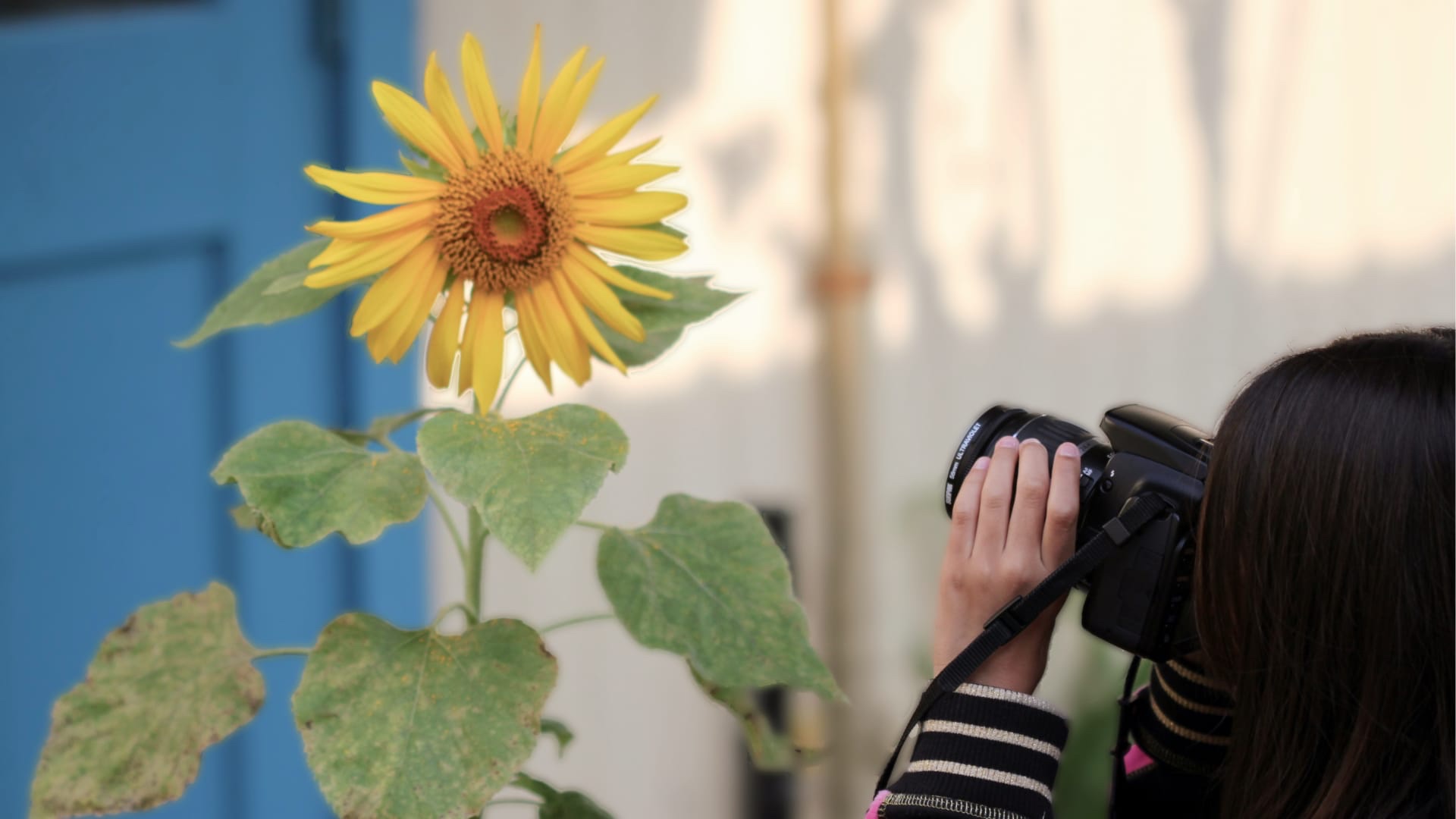
A young child is looking through the camera at a bright yellow sunflower with a brown center and green leaves. The sunflower is standing tall in front of a blue door. This photo shows someone observing a plant in nature and noticing its special features.
🔬 Scientific Phenomena
This image captures plant observation and scientific inquiry — a foundational life science practice. The child is engaging in direct observation of a sunflower, noticing its bright color, unique flower structure, and green leaves. Sunflowers demonstrate how plants have specific parts (petals, center disk, leaves, and stem) that help them survive and grow. The yellow petals and large flower head attract pollinators like bees, while the green leaves capture sunlight for energy through photosynthesis—both essential needs for plant survival.
📚 Core Science Concepts
- Plants need sunlight: The bright yellow petals and green leaves visible in this photo show that plants require sunlight to grow and produce energy. Sunflowers are famous for turning toward the sun throughout the day.
- Plants have different parts with different jobs: The sunflower shows distinct parts—the yellow petals attract pollinators, the brown disk center produces seeds, the green leaves capture light energy, and the green stem supports the whole flower. Each part helps the plant survive.
- Plants need water: Although not directly visible, the sturdy stem and healthy green leaves indicate this sunflower has received water. Plants need water (along with sunlight and soil nutrients) to survive and grow.
- Observation is a key science practice: The child using a camera to look closely at the sunflower demonstrates how scientists observe plants carefully to notice patterns and details that help us understand what plants need.
Pedagogical Tip:
Kindergarteners learn best through direct sensory observation. Encourage children to use all their senses (safely!) when observing plants: look at colors and shapes, touch leaves gently, smell flowers, and listen to leaves rustle in the wind. Create an "observation station" in your classroom with potted plants and hand lenses so children can examine plants closely throughout the day.
UDL Suggestions:
To support diverse learners, provide multiple ways to engage with plant observation:
- Visual: Use photos, colored drawings, and real plants with bright colors
- Tactile: Allow children to touch and feel different plant parts (soft petals, bumpy stems, smooth leaves)
- Kinesthetic: Have children act out how plants grow toward sunlight or move in the wind
- Language Support: Use simple vocabulary with visual supports (picture cards showing "leaves," "flowers," "stem") and repeat key terms during activities
🔍 Zoom In / Zoom Out Concepts
Zoom In — Inside the Leaf:
If we could shrink down and look inside a sunflower's green leaf, we'd see tiny structures called chloroplasts. These special parts are like little food factories that use sunlight, water, and air to make energy and food for the plant to grow. We can't see these with our eyes, but they're there working hard every sunny day!
Zoom Out — The Sunflower in Its Ecosystem:
A single sunflower is part of a larger living community. Bees and butterflies visit the flower to collect pollen and nectar, helping the plant make seeds. Birds eat those seeds for food. The sunflower also provides shade and shelter for small insects. Even the fallen leaves return nutrients to the soil, feeding other plants. One sunflower connects to many other living things!
🤔 Potential Student Misconceptions
- Misconception: "Plants don't need anything to survive—they just grow by themselves."
- Clarification: Plants are living things just like animals. They need three main things to survive and grow: sunlight (for energy), water (for their bodies), and soil (for nutrients and to hold them up). Without these, plants will get sick and die.
- Misconception: "All the green parts of a plant do the same job."
- Clarification: Different parts of a plant have different jobs. Leaves capture sunlight for food-making, stems hold the plant up and carry water, and roots drink water from the soil and keep the plant steady. Each part is special!
- Misconception: "Flowers are just pretty and don't help the plant survive."
- Clarification: Flowers are very important! They make seeds that grow into new plants. Flowers attract bees and butterflies that help spread pollen, and eventually the flower makes seeds that animals eat or that grow into new plants.
🎓 NGSS Connections
K-LS1-1: Use observations to describe patterns of what plants and animals (including humans) need to survive.
This image directly supports this standard by providing an authentic observation opportunity. Students can observe the sunflower's physical features (bright petals, green leaves, thick stem) and discuss what the plant needs: sunlight (visible in the bright daylight), water (inferred from healthy leaves and stem), and soil (where roots are anchored). The act of close observation using tools (a camera) models the scientific practice of gathering evidence about plant needs.
Relevant Disciplinary Core Idea:
All organisms have external parts. Different animals use their body parts in different ways to see, hear, grasp objects, protect themselves, move from place to place, and seek, find, and take in food and water. Plants also have different parts (roots, stems, leaves, flowers, fruits) that help them survive, grow, and produce new plants.
Relevant Crosscutting Concept:
— The photograph shows the pattern of a plant's structure: petals arranged around a center, symmetrical leaves along a stem, and organized growth.
— Each visible part of the sunflower (petals, leaves, stem) has a specific function that helps the plant survive.
💬 Discussion Questions
- "What do you think the sunflower needs to stay healthy and keep growing?" (Bloom's: Understand | DOK: 1)
- "Why do you think the petals are so bright yellow? What might that help the flower do?" (Bloom's: Analyze | DOK: 2)
- "If we took away the sunlight from this sunflower for many days, what do you think would happen to it? Why?" (Bloom's: Evaluate | DOK: 3)
- "How are the different parts of the sunflower (petals, leaves, stem, center) helping it survive?" (Bloom's: Analyze | DOK: 2)
📖 Vocabulary
- Sunflower: A tall plant with a big, bright yellow flower and a dark brown center that makes seeds.
- Petals: The colorful, leaf-like parts around the outside of a flower that help attract bees and butterflies.
- Leaves: The flat, green parts of a plant that catch sunlight and help the plant make food and energy.
- Stem: The thick green part of a plant that holds it up and carries water from the roots to all the other parts.
- Roots: The hidden parts of a plant under the soil that drink water and hold the plant steady in the ground.
- Survive: To stay alive and healthy by getting the things you need, like food, water, and air.
🌡️ Extension Activities
Activity 1: Plant Needs Investigation
Set up three sunflower (or bean) seedlings in identical containers. Place one in a sunny window, one in a dark closet, and one in normal classroom light. Over two weeks, have children observe and draw pictures of each plant every few days. Ask: "Which plant looks the healthiest? What does this tell us about what plants need?" This directly demonstrates K-LS1-1 by having children observe patterns in plant growth based on sunlight availability.
Activity 2: "What Does My Plant Need?" Observation Stations
Create four classroom stations, each showing one plant need: (1) a sunny windowsill, (2) a watering can and water, (3) soil samples, and (4) pictures of roots in soil. At each station, children observe, touch, and discuss why that need is important. Use sentence frames: "Plants need ___ because ___." This builds vocabulary and understanding of plant survival needs.
Activity 3: Sunflower Life Cycle Art
Children draw and color four stages of a sunflower: (1) seed in soil, (2) sprout with tiny leaves, (3) growing plant with leaves and stem, and (4) blooming flower. As they draw each stage, discuss: "What does the plant need at each stage to grow?" This helps children observe patterns in how plants change and what they need throughout their lives.
🔗 Cross-Curricular Ideas
- Math — Counting & Patterns: Have children count the petals on a real sunflower or in pictures. Discuss the pattern (often spiraling). Practice one-to-one correspondence and create bar graphs showing "How many petals did we count?"
- ELA — Descriptive Writing: Read The Sunflower by Jan Lööf or similar plant books. Ask children to describe the sunflower using sensory words: "What colors do you see? How do the leaves feel? What might the flower smell like?" Create a class word bank and write simple sentences together: "The sunflower is bright yellow."
- Social Studies — Caring for Our Environment: Discuss how sunflowers and other plants help our community (bees pollinate them, we eat sunflower seeds, they make our neighborhoods beautiful). Plant sunflower seeds together and care for them as a class, talking about our responsibility to nature.
- Art — Color & Nature Study: Have children paint or collage their own sunflower using yellow, brown, and green materials. Display them as a "sunflower garden." Discuss how artists use bright colors, just like nature does in flowers, to make things beautiful and eye-catching.
🚀 STEM Career Connection
- Agricultural Scientist — Works out how to grow more food on the same land without wearing the soil out.
- Try it: Design a simple experiment to test which type of soil helps a sunflower grow the tallest. (Practice: Constructing Explanations and Designing Solutions)
- Tools: test plots, soil kits, seed drills, yield monitors
- Where they work: research farms, seed companies, extension services, universities
- Meet one: Segenet Kelemu — How to protect African food crops from disease, and how insects themselves can become food.
- Median pay: /year — "Soil and plant scientists"
- Horticulturist — Grows and cares for plants on purpose — choosing what will thrive in a particular place.
- Try it: Explain why a sunflower needs sunlight and water to grow and produce seeds. (Practice: Constructing Explanations and Designing Solutions)
- Tools: pruning shears, soil test kits, grafting knives, greenhouses
- Where they work: botanical gardens, plant nurseries, city parks, farms and orchards
- Meet one: Carlos Magdalena — How to bring the world's rarest plants back from the edge, including the smallest water lily on Earth after it vanished from the wild.
- Median pay: /year — "Soil and plant scientists"
Wage figures are median annual wages for the U.S. occupation named after each one, from the U.S. Bureau of Labor Statistics, Occupational Employment and Wage Statistics (OEWS), national, May 2025. Several careers share one occupation, so their figures match.