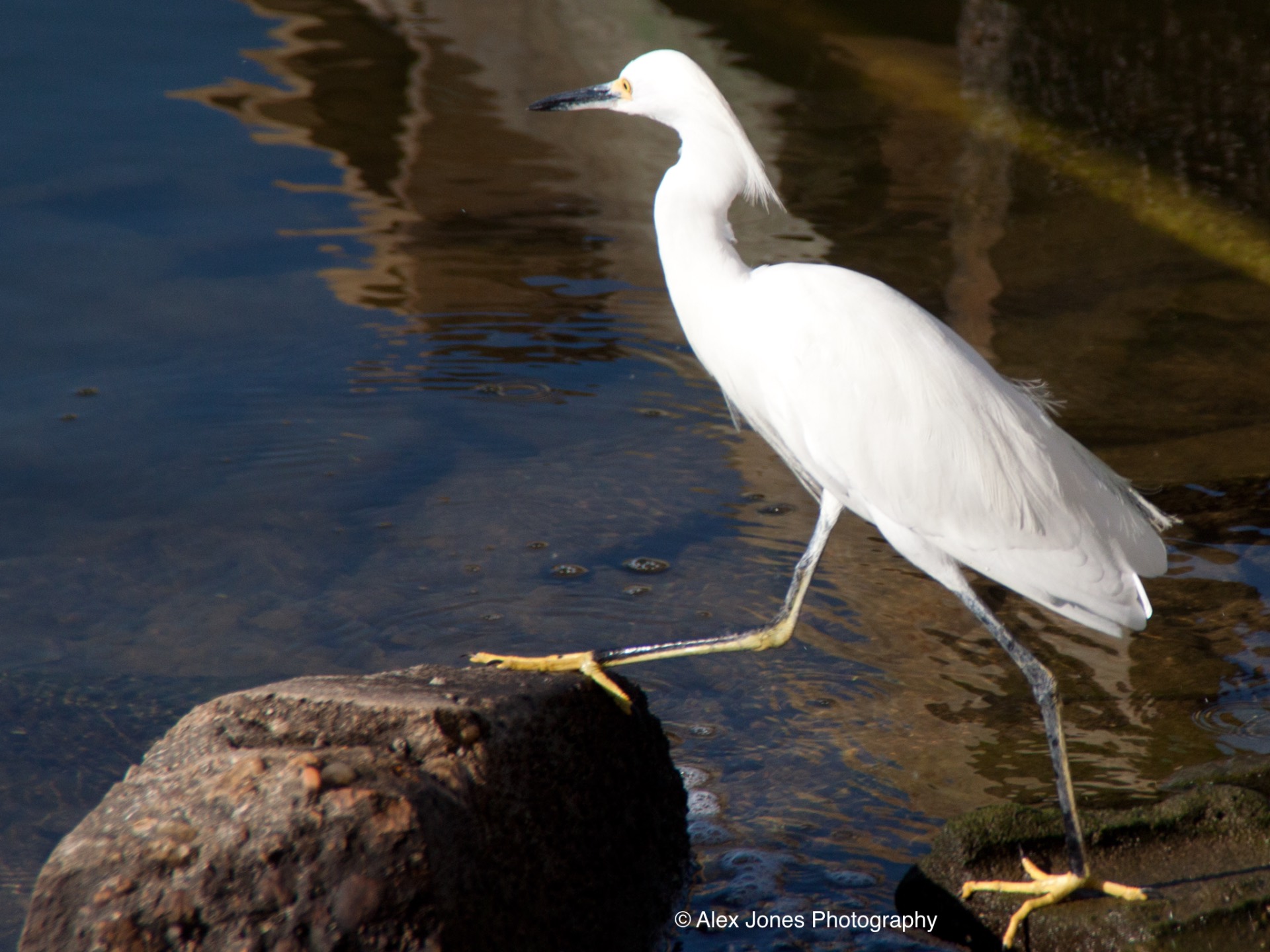
📸 Photo Description
A white bird called a snowy egret stands on one leg by the water. The bird has a long, thin black beak and bright yellow feet. It is looking for fish to catch in the shallow water.
🔬 Scientific Phenomena
The Anchoring Phenomenon shown here is adaptive feeding behavior in wading birds. The snowy egret demonstrates specialized physical adaptations (long legs, sharp beak, excellent eyesight) and behavioral adaptations (patient stalking, precise striking) that allow it to successfully hunt fish in shallow water environments. This phenomenon illustrates how organisms have evolved specific traits that help them survive and obtain food in their particular habitat.
📚 Core Science Concepts
- Animal Adaptations: The egret's long legs allow it to wade in water without getting its body wet, while its sharp, pointed beak is perfectly designed for catching slippery fish.
- Habitat Requirements: This bird lives in wetland environments where it can find the food, water, and shelter it needs to survive.
- Predator-Prey Relationships: The egret is a predator that hunts fish, frogs, and other small water animals, showing how energy moves through food chains.
- Behavioral Adaptations: Standing very still and waiting patiently is a learned behavior that helps the egret catch more prey.
Pedagogical Tip: Use the "See, Think, Wonder" thinking routine with this image. Have students first observe what they see, then think about what they notice, and finally wonder about questions they have. This builds observation skills and scientific curiosity.
UDL Suggestions: Provide multiple ways for students to demonstrate their understanding of animal adaptations - through drawings, acting out behaviors, creating models with clay, or verbal explanations. This supports different learning preferences and abilities.
🔍 Zoom In / Zoom Out Concepts
- Zoom In: At the cellular level, the egret's eyes contain special cells called rods and cones that help it see movement underwater and judge distances accurately when striking at fish.
- Zoom Out: The egret is part of a larger wetland ecosystem that includes plants, fish, insects, and other animals. Healthy wetlands filter water, prevent flooding, and provide homes for many different species.
🤔 Potential Student Misconceptions
- Misconception: "Birds only use their beaks for eating seeds."
Clarification: Different birds have different shaped beaks for different types of food - egrets have sharp beaks for catching fish, while cardinals have thick beaks for cracking seeds.
- Misconception: "All birds build nests in trees."
Clarification: Egrets and other water birds often build their nests in tall grasses near water or on platforms, not always in trees.
- Misconception: "The bird is standing on one leg because it's hurt."
Clarification: Many birds stand on one leg to conserve body heat and rest one leg while the other supports their weight.
🎓 NGSS Connections
- Performance Expectation: 3-LS4-3 - Construct an argument with evidence that in a particular habitat some organisms can survive well, some survive less well, and some cannot survive at all.
- Disciplinary Core Ideas: (Adaptation) and (Biodiversity and Humans)
- Crosscutting Concepts: and
💬 Discussion Questions
- What body parts help this egret catch fish, and how does each part help? (Bloom's: Analyze | DOK: 2)
- Why do you think egrets live near water instead of in forests? (Bloom's: Evaluate | DOK: 3)
- How might this bird's life change if the wetland dried up? (Bloom's: Predict | DOK: 3)
- What other animals might live in the same habitat as this egret? (Bloom's: Apply | DOK: 2)
📖 Science Vocabulary
- Adaptation: A special body part or behavior that helps an animal survive in its home.
- Predator: An animal that hunts and eats other animals for food.
- Habitat: The natural place where an animal lives and finds everything it needs.
- Wetland: A place where water covers the ground for most of the year.
- Wading: Walking slowly through shallow water.
- Prey: Animals that are hunted and eaten by other animals.
🔗 Cross-Curricular Ideas
- Math - Measurement & Data: Have students measure the length of egret beaks, legs, and body parts using rulers or string. Create a bar graph comparing the measurements of different wading birds (herons, sandpipers, cranes). This connects to measurement standards and data representation.
- ELA - Descriptive Writing: Students write "All About the Snowy Egret" informational texts or poetry describing the bird's appearance, behaviors, and habitat. They can use sensory words to describe what they see, hear, and observe about the egret hunting. This supports informational writing standards.
- Art - Nature Sketching & Color Study: Students create detailed drawings of the snowy egret, focusing on its white feathers, yellow feet, and black beak. They can paint or color their drawings, learning about color mixing and realistic representation. Display student artwork in a classroom "Wetland Gallery."
- Social Studies - Habitat Conservation: Introduce students to local wetlands in your community and discuss why protecting these habitats is important. Students can learn about conservation efforts and create posters encouraging wetland protection, connecting to citizenship and environmental stewardship.
🚀 STEM Career Connection
- Animal Behaviourist — Watches what animals do and works out why they do it.
- Try it: Act out how a snowy egret patiently waits for a fish, then quickly strikes to catch it. (Practice: Constructing Explanations and Designing Solutions)
- Tools: observation blinds, video recorders, stopwatches, behaviour checklists
- Where they work: zoos, field research stations, farms, universities
- Meet one: Rae Wynn-Grant — Where black bears and people run into each other, and how to keep both safe.
- Median pay: /year — "Zoologists and wildlife biologists"
- Ornithologist — Studies birds — how they fly, what they eat, where they nest, and where they travel.
- Try it: Compare the beak of a snowy egret to the beak of another bird and explain which is better for catching fish. (Practice: Constructing Explanations and Designing Solutions)
- Tools: binoculars, spotting scopes, leg bands, sound recorders
- Where they work: wildlife refuges, bird observatories, parks, universities
- Meet one: Corina Newsome — How seaside sparrows in salt marshes lose nests to rising water — nests built higher escape the flooding but become easier for predators to find.
- Median pay: /year — "Zoologists and wildlife biologists"
Wage figures are median annual wages for the U.S. occupation named after each one, from the U.S. Bureau of Labor Statistics, Occupational Employment and Wage Statistics (OEWS), national, May 2025. Several careers share one occupation, so their figures match.