📸 Photo Description
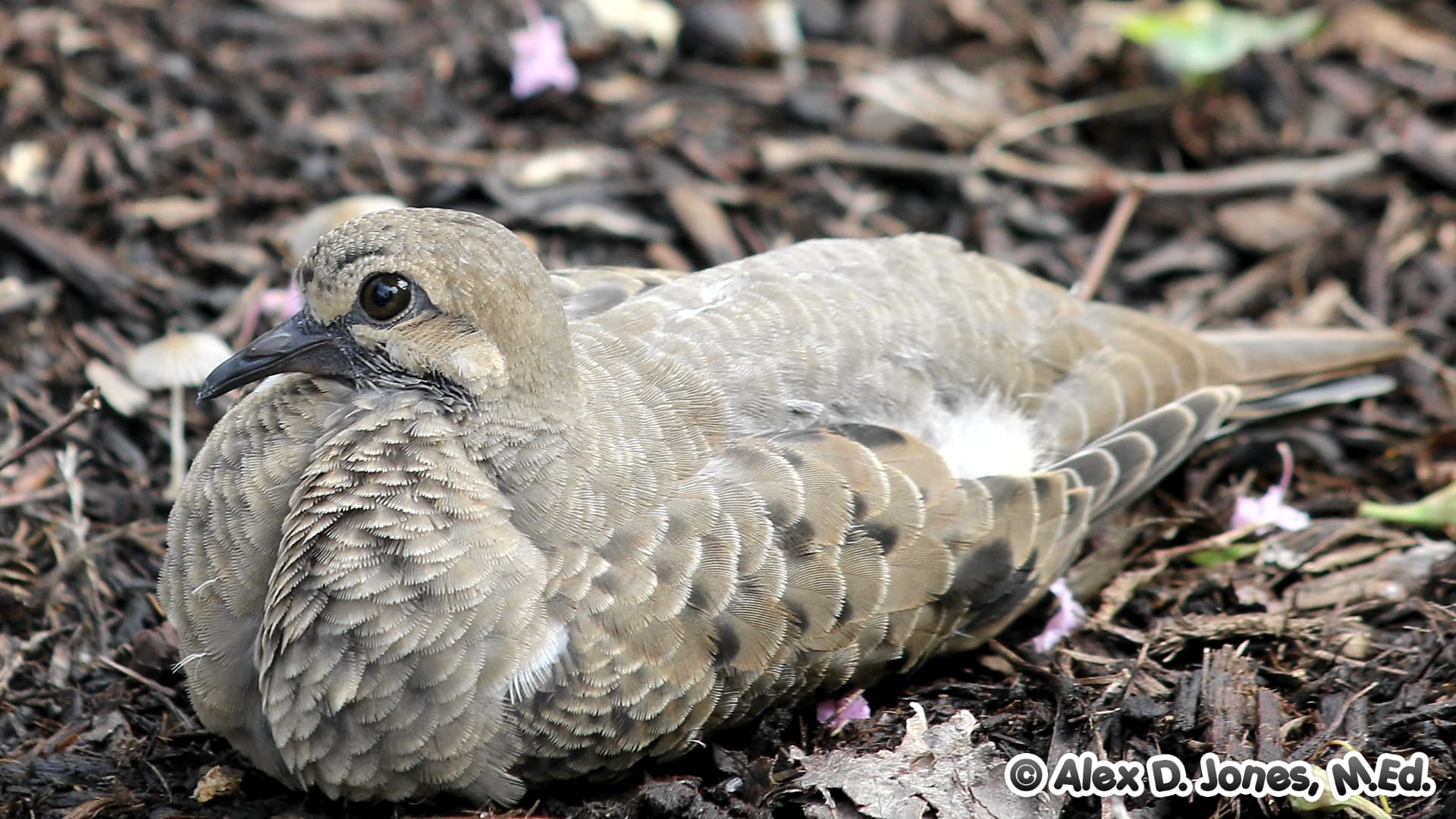
This photograph shows a baby bird called a chick sitting on the ground among twigs, rocks, and small purple flowers. The chick has soft, fluffy gray and white feathers, a small dark beak, and a round body. You can see the bird's eye and its tiny legs as it rests on the sandy, rocky ground near its natural habitat.
🔬 Scientific Phenomena
This image captures an early life stage of a bird and demonstrates how young animals need safe places to live and grow. Baby birds like this chick depend on their parents to keep them warm, protected, and fed. The chick's fluffy feathers help insulate its body to stay warm, and its location on the ground near shelter (rocks and vegetation) shows how animals seek habitats that meet their survival needs—protection from predators, safe ground for resting, and access to food and water.
📚 Core Science Concepts
- Animals need specific things to survive: Young animals like this chick need warmth (from parents or fluffy feathers), food, water, and shelter to stay alive and healthy.
- Baby animals look different from adults: This chick's fluffy, downy feathers and small size are different from a fully grown bird's appearance, but they are perfectly designed to help the chick survive at this life stage.
- Animals use their body features to meet their needs: The chick's soft feathers keep it warm, its beak helps it eat, and its small body is right-sized for hiding in safe spaces protected from danger.
- Habitats provide what animals need: The rocky, shrubby ground with vegetation offers the chick shelter, camouflage (its colors blend with the dirt), and protection from larger predators.
Pedagogical Tip:
Use this photo as a springboard for a "What Does This Animal Need?" observation activity. Have students sit in a circle and ask: "What do you think this baby bird needs to stay alive and healthy?" Record their observations on chart paper. This activates prior knowledge and helps students begin thinking like scientists by making evidence-based observations about animal needs.
UDL Suggestions:
To support diverse learners, provide multiple ways to engage with this concept:
- Visual Learners: Display the photo on a large screen; highlight different body parts (feathers, beak, eyes) with colored circles.
- Kinesthetic Learners: Have students act out how a baby bird moves, huddles for warmth, or begs for food.
- Language Learners: Pre-teach vocabulary (chick, feathers, beak, shelter, habitat) using simple labeled diagrams before discussing the photo.
- Digital Alternative: Provide audio descriptions of the image for students with visual impairments.
🔍 Zoom In / Zoom Out Concepts
Zoom In — Cellular & Microscopic Level:
If you could zoom way in on this chick's feathers, you'd see they're made of tiny structures called barbs and barbules that hook together like Velcro. These microscopic connections trap warm air close to the chick's body, creating insulation. Even the smallest feathers work at a microscopic level to keep the chick from getting too cold!
Zoom Out — Ecosystem & Larger System:
This chick is part of a larger bird community and food web in its habitat. Its parents hunt for insects and seeds to feed it, the ground provides nesting material and shelter, and the rocks and vegetation protect it from predators and harsh weather. The chick's survival depends on all these ecosystem parts working together—from the soil that grows plants, to the insects that feed the parents, to the weather patterns that affect the whole environment.
🤔 Potential Student Misconceptions
- Misconception: "Baby birds can survive on their own right away, just like baby humans."
- Clarification: Baby birds are completely helpless when they hatch. They need their parents to bring them food, keep them warm, and protect them from danger for many weeks until their feathers fully grow and they learn to fly.
- Misconception: "All birds have the same needs."
- Clarification: While all birds need food, water, warmth, and shelter, different types of birds live in different habitats and eat different foods. A chick that lives on rocky ground eats different things than a chick that lives in a forest or near water.
- Misconception: "The chick's feathers are for flying."
- Clarification: At this young stage, the chick's soft, fluffy feathers are mainly for staying warm, not for flying. As the chick grows, it will develop stronger feathers that will help it fly when it's older.
🎓 NGSS Connections
K-LS1-1: Use observations to describe patterns of what plants and animals (including humans) need to survive.
This photograph directly supports this standard by providing observable evidence of an animal (a baby bird) in its natural habitat. Students can observe and describe what this chick needs: shelter (the ground and rocks), warmth (shown by its fluffy feathers), safety from predators (its habitat provides hiding places), and access to food (parents bring it). The image helps students recognize patterns in what animals need across different contexts.
All organisms have from the environment to grow, reproduce, and survive.
💬 Discussion Questions
- What do you think this baby bird needs to stay healthy and alive? (Bloom's: Remember | DOK: 1)
- Why do you think the chick has such fluffy, soft feathers instead of smooth, shiny feathers like a grown-up bird? (Bloom's: Analyze | DOK: 2)
- If this chick was living in a snowy place instead of a rocky place, what would need to be different to help it survive? (Bloom's: Evaluate | DOK: 3)
- Where do you think the chick's parents are right now, and what might they be doing to help their baby? (Bloom's: Infer | DOK: 2)
📖 Vocabulary
- Chick: A baby bird that has just hatched or is very young and still needs its parents to take care of it.
- Feathers: The soft, fluffy coverings on a bird's body that keep it warm and help it stay safe.
- Shelter: A safe place where an animal can rest, hide from danger, and protect itself from bad weather.
- Habitat: The natural place where an animal lives that has everything it needs to survive, like food, water, and shelter.
- Survive: To stay alive and healthy by having the things you need, like food, water, warmth, and safety.
🌡️ Extension Activities
Activity 1: "What Do Animals Need?" Sorting Game
Create picture cards showing different animals in their habitats (a fish in water, a squirrel in a tree, a chick on the ground, a bear in a cave, etc.). Have students sort the animals into groups based on what they need to survive: shelter, food, water, and warmth. Discuss why each animal needs different things based on where it lives. This builds observational skills and pattern recognition tied directly to K-LS1-1.
Activity 2: Build a "Safe Home" for a Toy Bird
Provide students with natural materials (twigs, leaves, rocks, bark, moss) and challenge them to build a safe shelter for a small toy bird. Ask: "What does your bird need in its home? How will it stay warm? How will it stay safe from predators?" Students can test their designs by gently placing the toy bird inside and checking if it feels protected. This hands-on activity lets students apply their understanding of animal needs in a concrete, playful way.
Activity 3: Observe Real Birds or Videos
If possible, take students outside to observe real birds (sparrows, robins, pigeons, etc.) or watch short, age-appropriate video clips of birds in nature. Have them sketch or describe what birds are doing: looking for food, resting, caring for babies, staying with a group. Create a class chart: "What We Observed Birds Doing to Survive." This connects the photo to real-world observations and reinforces the concept that all animals actively work to meet their survival needs.
🔗 Cross-Curricular Ideas
- Math: Count and compare how many baby birds might be in a nest, or measure the length of twigs and feathers in the habitat. Create simple bar graphs showing different bird types and what they eat (seeds, insects, fish, berries).
- Language Arts / ELA: Read aloud books about baby birds and their families (see resources below). Have students dictate or draw what they learn about what baby birds need. Create a class "Bird Needs" big book where each student contributes a page showing one thing birds need to survive.
- Social Studies: Discuss where birds live in your local community (neighborhoods, parks, gardens, trees). Take a bird-watching walk around your school or neighborhood and talk about how humans can help birds by providing shelter (birdhouses) and food (bird feeders).
- Art: Have students create a mixed-media collage of a bird using actual twigs, leaves, feathers (ethically collected), and colored paper to represent the chick's natural habitat. Display these in the classroom to reinforce the connection between animals and their environments.
🚀 STEM Career Connection
- Ecologist — Studies how living things depend on each other and on the place they live.
- Try it: Draw a picture of a habitat and explain how a specific animal's coloring helps it survive there. (Practice: Constructing explanations using evidence)
- Tools: quadrat frames, measuring tapes, GPS units, a field notebook
- Where they work: forests, grasslands, wetlands, universities
- Meet one: Sandra Díaz — What a plant's leaves, wood and shape tell you about how it lives — and how those traits add up across a whole ecosystem.
- Median pay: /year — "Environmental scientists and specialists, including health"
- Zoologist — Studies animals — their bodies, their behaviour, and how they are related to each other.
- Try it: Compare the fur colors of two different animals and explain which one is better camouflaged in a forest. (Practice: Constructing explanations using evidence)
- Tools: observation blinds, animal tags, cameras, a field notebook
- Where they work: zoos, research stations, national parks, universities
- Meet one: Rae Wynn-Grant — Where black bears and people run into each other, and how to keep both safe.
- Median pay: /year — "Zoologists and wildlife biologists"
Wage figures are median annual wages for the U.S. occupation named after each one, from the U.S. Bureau of Labor Statistics, Occupational Employment and Wage Statistics (OEWS), national, May 2025. Several careers share one occupation, so their figures match.