📸 Photo Description
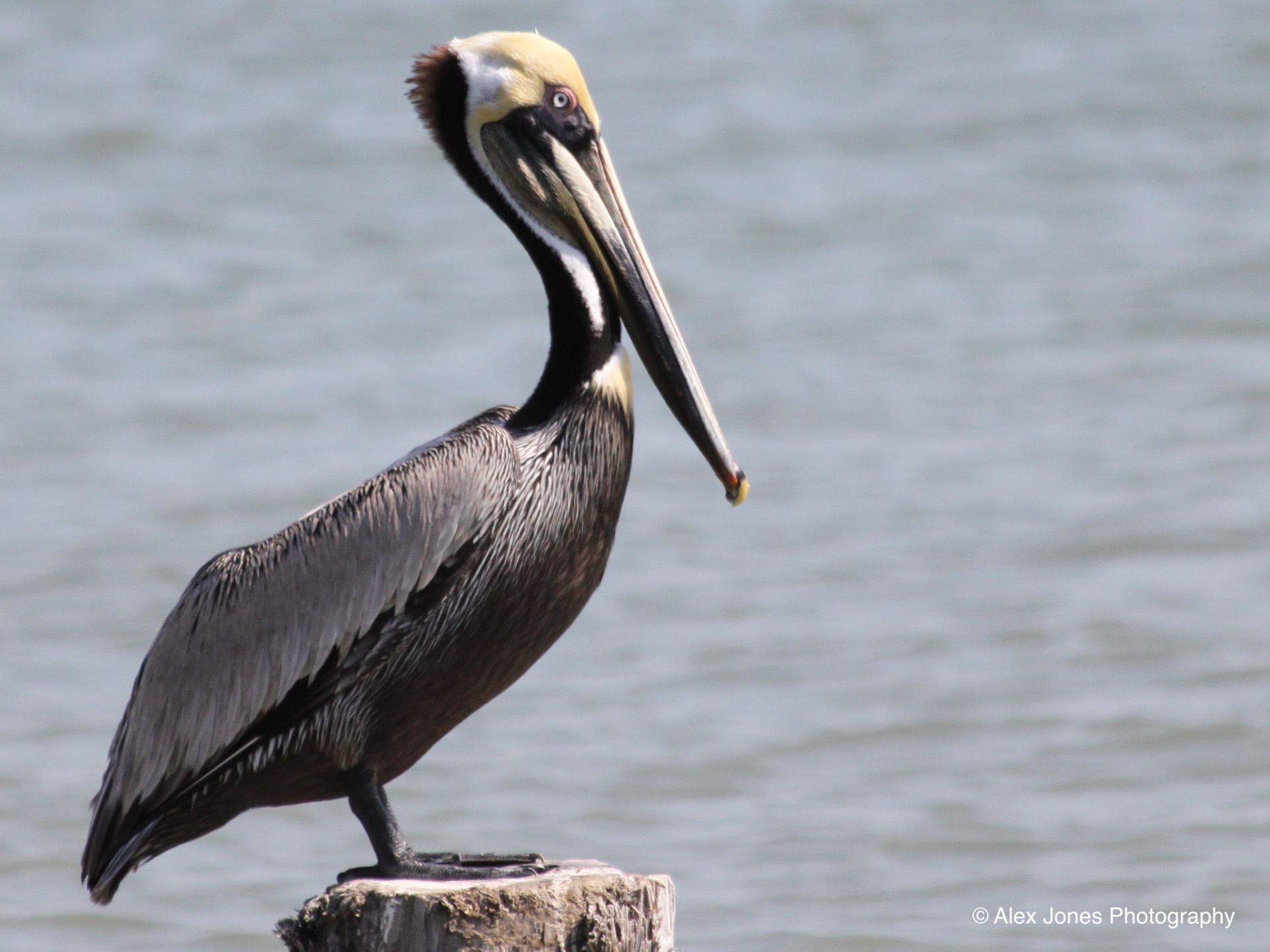
This brown pelican sits on a wooden post near the ocean. It has a huge yellow and black beak that looks like a big pouch. The bird's body is covered in gray and brown feathers, and it has webbed feet for swimming.
🔬 Scientific Phenomena
The anchoring phenomenon shown here is structural adaptation for survival. This pelican's enormous beak with its expandable throat pouch (called a gular pouch) is specifically designed for its feeding strategy. When pelicans dive into water, the pouch expands to scoop up fish and water - up to 3 gallons! The bird then drains the water out while keeping the fish inside. This specialized structure allows pelicans to be highly successful fish-eating birds in coastal environments.
📚 Core Science Concepts
- Body structures help animals survive - The pelican's large beak pouch, webbed feet, and waterproof feathers are all adaptations that help it catch fish and live near water.
- Animals have different feeding strategies - Pelicans are plunge-divers that use their specialized beaks to scoop fish from the water, unlike other birds that might hunt differently.
- Habitat shapes animal features - Coastal and marine environments have influenced the pelican's evolution, resulting in features perfect for ocean fishing.
- Form follows function in nature - Every part of the pelican's body has a specific job that helps it survive in its environment.
Pedagogical Tip: Use hand gestures and body movements when teaching about pelican adaptations. Have students cup their hands to mimic the pelican's pouch or pretend to dive like a pelican. This kinesthetic approach helps cement understanding of structure-function relationships.
UDL Suggestions: Provide multiple ways for students to show their understanding of animal adaptations: drawing and labeling pelican parts, acting out feeding behaviors, creating a pelican fact book, or building a model pelican beak. This allows students with different strengths to demonstrate their learning.
🔍 Zoom In / Zoom Out Concepts
- Zoom In: The pelican's feathers have a microscopic structure with tiny barbs and hooks that lock together, creating a waterproof barrier. Special oil glands near the tail produce oil that the pelican spreads on its feathers during preening to maintain waterproofing.
- Zoom Out: Pelicans are part of coastal food webs, helping control fish populations while serving as indicators of ocean health. Their presence signals a healthy marine ecosystem, and their nesting colonies contribute to nutrient cycling on coastal islands through their droppings.
🤔 Potential Student Misconceptions
- Misconception: "Pelicans store food in their pouches like chipmunks store nuts in their cheeks."
Reality: Pelicans use their pouches only for catching fish, then swallow the fish right away. The pouch is not a storage container.
- Misconception: "All birds that live near water look the same."
Reality: Water birds have many different adaptations - pelicans have pouches, ducks have flat bills, and herons have long thin beaks, each designed for different ways of getting food.
- Misconception: "The pelican's beak is just really big for no reason."
Reality: The large beak with its pouch is perfectly designed for the pelican's diving and scooping feeding strategy.
🎓 NGSS Connections
- Performance Expectation: 3-LS4-3: Construct an argument that some animals form groups that help members survive.
- Disciplinary Core Ideas: - Environmental changes affect organisms, and - Sometimes differences give individuals advantages in surviving and reproducing
- Crosscutting Concepts: and
💬 Discussion Questions
- How does the pelican's beak help it get food that other birds cannot catch? (Bloom's: Analyze | DOK: 2)
- What would happen if a pelican tried to live in a desert instead of near the ocean? (Bloom's: Evaluate | DOK: 3)
- Which body parts of this pelican are most important for its survival, and why? (Bloom's: Evaluate | DOK: 3)
- How are a pelican's feet different from a robin's feet, and why? (Bloom's: Compare | DOK: 2)
📖 Science Vocabulary
- Adaptation: A special body part or behavior that helps an animal survive in its home.
- Habitat: The natural place where an animal lives and gets everything it needs.
- Webbed feet: Toes connected by skin flaps that help birds swim and walk on sand.
- Gular pouch: The stretchy throat bag that pelicans use to scoop up fish.
- Predator: An animal that hunts and eats other animals for food.
- Waterproof: Something that keeps water from getting through, like a raincoat.
🔗 Cross-Curricular Ideas
- Math - Measurement & Data: Have students measure the length of a pelican's beak using string or rulers, then compare it to other bird beaks (like a robin or hummingbird). Create a simple bar graph showing beak lengths of different birds. This connects to 3.MD.B.3 (representing and interpreting data).
- ELA - Informational Writing: Students write a "Day in the Life of a Pelican" narrative, describing what the bird does from sunrise to sunset using their knowledge of pelican adaptations and behaviors. They can illustrate their writing with labeled diagrams, connecting to 3.W.3 (narrative writing).
- Social Studies - Coastal Communities: Explore how pelicans and fishing are connected to coastal towns and economies. Discuss why some communities have pelicans in their area and how these birds are protected by laws. Students can locate coastal regions on a map where pelicans live.
- Art - Nature Observation Drawing: Students create detailed sketches of the pelican's features, focusing on the beak, feathers, and feet. They can use colored pencils to show the color patterns and then label the adaptations they observe, combining art with scientific observation skills.
🚀 STEM Career Connection
- Biologist — Studies living things of every kind and what keeps them alive.
- Try it: Explain how a pelican's beak helps it survive by scooping up fish. (Practice: Constructing Explanations and Designing Solutions)
- Tools: microscopes, sample jars, measuring tools, a field notebook
- Where they work: laboratories, field sites, museums, universities
- Meet one: Sandra Díaz — What a plant's leaves, wood and shape tell you about how it lives — and how those traits add up across a whole ecosystem.
- Median pay: /year — "Biological scientists, all other"
- Conservation Biologist — Works out which plants and animals are in trouble, and what would help them recover.
- Try it: Design a way to help pelicans find enough fish if their food source is in danger. (Practice: Constructing Explanations and Designing Solutions)
- Tools: population surveys, GPS trackers, habitat maps, trail cameras
- Where they work: nature reserves, conservation charities, government agencies, universities
- Meet one: Tierra Curry — Which plants and animals are closest to disappearing, and what it takes to save them.
- Median pay: /year — "Zoologists and wildlife biologists"
- Wildlife Biologist — Studies wild animals — what they eat, where they go, and what they need to survive.
- Try it: Explain how the pelican's beak is an adaptation that helps it survive in its environment. (Practice: Constructing Explanations and Designing Solutions)
- Tools: binoculars, radio collars, trail cameras, a field notebook
- Where they work: national parks, wildlife refuges, state wildlife agencies, universities
- Meet one: Rae Wynn-Grant — Where black bears and people run into each other, and how to keep both safe.
- Median pay: /year — "Zoologists and wildlife biologists"
Wage figures are median annual wages for the U.S. occupation named after each one, from the U.S. Bureau of Labor Statistics, Occupational Employment and Wage Statistics (OEWS), national, May 2025. Several careers share one occupation, so their figures match.